. 2012 Jan;36(1):27-39.
doi: 10.5142/jgr.2012.36.1.27.

Ginseng and diabetes: the evidences from in vitro, animal and human studies

Affiliations

Ginseng and diabetes: the evidences from in vitro, animal and human studies

Hai-Dan Yuan et al. J Ginseng Res. 2012 Jan.

Abstract

Panax ginseng exhibits pleiotropic beneficial effects on cardiovascular system, central nervous system, and immune system. In the last decade, numerous preclinical findings suggest ginseng as a promising therapeutic agent for diabetes prevention and treatment. The mechanism of ginseng and its active components is complex and is demonstrated to either modulate insulin production/secretion, glucose metabolism and uptake, or inflammatory pathway in both insulin-dependent and insulin-independent manners. However, human studies are remained obscure because of contradictory results. While more studies are warranted to further understand these contradictions, ginseng holds promise as a therapeutic agent for diabetes prevention and treatment. This review summarizes the evidences for the therapeutic potential of ginseng and ginsenosides from in vitro studies, animal studies and human clinical trials with a focus on diverse molecular targets including an AMP-activated protein kinase signaling pathway.

Keywords: AMP-activated protein kinase (AMPK); Diabetes mellitus; Ginsenosides; Panax ginseng.


Figures
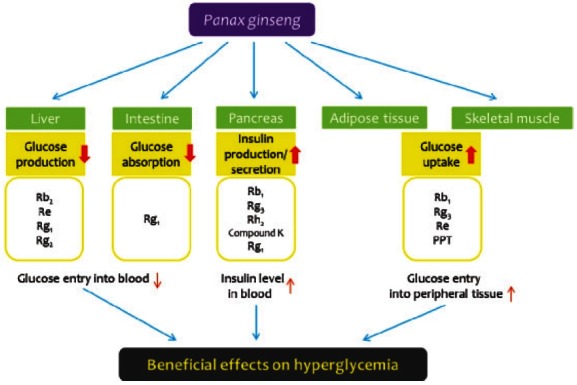
Fig. 1.
Fig. 1.. Pharmacological effects of Panax ginseng on various organs related to diabetes. Ginsenosides known to work on each organ are listed underneath. PPT, protopanaxatriol.
Fig. 2.
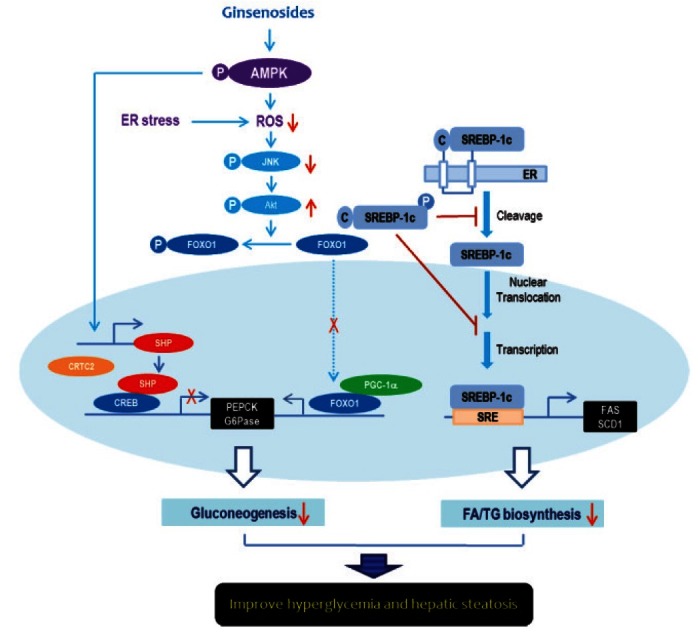
Fig. 2.. Proposed model for ginsenosides to suppress hepatic gluconeogenesis and steatosis through induction of small heterodimer partner (SHP) gene expression, reduction of reactive oxygen species (ROS) production, or phosphorylation of sterol regulatory element-binding protein (SREBP)-1c via AMP-activated protein kinase (AMPK) signaling pathway. Lee et al. demonstrated that SHP decreases cAMP response element binding (CREB)-dependent induction of gluconeogenic gene expression and hepatic glucose production via disruption of CREB·CREB-regulated transcription co-activator 2 (CRTC2) complex due to direct interaction with CREB. AMPK is also known to suppress mitochondrial ROS production by oxidative stress via inducing antioxidant enzymes such as manganese superoxide dismutase, which leads to inactivation of c-Jun NH2-Terminal kinase (JNK), activation of Akt and consequently inhibition of hepatic glucose production. Recently, Li et al. also demonstrated that AMPK interacts with and directly phosphorylates SREBP, which is necessary for inhibition of proteolytic processing and transcriptional activity of SREBP-1c in response to ginsenosides. ER, endoplasmic reticulum; FAS, fatty acid synthase; PEPCK, phosphoenolpyruvate carboxykinase; PGC-1α, peroxisome proliferator-activated receptor-γ coactivator-1 α; FAS, fatty acid synthase; SCD1, stearoyl-CoA desaturase-1; FA, fatty acid; TG, triglyceride.

References

    1. Wild S, Roglic G, Green A, Sicree R, King H. Global prevalence of diabetes: estimates for the year 2000 and projections for 2030. Diabetes Care. 2004;27:1047–1053. doi: 10.2337/diacare.27.5.1047. - DOI - PubMed
    1. Kim DJ. The epidemiology of diabetes in Korea. Diabetes Metab J. 2011;35:303–308. doi: 10.4093/dmj.2011.35.4.303. - DOI - PMC - PubMed
    1. McCullough AJ. Epidemiology of the metabolic syndrome in the USA. J Dig Dis. 2011;12:333–340. doi: 10.1111/j.1751-2980.2010.00469.x. - DOI - PubMed
    1. Warren RE. The stepwise approach to the management of type 2 diabetes. Diabetes Res Clin Pract. 2004;65(Suppl 1):S3–S8. doi: 10.1016/j.diabres.2004.07.002. - DOI - PubMed
    1. The Diabetes Control and Complications Trial Research Group. The effect of intensive treatment of diabetes on the development and progression of long-term complications in insulin-dependent diabetes mellitus. N Engl J Med. 1993;329:977–986. doi: 10.1056/NEJM199309303291401. - DOI - PubMed

LinkOut - more resources