. 2013 May 14:4:133.
doi: 10.3389/fpls.2013.00133. eCollection 2013.

When stress and development go hand in hand: main hormonal controls of adventitious rooting in cuttings

Affiliations

When stress and development go hand in hand: main hormonal controls of adventitious rooting in cuttings

Cibele T da Costa et al. Front Plant Sci. .

Abstract

Adventitious rooting (AR) is a multifactorial response leading to new roots at the base of stem cuttings, and the establishment of a complete and autonomous plant. AR has two main phases: (a) induction, with a requirement for higher auxin concentration; (b) formation, inhibited by high auxin and in which anatomical changes take place. The first stages of this process in severed organs necessarily include wounding and water stress responses which may trigger hormonal changes that contribute to reprogram target cells that are competent to respond to rooting stimuli. At severance, the roles of jasmonate and abscisic acid are critical for wound response and perhaps sink strength establishment, although their negative roles on the cell cycle may inhibit root induction. Strigolactones may also inhibit AR. A reduced concentration of cytokinins in cuttings results from the separation of the root system, whose tips are a relevant source of these root induction inhibitors. The combined increased accumulation of basipetally transported auxins from the shoot apex at the cutting base is often sufficient for AR in easy-to-root species. The role of peroxidases and phenolic compounds in auxin catabolism may be critical at these early stages right after wounding. The events leading to AR strongly depend on mother plant nutritional status, both in terms of minerals and carbohydrates, as well as on sink establishment at cutting bases. Auxins play a central role in AR. Auxin transporters control auxin canalization to target cells. There, auxins act primarily through selective proteolysis and cell wall loosening, via their receptor proteins TIR1 (transport inhibitor response 1) and ABP1 (Auxin-Binding Protein 1). A complex microRNA circuitry is involved in the control of auxin response factors essential for gene expression in AR. After root establishment, new hormonal controls take place, with auxins being required at lower concentrations for root meristem maintenance and cytokinins needed for root tissue differentiation.

Keywords: adventitious rooting; auxin; cytokinin; hormonal crosstalk; jasmonic acid; microRNAs; nutrition; receptors.


Figures
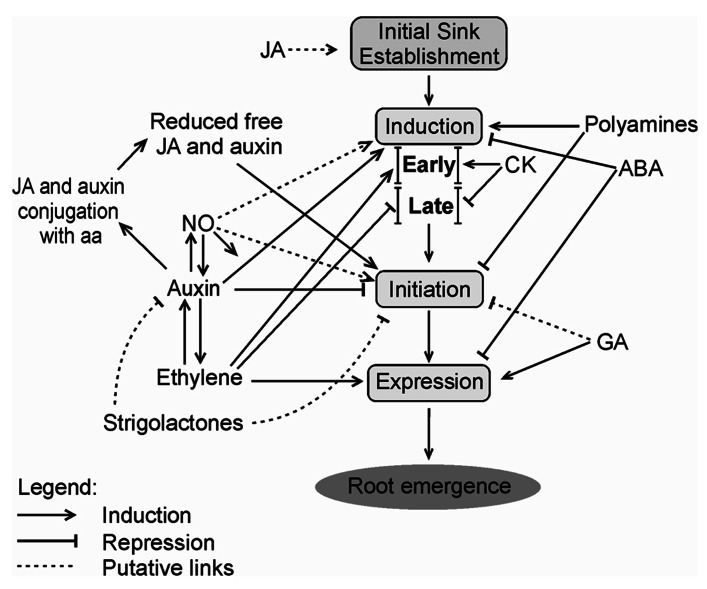
FIGURE 1
FIGURE 1
Possible phytohormonal interactions during distinct phases of the adventitious rooting process. JA may promote initial carbohydrate sink establishment before induction or at its early moments. Induction phase is positively regulated by auxin, polyamines and, in early stage, by CK and ethylene. However, during late induction, cytokinin and ethylene act as negative regulators. ABA has a negative effect on AR induction. Initiation phase is inhibited by auxin, polyamines, and GA. JA and auxin are conjugated with aa, so the levels of these phytohormones decrease allowing the progress of the initiation phase. Strigolactones may repress auxin action by reducing its transport and accumulation, or may directly inhibit AR. In contrast, NO is regarded as a stimulator of AR, both during induction and initiation phases. Ethylene increases auxin transport, stimulates expression, but shows a direct repressor effect at induction phase, except perhaps at its early stage, as pointed out above. Auxin may also promote ethylene biosynthesis. Expression phase is induced by ethylene and GA, and suffers repression of ABA. Root emergence is the visible phenotype after the expression phase. Relative positions of phytohormone names within the scheme are not meant to represent differences in importance, but aim at better clarity of the layout. JA, Jasmonic acid; CK, cytokinin; ABA, abscisic acid; GA, gibberellin; NO, nitric oxide; aa, amino acids.
FIGURE 2
FIGURE 2
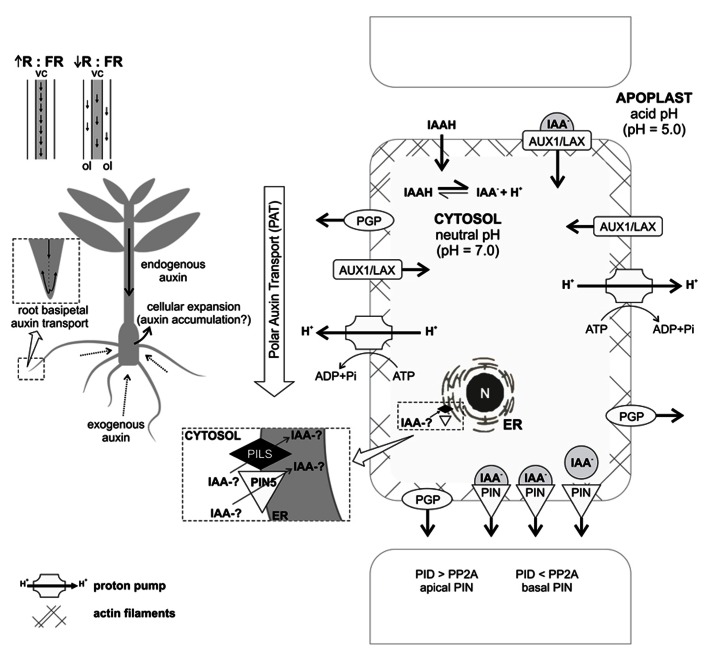
Concept of auxin transport processes probably involved in AR. Active, polar, and basipetal auxin transport contributes to auxin accumulation in the rooting zone of a cutting. Endogenous auxin is transported through the stem in an active, polar, and basipetal way. In daylight, when there is high red:far-red ratio (R:FR), the transport is mainly through the central cylinder (vc). In shade conditions, with low R:FR ratio, a less efficient route by the outer cell layers (ol), is preferred. When exogenous auxin is applied to the medium, it is absorbed by diffusion, which can cause cellular expansion in the basal part of the plant, perhaps due to auxin accumulation. Once adventitious roots are established, they provide a follow up to stem basipetal transport, continuing through the stele as acropetal transport in roots and then basipetal through the subepidermal cell layers of the newly formed organs. Intercellular auxin transport involves specific carriers: AUX1/LAX proteins, related with auxin influx; PGP proteins, related with auxin efflux and lateral transport; and PIN proteins, which have an asymmetrical distribution and allow directed auxin efflux. The PIN correct localization in the cell and the route of the auxin flow is determined by the balance between the kinase protein PID and the phosphatase PP2A. Concerning intracellular transport, auxin can be transported into the endoplasmic reticulum (ER) by the action of PILS proteins and PIN5, which reduce free auxin levels and increase auxin conjugates. It remains to be elucidated if auxin conjugates can be formed into the ER or just in cytosol. For more details, see text. N – nucleus; IAA-? – auxin in free or conjugated form.
FIGURE 3
FIGURE 3
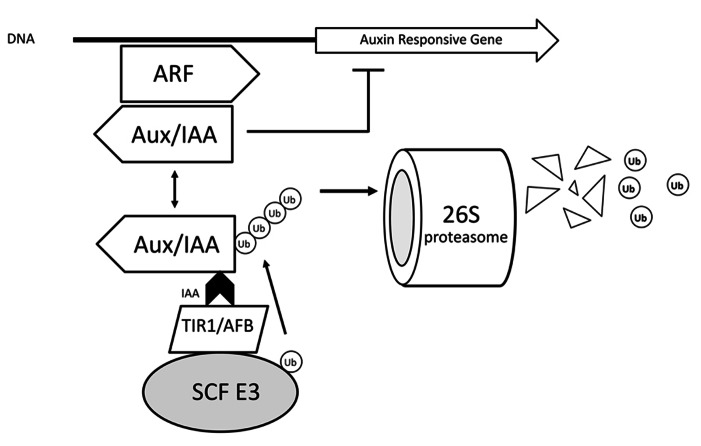
Auxin action mechanism based on TIR1. Upon binding of auxin to the F-Box (TIR1/AFB) subunit of the SCF TIR1/AFB complexes, their affinity toward the domain II of AuxIAA proteins is greatly enhanced with auxin acting as a “molecular glue” bringing the two proteins together; this binding triggers the ubiquitination of the AuxIAA by the SCF complex leading to its destruction by the 26S proteasome. The degradation of the transcriptional repressor releases the transcriptional activity of ARFs and auxin-responsive genes are expressed. E3 – ubiquitin protein ligase.
FIGURE 4
FIGURE 4
Summary of the auxin perception by ABP1 and TIR1 receptors. Rapid auxin responses are thought to be mediated by ABP1. Auxin is perceived by ABP1 at the outer surface of the Plasma membrane. In this case, ABP1 is anchored by an unknown membrane-associated protein (Protein?). In flowering plants, ABP1 is mainly located at the endoplasmic reticulum (ER) due to an ER retention motif (KDEL). Currently, it is not known how ABP1 is exported to the plasma membrane. Binding of auxin to ABP1 induces several events including activation of proton pumps, which culminates in acidification of the outer space and contributes to cell wall loosening. There is also activation of potassium inward channels, which increase the intracellular K+ and, consequently, lead to increased water uptake, allowing cell expansion. For slower responses, auxin is perceived by the F-box TIR1, which directs the auxin repressors Aux/IAAs for degradation and releases the auxin response factors (ARFS) to induce auxin-related gene expression.

References

    1. Abu-Abied M., Szwerdszarf D., Mordehaev I., Levy A., Rogovoy O., Belausov E., et al. (2012). Microarray analysis revealed upregulation of nitrate reductase in juvenile cuttings of Eucalyptus grandis, which correlated with increased nitric oxide production and adventitious root formation. Plant J. 71 787–799 - PubMed
    1. Acosta M., Oliveros-Valenzuela M. R., Nicolás, C., Sánchez-Bravo J. (2009). Rooting of carnation cuttings. The auxin signal. Plant Signal. Behav. 4 234–236 - PMC - PubMed
    1. Agulló-Antón, M. A., Sánchez-Bravo J., Acosta M., Druege U. (2011). Auxins or sugars: what makes the difference in the adventitious rooting of stored carnation cuttings? J. Plant Growth Regul. 30 100–113
    1. Ahkami A. H., Lischewski S., Haensch K. T., Porfirova S., Hofmann J., Rolletschek H., et al. (2009). Molecular physiology of adventitious root formation in Petunia hybrida cuttings: involvement of wound response and primary metabolism. New Phytol. 181 613–625 - PubMed
    1. Aida M., Beis D., Heidstra R., Willemsen V., Blilou I., Galinha C., et al. (2004). The PLETHORA genes mediate patterning of the Arabidopsis root stem cell niche. Cell 119 109–120 - PubMed