. 2013 May 13:4:138.
doi: 10.3389/fpls.2013.00138. eCollection 2013.

Open or close the gate - stomata action under the control of phytohormones in drought stress conditions

Affiliations

Open or close the gate - stomata action under the control of phytohormones in drought stress conditions

Agata Daszkowska-Golec et al. Front Plant Sci. .

Abstract

Two highly specialized cells, the guard cells that surround the stomatal pore, are able to integrate environmental and endogenous signals in order to control the stomatal aperture and thereby the gas exchange. The uptake of CO2 is associated with a loss of water by leaves. Control of the size of the stomatal aperture optimizes the efficiency of water use through dynamic changes in the turgor of the guard cells. The opening and closing of stomata is regulated by the integration of environmental signals and endogenous hormonal stimuli. The various different factors to which the guard cells respond translates into the complexity of the network of signaling pathways that control stomatal movements. The perception of an abiotic stress triggers the activation of signal transduction cascades that interact with or are activated by phytohormones. Among these, abscisic acid (ABA), is the best-known stress hormone that closes the stomata, although other phytohormones, such as jasmonic acid, brassinosteroids, cytokinins, or ethylene are also involved in the stomatal response to stresses. As a part of the drought response, ABA may interact with jasmonic acid and nitric oxide in order to stimulate stomatal closure. In addition, the regulation of gene expression in response to ABA involves genes that are related to ethylene, cytokinins, and auxin signaling. In this paper, recent findings on phytohormone crosstalk, changes in signaling pathways including the expression of specific genes and their impact on modulating stress response through the closing or opening of stomata, together with the highlights of gaps that need to be elucidated in the signaling network of stomatal regulation, are reviewed.

Keywords: ABA; abiotic stress; crosstalk; guard cells; jasmonic acid; phytohormones; stomata.


Figures
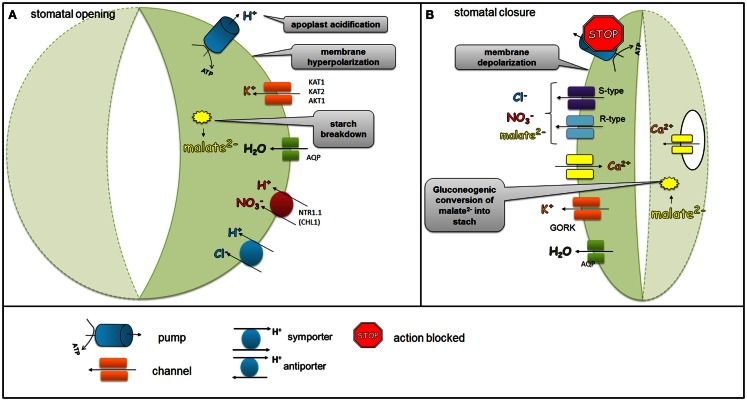
Figure 1
Figure 1
Regulation of ion channels, pumps, and transporters localized in the plasma membrane of the guard cells during stomatal opening and closure. During stomatal opening (A) H+-ATPase pumps H+ from the guard cells and hyperpolarizes the membrane, which leads to the activation of K+ inward rectifying channels (KAT1, KAT2, AKT1). Anionic species such as malate2− from the breakdown of starch and transported NO3- and Cl ions contribute to the intracellular solute buildup that can mediate the import of sugars or can be used for the synthesis of sugars. Ions supplied into the guard cells together with water transported via aquaporins generate the turgor that is needed to keep stomata opened. During stomatal closure (B), H+-ATPase is inhibited and S-type and R-type anion channels are activated. As the plasma membrane is depolarized, S-type and R-type channels facilitate the efflux of malate2−, Cl, and NO3-. At the same time, K+ outwardly rectifying channels such as GORK are activated through the depolarization of the membrane, which leads to the efflux of K+. The decreased level of malate2− is also caused by the gluconeogenic conversion of malate into starch. The elevation of the Ca2+ concentration as a result of the release of Ca2+- via channels situated in both the plasma membrane and in the tonoplast is another event that accompanies stomatal closure.
Figure 2
Figure 2
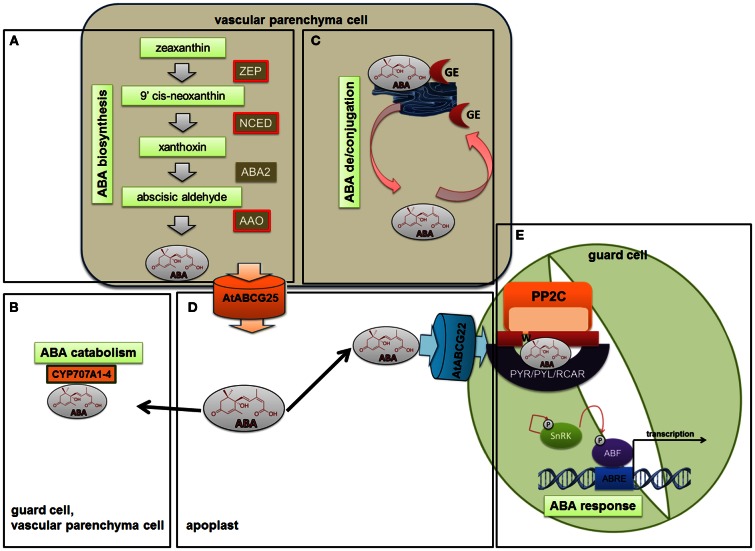
Abscisic acid biosynthesis, catabolism, deconjugation, transport, and signaling. ABA biosynthesis (A) is mainly induced by upregulating NCED3, ZEP, and AAO genes. At the same time as the biosynthesis of ABA is induced, the catabolism (B) that is performed by CYP707A1-4 is inhibited. The balance between active and inactive ABA in the cell is achieved not only by the regulation of biosynthesis and catabolism but also by ABA conjugation and deconjugation. The most widespread conjugate is the ABA glucosyl ester (ABA-GE), which is catalyzed by ABA glucosyltransferase (C). ABA delivery to the guard cells via ABCG transporters such as AGCG22 (D) promotes a cascade of reactions. The core of early ABA signaling involves ABA receptors – PYR/PYL/RCAR proteins, PP2Cs, and SnRKs (E). After binding ABA to the receptor, the negative regulatory action of PP2Cs is inhibited and SnRKs are able to phosphorylate and activate downstream targets in order to transduce the ABA signal.
Figure 3
Figure 3
The role of ABA in the diurnal regulation of stomatal movements. In the dark phase of the day (A), ABA biosynthesis is favored and at the same time the catabolism of ABA is inhibited. As a result of these processes, elevated levels of ABA are present in the guard cells. ABA activates the efflux of Ca2+ from internal stores, the activation of S-type and R-type anion channels leading to the efflux of Cl, malate2−, and NO3-, the activation of GORK channel, which leads to the efflux of K+ and consequently to the closing of stomatal pores. The decreased level of malate2− is also caused by the gluconeogenic conversion of malate into starch. In the dawn (B), the first light promotes ABA catabolism processes and the level of ABA biosynthesis decreases, which leads to a decreased concentration of active ABA in the guard cells. Low endogenous ABA levels no longer inhibit H+-ATPase (H+-pump), which is then able to extrude H+ from the guard cells. At the same time, the accumulation of water and ions, such as K+, Cl, malate2− occurs in order to generate the turgor that is needed to keep stomata open.
Figure 4
Figure 4
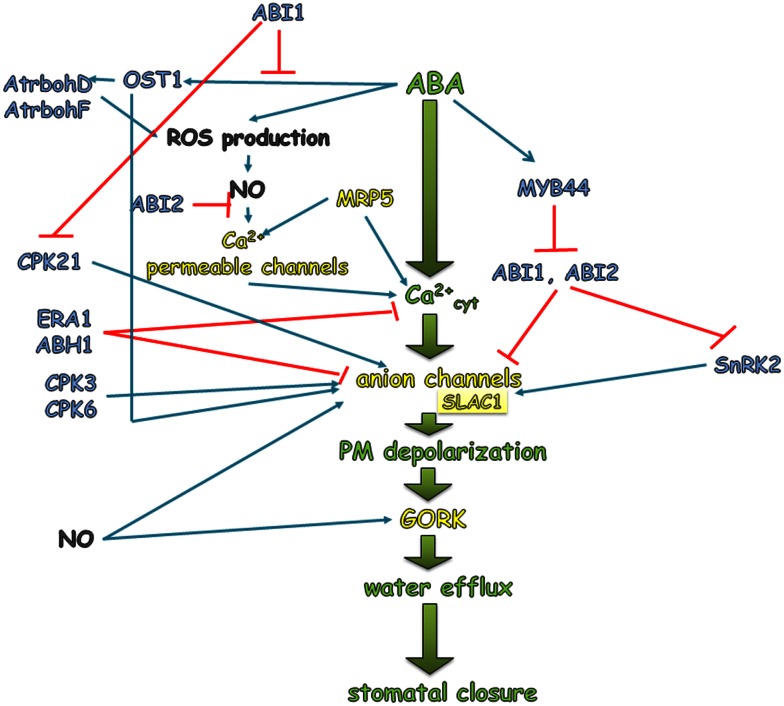
ABA regulation of stomatal closure during drought stress. An increased level of endogenous ABA in response to drought activates a signal transduction pathway that involves a sequence of events such as the elevation of the cytosolic Ca2+ level, which consequently activates the anion channels (S-type and R-type), which leads to membrane depolarization. The latter activate GORK, which is responsible for extruding K+ from the guard cells. Simultaneous with the efflux of K+, an efflux of water is observed. Together, these events lead to a decrease in the turgor of the guard cells and to stomatal closure under drought conditions. The sequence of events, which is explained in detail in the main text and presented in green in the figure, is the core of the reactions that are induced or inhibited by different proteins that are activated by ABA. Blue arrows indicate activation, while red blunt ended lines indicate inhibition.
Figure 5
Figure 5
Me-JA regulated stomatal closure during drought stress. MeJA, before it can be bound by a receptor in the plant cell, is converted into a biologically active form (+)-7-iso-Jasmonoyl-l-isoleucine (JA-Ile). JA-Ile is then bound by the receptor SCFCOI complex that contains the coronatine insensitive1 (COI1) F-box protein. This interaction leads to the JAZ degradation which is negative regulator of MYC2. Inactive JAZ is not able to repress MYC2 function which in turn activates JA-responsive genes. MeJA induces the formation of ROS and NO, which activate the efflux of Ca2+ from internal stores and the influx from the apoplast by channels in plasma membrane. CPK6 acts downstream of NO and ROS signaling and therefore may be the target of an NO-stimulated influx of Ca2+ into the cytoplasm. As a feedback loop, MeJA-induced influx of Ca2+ into the cytoplasm activates CPK6, which in turn is able to activate the S-type anion channel – SLAC1, which then leads to the MeJA-stimulated stomatal closure.
Figure 6
Figure 6
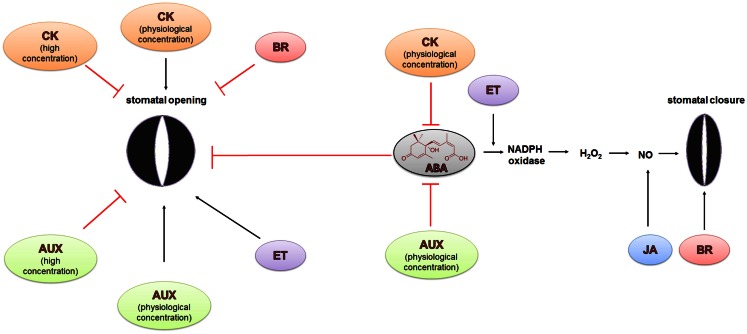
Hormonal crosstalk in the regulation of stomatal closure and opening during water stress. The regulation of stomatal opening and closure is not only regulated by ABA, whose role is dominant, but also by other phytohormones. Jasmonates (JA) and brassinosteroids (BR) induce stomatal closure and inhibit stomatal opening under drought conditions, whereas the role of other hormones is ambiguous. Cytokinins (CK) and auxins (AUX) in low physiological concentrations promote stomatal opening while in high concentrations, they are able to inhibit this process. The role of ethylene (ET) is the most curious. It can stimulate the closing and opening of the stomata. The details are described in the text.

References

    1. Abeles F. B., Morgan P. W., Saltveit M. E. (1992). Ethylene in Plant Biology. 2nd Edn. San Diego: Academic Press
    1. Berleth T., Sachs T. (2001). Plant morphogenesis: long-distance coordination and local patterning. Curr. Opin. Plant Biol. 4, 57–62 10.1016/S1369-5266(00)00136-9 - DOI - PubMed
    1. Blatt M. R., Armstrong F. (1993). K+ channels of stomatal guard cells: abscisic-acid evoked control of the outward rectifier mediated by cytoplasmic pH. Planta 191, 330–341 10.1007/BF00195690 - DOI
    1. Blatt M. R., Thiel G. (1994). K+ channels of stomatal guard cells: bimodal control of the K+ inward-rectifier evoked by auxin. Plant J. 5, 55–68 10.1046/j.1365-313X.1994.5010055.x - DOI - PubMed
    1. Bleecker A. B., Kende H. (2000). Ethylene: a gaseous signal molecule in plants. Annu. Rev. Cell Dev. Biol. 16, 1–18 10.1146/annurev.cellbio.16.1.1 - DOI - PubMed