


Effectiveness of a hospital-based work support intervention for female cancer patients - a multi-centre randomised controlled trial
- PMID: 23717406
- PMCID: PMC3661555
- DOI: 10.1371/journal.pone.0063271
Effectiveness of a hospital-based work support intervention for female cancer patients - a multi-centre randomised controlled trial
Abstract
Objective: One key aspect of cancer survivorship is return-to-work. Unfortunately, many cancer survivors face problems upon their return-to-work. For that reason, we developed a hospital-based work support intervention aimed at enhancing return-to-work. We studied effectiveness of the intervention compared to usual care for female cancer patients in a multi-centre randomised controlled trial.
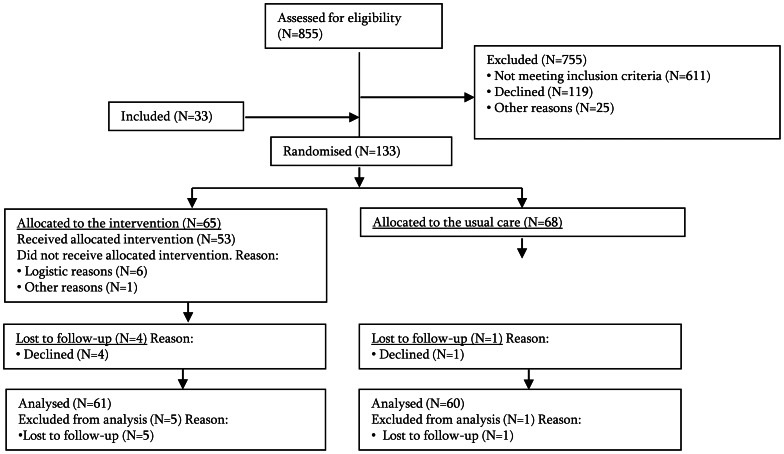
Methods: Breast and gynaecological cancer patients who were treated with curative intent and had paid work were randomised to the intervention group (n = 65) or control group (n = 68). The intervention involved patient education and support at the hospital and improvement of communication between treating and occupational physicians. In addition, we asked patient's occupational physician to organise a meeting with the patient and the supervisor to make a concrete gradual return-to-work plan. Outcomes at 12 months of follow-up included rate and time until return-to-work (full or partial), quality of life, work ability, work functioning, and lost productivity costs. Time until return-to-work was analyzed with Kaplan-Meier survival analysis.
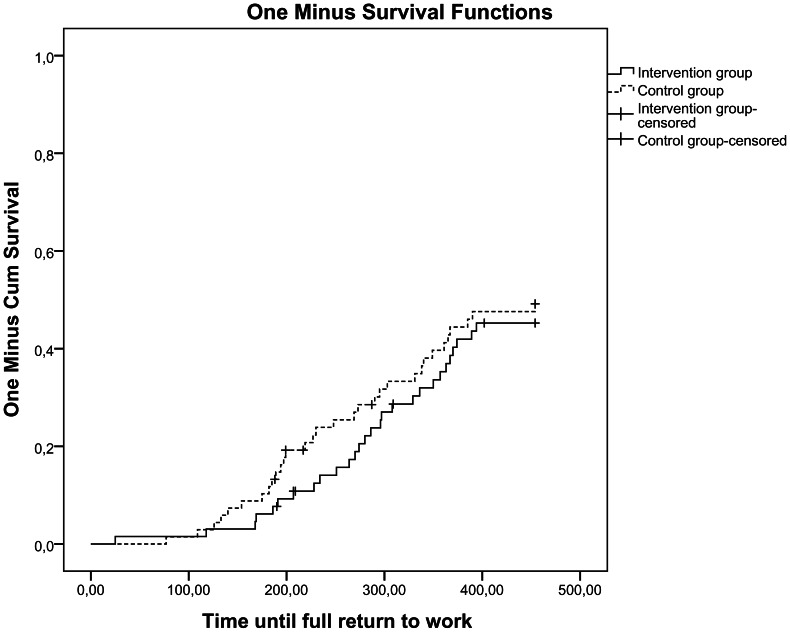
Results: Return-to-work rates were 86% and 83% (p = 0.6) for the intervention group and control group when excluding 8 patients who died or with a life expectancy of months at follow-up. Median time from initial sick leave to partial return-to-work was 194 days (range 14-435) versus 192 days (range 82-465) (p = 0.90) with a hazard ratio of 1.03 (95% CI 0.64-1.6). Quality of life and work ability improved statistically over time but did not differ statistically between groups. Work functioning and costs did not differ statistically between groups.
Conclusion: The intervention was easily implemented into usual psycho-oncological care and showed high return-to-work rates. We failed to show any differences between groups on return-to-work outcomes and quality of life scores. Further research is needed to study which aspects of the intervention are useful and which elements need improvement.
Trial registration: Nederlands Trial Register (NTR) 1658.
Conflict of interest statement
Figures
References
-
- Peteet JR (2000) Cancer and the meaning of work. Gen Hosp Psychiatry 22: 200–205. - PubMed
-
- Mols F, Thong MS, Vreugdenhil G, van de Poll-Franse LV (2009) Long-term cancer survivors experience work changes after diagnosis: results of a population-based study. Psychooncology 18: 1252–1260 10.1002/pon.1522 [doi] - DOI - PubMed
-
- Mols F, Vingerhoets AJ, Coebergh JW, van de Poll-Franse LV (2005) Quality of life among long-term breast cancer survivors: a systematic review. Eur J Cancer 41: 2613–2619 S0959-8049(05)00726-4 [pii];10.1016/j.ejca.2005.05.017 [doi] - DOI - PubMed
-
- Fleer J, Hoekstra HJ, Sleijfer DT, Tuinman MA, Klip EC, et al. (2006) Quality of life of testicular cancer survivors and the relationship with sociodemographics, cancer-related variables, and life events. Support Care Cancer 14: 251–259 10.1007/s00520-005-0879-3 [doi] - DOI - PubMed
-
- De Boer A, Taskila T, Ojajärvi A, van Dijk F, Verbeek J (2009) Cancer survivors and unemployment - A meta-analysis and meta-regression. JAMA 301: 753–762. - PubMed
Publication types
MeSH terms
LinkOut - more resources
Full Text Sources
Other Literature Sources
