


Mortality implications of angina and blood pressure in hypertensive patients with coronary artery disease: New data from extended follow-up of the International Verapamil/Trandolapril Study (INVEST)
- PMID: 23720247
- PMCID: PMC3775918
- DOI: 10.1002/clc.22145
Mortality implications of angina and blood pressure in hypertensive patients with coronary artery disease: New data from extended follow-up of the International Verapamil/Trandolapril Study (INVEST)
Abstract
Background: Angina and hypertension are common in patients with coronary artery disease (CAD); however, the effect on mortality is unclear. We conducted this prespecified analysis of the International Verapamil/Trandolapril Study (INVEST) to assess relationships between angina, blood pressure (BP), and mortality among elderly, hypertensive CAD patients.
Hypothesis: Angina and elevated BP will be associated with higher mortality.
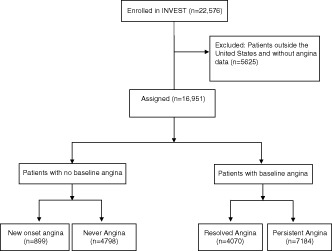
Methods: Extended follow-up was performed using the National Death Index for INVEST patients in the United States (n = 16 951). Based on angina history at enrollment and during follow-up visits, patients were divided into groups: persistent angina (n = 7184), new-onset angina (n = 899), resolved angina (n = 4070), and never angina (n = 4798). Blood pressure was evaluated at baseline, during drug titration, and during follow-up on-treatment. On-treatment systolic BP was classified as tightly controlled (<130 mm Hg), controlled (130-139 mm Hg), or uncontrolled (≥140 mm Hg). A Cox proportional hazards model was created adjusting for age, heart failure, diabetes, renal impairment, myocardial infarction, stroke, and smoking. The angina groups and BP control groups were compared using the never-angina group as the reference.
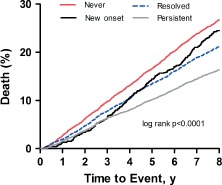
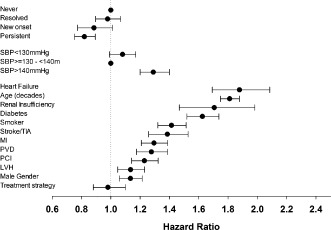
Results: Only in the persistent-angina group was a significant association with mortality observed, with an apparent protective effect (hazard ratio: 0.82, 95% confidence interval: 0.75-0.89, P < 0.0001). Uncontrolled BP was associated with increased mortality risk (hazard ratio: 1.29, 95% confidence interval: 1.20-1.40, P < 0.0001), as were several other known cardiovascular risk factors.
Conclusions: In hypertensive CAD patients, persistent angina was associated with lower mortality. The observed effect was small compared with other cardiovascular risk factors, such as BP, which were associated with increased mortality.
Trial registration: ClinicalTrials.gov NCT00133692.
© 2013 Wiley Periodicals, Inc.
Figures
References
-
- Poole‐Wilson PA, Lubsen J, Kirwan BA, et al. Effect of long‐acting nifedipine on mortality and cardiovascular morbidity in patients with stable angina requiring treatment (ACTION trial): randomised controlled trial. Lancet. 2004;364:849–857. - PubMed
-
- Hemingway H, McCallum A, Shipley M, et al. Incidence and prognostic implications of stable angina pectoris among women and men. JAMA. 2006;295:1404–1411. - PubMed
-
- Kannel WB, Feinleib M. Natural history of angina pectoris in the Framingham study: prognosis and survival. Am J Cardiol. 1972;29:154–163. - PubMed
Publication types
MeSH terms
Substances
Associated data
Grants and funding
LinkOut - more resources
Full Text Sources
Other Literature Sources
Medical
Miscellaneous
