


Psychological responses and adherence to exercise in heart failure
- PMID: 23720399
- PMCID: PMC3760978
- DOI: 10.1002/rnj.106
Psychological responses and adherence to exercise in heart failure
Abstract
Purpose: The purpose of this study was to describe psychological effects and exercise adherence during a multicomponent exercise training intervention.
Methods: A sample of 42 patients with heart failure were randomized into an exercise (INV) group (n = 22) and an attention control (AC) group (n = 20). The exercise protocol included two 12-week phases, a structured phase and a self-managed phase. The psychological responses assessed were mood states and exercise self-efficacy. To meet the second purpose of the study, the exercise group was dichotomized based on the number of sessions completed to create two adherence subgroups.
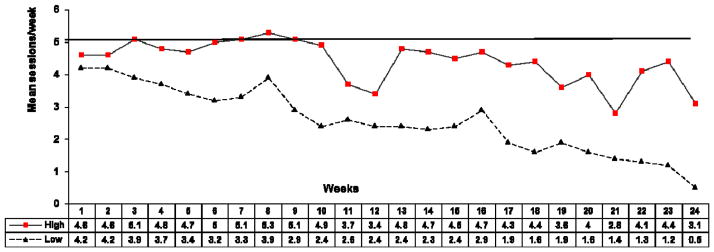
Findings: Results indicate self-efficacy improved for the INV group and was maintained during the self-management phase. The adherence subgroups demonstrated different patterns for weekly exercise. Depression and confusion scores improved for the high-adherence group in contrast to worsening for the low-adherence group.
Conclusions: Results suggest a need for further study of the psychological responses of exercise adherence for patients with heart failure.
Clinical relevance: The study indicates the importance of continuous assessment of exercise participation and longer term adherence support for patients with heart failure.
Keywords: Heart failure; adherence; exercise; frequency; psychological.
© 2013 Association of Rehabilitation Nurses.
Figures
References
-
- Bandura A. Self-efficacy: The exercise of control. New York: W. H. Freeman; 1997.
-
- Chien CL, Lee CM, Wu YW, Wu YT. Home-based exercise improves the quality of life and physical function but not the psychological status of people with chronic heart failure: A randomised trial. Journal of Physiotherapy. 2011;57(3):157–163. - PubMed
-
- Cohen J. Statistical Power Analysis for the Behavioral Sciences. Hillsdale, NJ: Lawrence Erlbaum Associates; 1988.
-
- Conn VS, Algase DL, Rawl SM, Zerwic JJ, Wyman JF. Publishing pilot intervention work. Western Journal of Nursing Research. 2010;32(8):994–1010. - PubMed
-
- Corvera-Tindel T, Doering LV, Gomez T, Dracup K. Predictors of noncompliance to exercise training in heart failure. The Journal of Cardiovascular Nursing. 2004;19(4):269–77. - PubMed
Publication types
MeSH terms
Grants and funding
LinkOut - more resources
Full Text Sources
Medical