Review
. 2013 Sep;23(9):1038-46.
doi: 10.1093/glycob/cwt040. Epub 2013 May 28.

A refined palate: bacterial consumption of host glycans in the gut

Affiliations
Review

A refined palate: bacterial consumption of host glycans in the gut

Angela Marcobal et al. Glycobiology. 2013 Sep.

Abstract

The human intestine houses a dense microbial ecosystem in which the struggle for nutrients creates a continual and dynamic selective force. Host-produced mucus glycans provide a ubiquitous source of carbon and energy for microbial species. Not surprisingly, many gut resident bacteria have become highly adapted to efficiently consume numerous distinct structures present in host glycans. We propose that sophistication in mucus consumption is a trait most likely to be found in gut residents that have co-evolved with hosts, microbes that have adapted to the complexity associated with the host glycan landscape.

Keywords: gut microbiota; host-microbial interaction; microbiome; mucin; polysaccharide utilization.


Figures
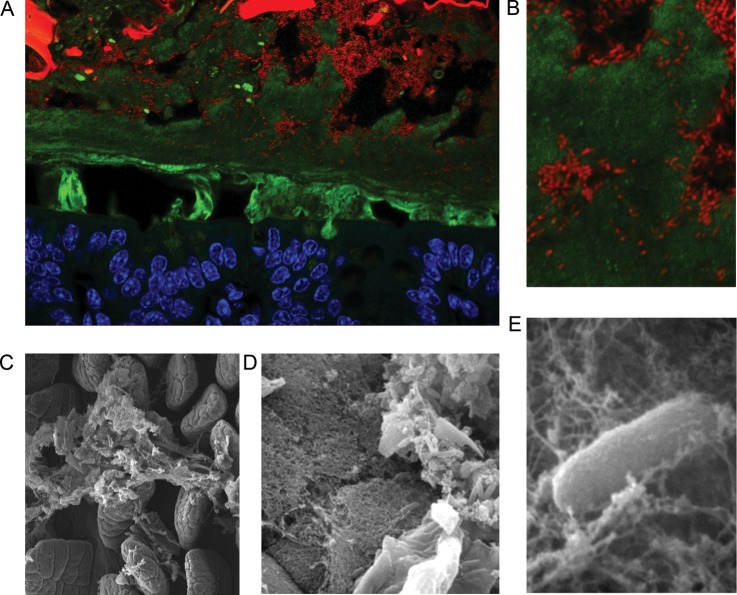
Fig. 1.
Fig. 1.
Localization of Bacteroides thetaiotaomicron (Bt) to the outer layer of colonic mucus. (A) A cross-section of distal colon of a gnotobiotic mouse colonized with Bt. Cells are stained with DAPI and false colored with blue (host tissue) or red (bacterial cells) and mucus is stained with an anti-MUC2 antibody (green). The small Bt rods occupy discrete microhabitats that include dietary plant material (intense large red and green objects), loose lumenal mucus (diffuse green signal) and the outer loose layer of epithelium-adjacent mucus. (B). Zoomed in the view of Bt embedded within mucus. Scanning electron micrographs of (C) mucus covering intestinal villi of the mouse; (D) Bt embedded in a mucus lattice (middle) overlying epithelial cells (bottom left), and in food particle (upper right), within the gnotobiotic mouse gut (Sonnenburg et al. 2005); (E) zoomed in view of Bt in mucus (Sonnenburg et al. 2005). Bt cells are ∼1 × 5 μm.
Fig. 2.
Fig. 2.
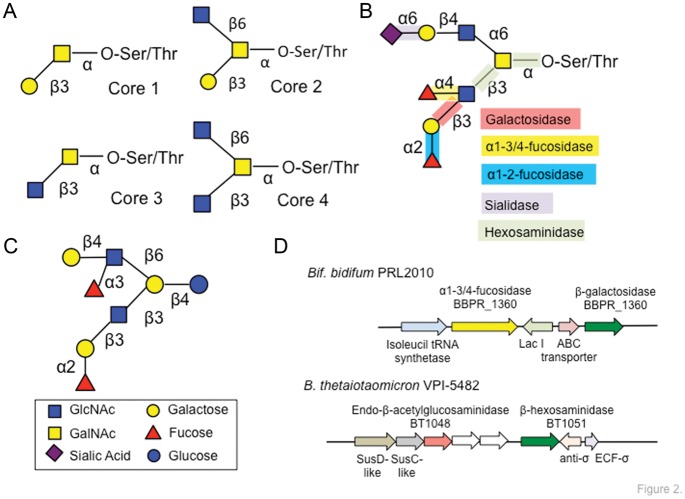
Structural features of intestinal mucin glycans and similarities with HMOs. (A) The vast majority of mucin glycans are based on variations of an O-linked core in which N-acetylgalactosamine is attached to either a serine or a threonine residue on the mucin polypeptide backbone. Seven discrete core structures have been associated with gut mucin glycans; the predominant core-1 thru core-4 are shown (Varki et al. 2009). (B) Examples of a mucin O-glycan extended core-4 structure from the ileum (Robbe et al. 2004) and the diverse set of GHs required to liberate monosaccharides from mucin glycans and makes them available for microbial fermentation in the gut. (C) Example of a branched HMO built upon a lactose core; note the similarity to the mucin glycan structure. (D) Prototypic operons within B. bifidum and Bt that encode machinery compatible with mucin glycan use, including multiple GHs.
Fig. 3.
Fig. 3.
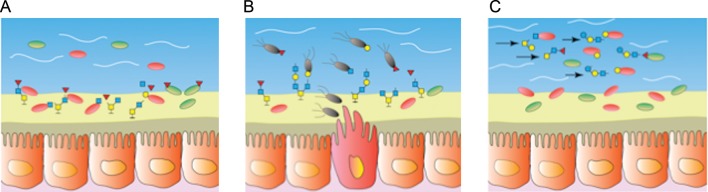
The role of mucus in supporting a gut ecosystem. (A) Mucus supports an adhesive community of microbial mutualists that dine on and embed within the outer loose layer of mucus. Degradation of the structural complexity of mucin glycans is accomplished by this community of highly adapted gut residents. (B) During times of perturbation, efficient partitioning of host mucus resources may be disrupted enabling less adapted strains, like pathogenic species (represented with flagellae) to cross-feed on free monosaccharides. (C) Milk oligosaccharides offer an orally delivered mucin-glycan-like substrate to the distal gut to aid in the nutritional support and establishment of a beneficial community of microbes.

References

    1. An G, Wei B, Xia B, McDaniel JM, Ju T, Cummings RD, Braun J, Xia L. Increased susceptibility to colitis and colorectal tumors in mice lacking core 3-derived O-glycans. J Exp Med. 2007;204:1417–1429. doi:10.1084/jem.20061929. - DOI - PMC - PubMed
    1. Bayliss CE, Turner RJ. Examination of organisms associated with mucin in the colon by scanning electron-microscopy. Micron. 1982;13:35–40.
    1. Benjdia A, Leprince J, Guillot A, Vaudry H, Rabot S, Berteau O. Anaerobic sulfatase-maturating enzymes: Radical SAM enzymes able to catalyze in vitro sulfatase post-translational modification. J Am Chem Soc. 2007;129:3462–3463. doi:10.1021/ja067175e. - DOI - PubMed
    1. Benjdia A, Martens EC, Gordon JI, Berteau O. Sulfatases and a radical S-adenosyl-L-methionine (AdoMet) enzyme are key for mucosal foraging and fitness of the prominent human gut symbiont, Bacteroides thetaiotaomicron. J Biol Chem. 2011;286:25973–25982. doi:10.1074/jbc.M111.228841. - DOI - PMC - PubMed
    1. Bjursell MK, Martens EC, Gordon JI. Functional genomic and metabolic studies of the adaptations of a prominent adult human gut symbiont, Bacteroides thetaiotaomicron, to the suckling period. J Biol Chem. 2006;281:36269–36279. doi:10.1074/jbc.M606509200. - DOI - PubMed

Publication types

Substances

LinkOut - more resources