. 2013 May 16:4:112.
doi: 10.3389/fphys.2013.00112. eCollection 2013.

nNOS(+) striatal neurons, a subpopulation spared in Huntington's Disease, possess functional NMDA receptors but fail to generate mitochondrial ROS in response to an excitotoxic challenge

Affiliations

nNOS(+) striatal neurons, a subpopulation spared in Huntington's Disease, possess functional NMDA receptors but fail to generate mitochondrial ROS in response to an excitotoxic challenge

Lorella M T Canzoniero et al. Front Physiol. .

Abstract

Huntington's disease (HD) is a neurodegenerative condition characterized by severe neuronal loss in the cortex and striatum that leads to motor and behavioral deficits. Excitotoxicity is thought to be involved in HD and several studies have indicated that NMDA receptor (NMDAR) overactivation can play a role in the selective neuronal loss found in HD. Interestingly, a small subset of striatal neurons (less than 1% of the overall population) is found to be spared in post-mortem HD brains. These neurons are medium-sized aspiny interneurons that highly express the neuronal isoform of nitric oxide synthase (nNOS). Intriguingly, neurons expressing large amounts of nNOS [hereafter indicated as nNOS(+) neurons] show reduced vulnerability to NMDAR-mediated excitotoxicity. Mechanisms underlying this reduced vulnerability are still largely unknown and may shed some light on pathogenic mechanisms involved in HD. One untested possibility is that nNOS(+) neurons possess fewer or less functioning NMDARs. Employing single cell calcium imaging we challenged this hypothesis and found that cultured striatal nNOS(+) neurons show NMDAR-evoked responses that are identical to the ones observed in the overall population of neurons that express lower levels of nNOS [nNOS(-) neurons]. NMDAR-dependent deregulation of intraneuronal Ca(2+) is known to generate high levels of reactive oxygen species of mitochondrial origin (mt-ROS), a crucial step in the excitotoxic cascade. With confocal imaging and dihydrorhodamine (DHR; a ROS-sensitive probe) we compared mt-ROS levels generated by NMDAR activation in nNOS(+) and (-) cultured striatal neurons. DHR experiments revealed that nNOS(+) neurons failed to produce significant amounts of mt-ROS in response to NMDA exposure, thereby providing a potential mechanism for their reduced vulnerability to excitotoxicity and decreased vulnerability in HD.

Keywords: Huntington's disease; NADPH diaphorase; excitotoxicity; nitric oxide synthase; reactive oxygen species.


Figures
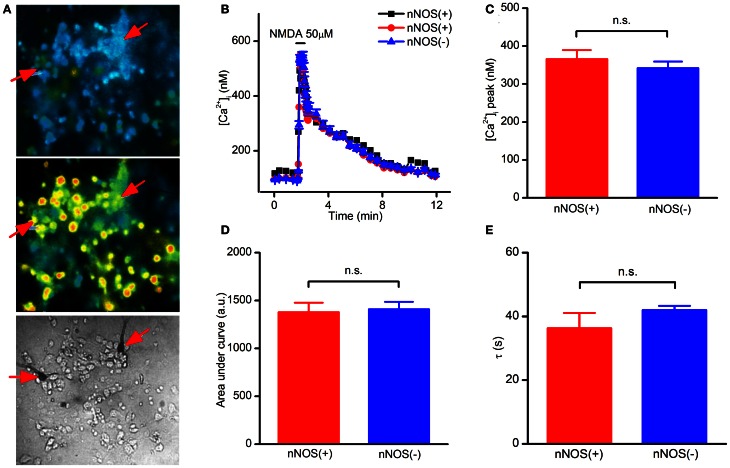
Figure 1
Figure 1
NMDAR-dependent [Ca2+]i rises in striatal cultured neurons evaluated with a high affinity Ca2+-sensitive probe. (A) Fluorescence images of fura-2 loaded striatal neurons before (top), and upon NMDA exposure (middle). Bright field image (bottom) showing stained nNOS(+), indicated by arrows, and nNOS(−)neurons. (B) Time course of NMDAR-dependent [Ca2+]i rises, traces of a single experiment [NOS(+) (n = 2) and nNOS(−) (n = 47)], representative of 20 independent experiments. (C) Average [Ca2+]i peak amplitude in the two neuronal populations (p = 0.42). (D) [Ca2+]i dynamics expressed as area under the curve (p = 0.70). (E) Recovery phase following NMDA exposure (p = 0.43). Results are expressed as mean values ± SEM; nNOS(+) n = 22; nNOS(−) n = 560.
Figure 2
Figure 2
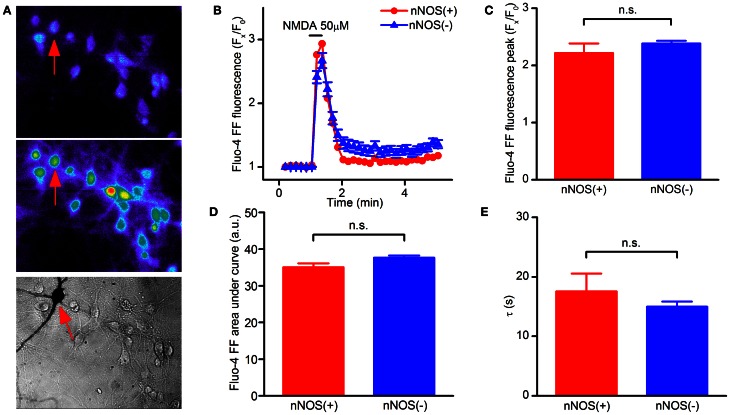
NMDAR-dependent [Ca2+]i rises in striatal cultured neurons evaluated with a low affinity Ca2+-sensitive probe. (A) Fluorescence images of fluo4-FF loaded striatal neurons before (top) and upon NMDA exposure (middle). Bright field image (bottom) showing stained nNOS(+), indicated by arrows, and nNOS(−) neurons. (B) Time course of NMDAR-dependent [Ca2+]i rises, traces of a single experiment [nNOS(+) (n = 1) and nNOS(−) (n = 18)], representative of 12 independent experiments. (C) Average Ca2+i peak amplitude in the two neuronal populations (p = 0.36). (D) [Ca2+]i dynamics expressed as area under the curve (p = 0.24). (E) Recovery phase following NMDA exposure (p = 0.43). Results are expressed as mean values ± SEM; nNOS(+) n = 13; nNOS(−) n = 165.
Figure 3
Figure 3
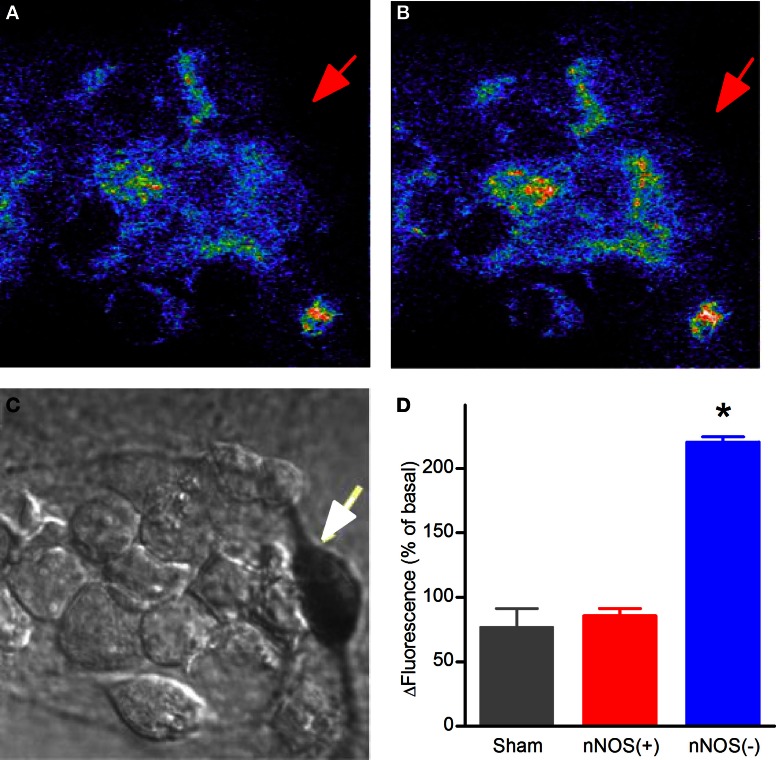
NMDAR-dependent mitochondrial ROS production in striatal cultured neurons. (A) Confocal images of basal levels of fluorescence of DHR-loaded neurons prior to NMDA stimulation. (B) DHR fluorescence 25 min after a 5 min NMDA exposure. (C) Bright field image showing stained nNOS(+), indicated by arrow, and nNOS(−) neurons. (D) Quantification of DHR fluorescence increases 25 min after NMDA exposure (*p < 0.001). Results are expressed as mean % of Fx/F0 ± SEM; nNOS(+) n = 19; nNOS(−) n = 142 from 18 independent experiments.

References

    1. Bano D., Young K. W., Guerin C. J., Lefeuvre R., Rothwell N. J., Naldini L., et al. (2005). Cleavage of the plasma membrane Na+/Ca2+ exchanger in excitotoxicity. Cell 120, 275–285 10.1016/j.cell.2004.11.049 - DOI - PubMed
    1. Beal M. F., Kowall N. W., Ellison D. W., Mazurek M. F., Swartz K. J., Martin J. B. (1986). Replication of the neurochemical characteristics of Huntington's disease by quinolinic acid. Nature 321, 168–171 10.1038/321168a0 - DOI - PubMed
    1. Beckman J. S., Koppenol W. H. (1996). Nitric oxide, superoxide, and peroxynitrite: the good, the bad, and ugly. Am. J. Physiol. 271, C1424–C1437 - PubMed
    1. Brown G. C. (2010). Nitric oxide and neuronal death. Nitric Oxide 23, 153–165 - PubMed
    1. Cattaneo E., Zuccato C., Tartari M. (2005). Normal huntingtin function: an alternative approach to Huntington's disease. Nat. Rev. Neurosci. 6, 919–930 10.1038/nrn1806 - DOI - PubMed