Comparative Study
. 2013 May 30:11:141.
doi: 10.1186/1741-7015-11-141.

Why do hypertensive patients of African ancestry respond better to calcium blockers and diuretics than to ACE inhibitors and β-adrenergic blockers? A systematic review

Affiliations
Comparative Study

Why do hypertensive patients of African ancestry respond better to calcium blockers and diuretics than to ACE inhibitors and β-adrenergic blockers? A systematic review

Lizzy M Brewster et al. BMC Med. .

Abstract

Background: Clinicians are encouraged to take an individualized approach when treating hypertension in patients of African ancestry, but little is known about why the individual patient may respond well to calcium blockers and diuretics, but generally has an attenuated response to drugs inhibiting the renin-angiotensin system and to β-adrenergic blockers. Therefore, we systematically reviewed the factors associated with the differential drug response of patients of African ancestry to antihypertensive drug therapy.

Methods: Using the methodology of the systematic reviews narrative synthesis approach, we sought for published or unpublished studies that could explain the differential clinical efficacy of antihypertensive drugs in patients of African ancestry. PUBMED, EMBASE, LILACS, African Index Medicus and the Food and Drug Administration and European Medicines Agency databases were searched without language restriction from their inception through June 2012.

Results: We retrieved 3,763 papers, and included 72 reports that mainly considered the 4 major classes of antihypertensive drugs, calcium blockers, diuretics, drugs that interfere with the renin-angiotensin system and β-adrenergic blockers. Pharmacokinetics, plasma renin and genetic polymorphisms did not well predict the response of patients of African ancestry to antihypertensive drugs. An emerging view that low nitric oxide and high creatine kinase may explain individual responses to antihypertensive drugs unites previous observations, but currently clinical data are very limited.

Conclusion: Available data are inconclusive regarding why patients of African ancestry display the typical response to antihypertensive drugs. In lieu of biochemical or pharmacogenomic parameters, self-defined African ancestry seems the best available predictor of individual responses to antihypertensive drugs.


Figures
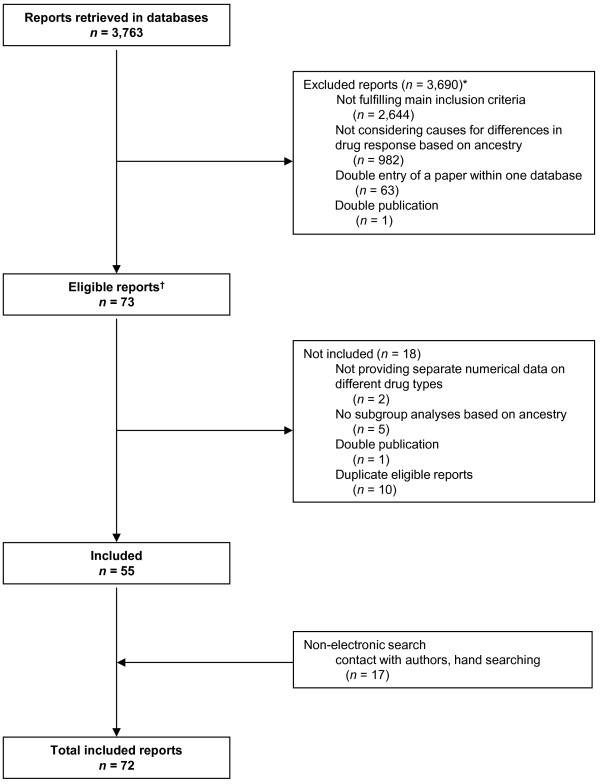
Figure 1
Figure 1
Flow diagram. Data were retrieved from PUBMED, EMBASE, LILACS, the African Index Medicus, and the Food and Drug Administration and European Medicines Agency databases. *Studies were excluded using a hierarchical approach. First, we excluded reports that did not fulfill the main inclusion criteria (n = 2,644): an original report considering drug therapy with different available drug types in non-pregnant adults of African ancestry with uncomplicated hypertension, defined as the absence of clinical heart failure, stroke or end stage renal disease as reported by the authors. Studies conducted exclusively in diabetics were also excluded in this step. Of the remaining studies fulfilling these main inclusion criteria (n = 1,119), most studies were excluded in the next step (n = 982), because these were not original reports providing an explanation for the difference in response to antihypertensive drugs between ancestry groups. As a quality and consistency check, each paper retrieved from the search yield (n = 3,763) was categorized, per database, thus the excluded paper categories harbor duplicate reports, occurring in more than one database. Eligible reports thus fulfilled the inclusion criteria, and were original reports considering potential causes for the differential response of patients of African ancestry to antihypertensive drugs used as single drug or single drug-based treatment. Included studies from the electronic searches (n = 55) [14-68], and hand search (n = 17) [12,69-84] are described in detail in the Results section.
Figure 2
Figure 2
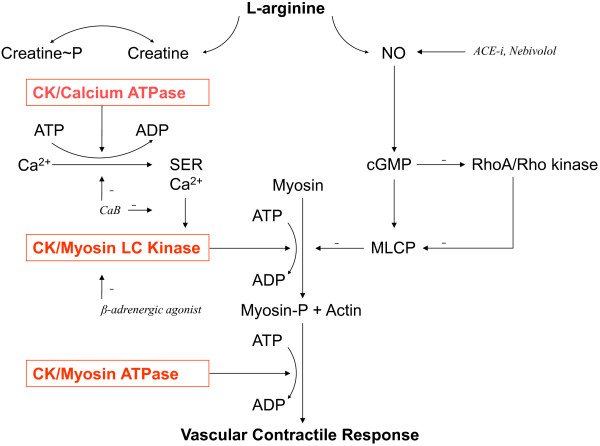
Modulators of vascular contractility. This is a schematic representation of the main regulatory pathways of vascular smooth muscle contraction, based on Brewster et al.[12,72]. Creatine kinase (CK) is colocalized with Ca2+ ATPase and myosin ATPase, and evidence suggests the enzyme is also colocalized with myosin light chain (LC) kinase, to rapidly supply these enzymes with ATP using creatine phosphate (Creatine ~ P) [11,12,72,88-90]. The guanidino compounds creatine and nitric oxide (NO) have a common precursor in L-Arginine [12]. NO, RhoA/Rho kinase, and calcium-dependent pathways are intracellular effectors of blood pressure-regulating systems that converge on metabolic processes fueled by CK [11,12,72,88-91,93-95]. CK is high in persons of African ancestry [11,12,72,73], and this is thought to lead to greater contractility of vascular smooth muscle [11,12,72]. Vascular contractile responses can be reduced through enhancing NO-dependent pathways, including with ACE inhibitor (ACE-i) or nebivolol-induced NO synthesis, or through indirect inhibition of CK-dependent pathways, as with calcium blockers (CaB) or β-adrenergic agonists. Calcium blockers may block the entry of calcium in the cell as well as the outflow from the sarcoendoplasmic reticulum (SER) [93]. β-adrenergic agonists reduce contractility mainly through inhibition of myosin light chain kinase [91]. β-adrenergic blockers antagonize this beneficial effect, which may help explain the more frequent occurrence of blood pressure increase with β-blockers in persons of African ancestry [3,92], within the context of the greater vascular contractility in this population subgroup [11,12,36,37,39,72]. cGMP, guanosine cyclic 3′,5′-(monophosphate); MLCP, myosin light chain phosphatase.
Figure 3
Figure 3
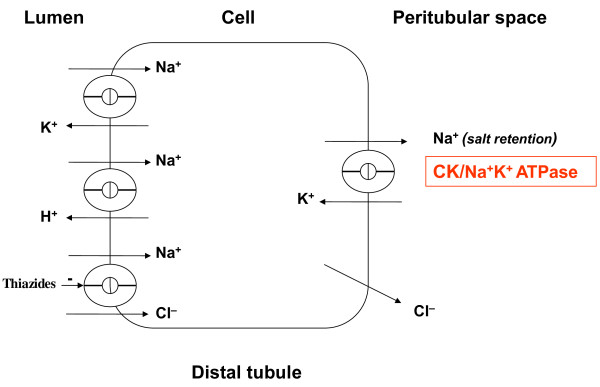
Pharmacodynamics of thiazide diuretics. This is a schematic reproduction of the kidney distal convoluted tubule. Sodium retention is driven by basolateral Na+K+ ATPase throughout the kidney [86]. Creatine kinase (CK), reported to be high in persons of African ancestry [11,12,72,73], is tightly bound near basolateral Na+K+ ATPase, where it rapidly regenerates ATP to facilitate sodium retention [87]. Enhanced sodium retention occurs more frequently in persons of African ancestry [96]. Thiazide diuretics counteract this effect, albeit indirectly and partly, through inhibition of luminal Na+Cl -cotransport.

References

    1. Ford ES. Trends in mortality from all causes and cardiovascular disease among hypertensive and nonhypertensive adults in the United States. Circulation. 2011;123:1737–1744. doi: 10.1161/CIRCULATIONAHA.110.005645. - DOI - PubMed
    1. Opie LH, Seedat YK. Hypertension in sub-Saharan African populations. Circulation. 2005;112:3562–3568. doi: 10.1161/CIRCULATIONAHA.105.539569. - DOI - PubMed
    1. Brewster LM, van Montfrans GA, Kleijnen J. Systematic review: antihypertensive drug therapy in black patients. Ann Intern Med. 2004;141:614–627. doi: 10.7326/0003-4819-141-8-200410190-00009. - DOI - PubMed
    1. Jolly S, Vittinghoff E, Chattopadhyay A, Bibbins-Domingo K. Higher cardiovascular disease prevalence and mortality among younger blacks compared to whites. Am J Med. 2010;123:811–818. doi: 10.1016/j.amjmed.2010.04.020. - DOI - PubMed
    1. Flack JM, Sica DA, Bakris G, Brown AL, Ferdinand KC, Grimm RH Jr, Hall WD, Jones WE, Kountz DS, Lea JP, Nasser S, Nesbitt SD, Saunders E, Scisney-Matlock M, Jamerson KA. Management of high blood pressure in Blacks: an update of the International Society on Hypertension in Blacks consensus statement. Hypertension. 2010;56:780–800. doi: 10.1161/HYPERTENSIONAHA.110.152892. - DOI - PubMed

Publication types

MeSH terms

Substances