. 2013 Aug 15;115(4):436-45.
doi: 10.1152/japplphysiol.00009.2013. Epub 2013 May 30.

Can tidal breathing with deep inspirations of intact airways create sustained bronchoprotection or bronchodilation?

Affiliations

Can tidal breathing with deep inspirations of intact airways create sustained bronchoprotection or bronchodilation?

Brian C Harvey et al. J Appl Physiol (1985). .

Abstract

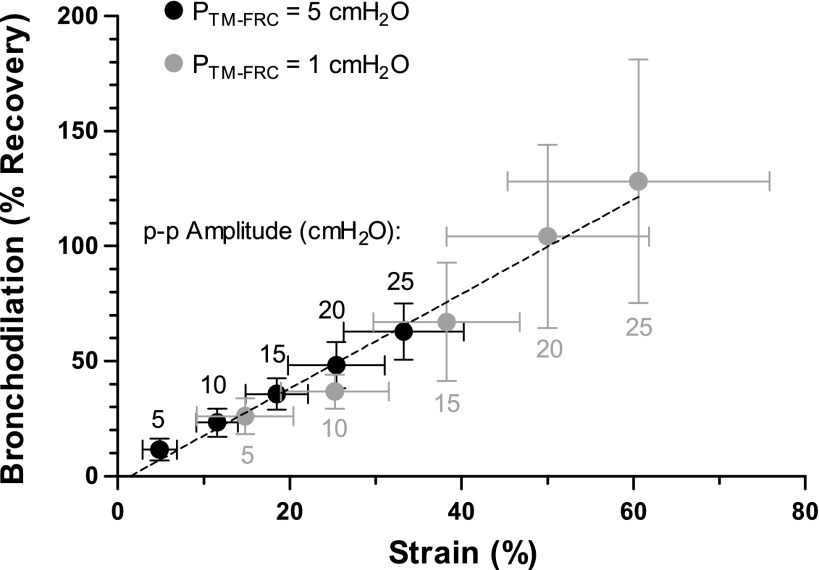
Fluctuating forces imposed on the airway smooth muscle due to breathing are believed to regulate hyperresponsiveness in vivo. However, recent animal and human isolated airway studies have shown that typical breathing-sized transmural pressure (Ptm) oscillations around a fixed mean are ineffective at mitigating airway constriction. To help understand this discrepancy, we hypothesized that Ptm oscillations capable of producing the same degree of bronchodilation as observed in airway smooth muscle strip studies requires imposition of strains larger than those expected to occur in vivo. First, we applied increasingly larger amplitude Ptm oscillations to a statically constricted airway from a Ptm simulating normal functional residual capacity of 5 cmH2O. Tidal-like oscillations (5-10 cmH2O) imposed 4.9 ± 2.0% strain and resulted in 11.6 ± 4.8% recovery, while Ptm oscillations simulating a deep inspiration at every breath (5-30 cmH2O) achieved 62.9 ± 12.1% recovery. These same Ptm oscillations were then applied starting from a Ptm = 1 cmH2O, resulting in approximately double the strain for each oscillation amplitude. When extreme strains were imposed, we observed full recovery. On combining the two data sets, we found a linear relationship between strain and resultant recovery. Finally, we compared the impact of Ptm oscillations before and after constriction to Ptm oscillations applied only after constriction and found that both loading conditions had a similar effect on narrowing. We conclude that, while sufficiently large strains applied to the airway wall are capable of producing substantial bronchodilation, the Ptm oscillations necessary to achieve those strains are not expected to occur in vivo.

Keywords: airway smooth muscle; asthma; bronchodilation; bronchoprotection; intact airways.


Figures
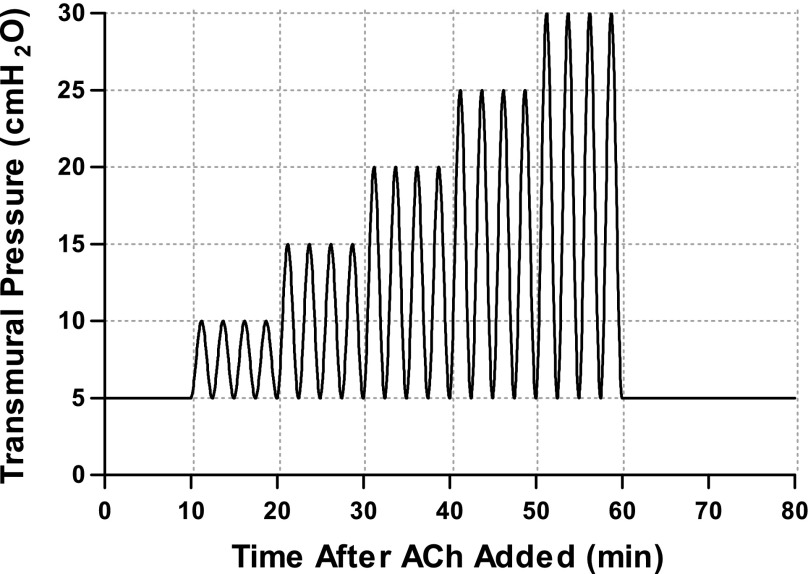
Fig. 1.
Fig. 1.
Schematic of protocol 1. Intact airways were constricted under a static transmural pressure (Ptm; 5 cmH2O) for 10 min, followed by Ptm oscillations (frequency = 0.2 Hz) applied above a simulated functional residual capacity (FRC) (Ptm = 5 cmH2O) of increasing peak-to-peak (p-p) magnitude from 5 to 25 cmH2O in increments of 5 cmH2O, and finally 20 min of static Ptm. The experiment was repeated in a separate set of airways with a reduced FRC (Ptm = 1 cmH2O) (not shown). ACh, acetylcholine.
Fig. 2.
Fig. 2.
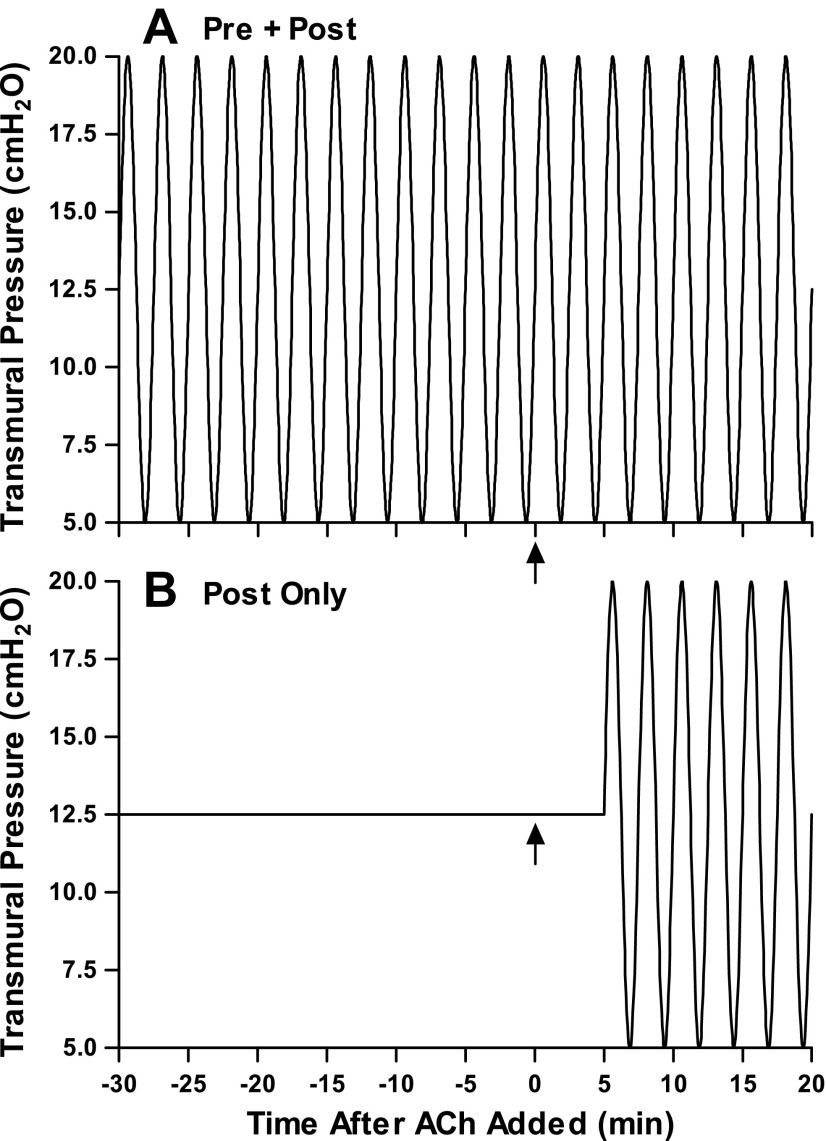
Schematic of protocol 2. Intact airways were constricted twice in random order. A: Pre + Post: intact airways were exposed to large Ptm oscillations (5–20 cmH2O, 0.2 Hz) for 30 min before addition of ACh (10−5 M) and throughout the duration (20 min) of the constriction. B: Post Only: intact airways were constricted with the same dose of ACh under a static Ptm for 5 min (Static loading condition), and then large Ptm oscillations (5–20 cmH2O) were applied for the next 15 min. Arrows indicate the time at which ACh was added to the bath.
Fig. 3.
Fig. 3.
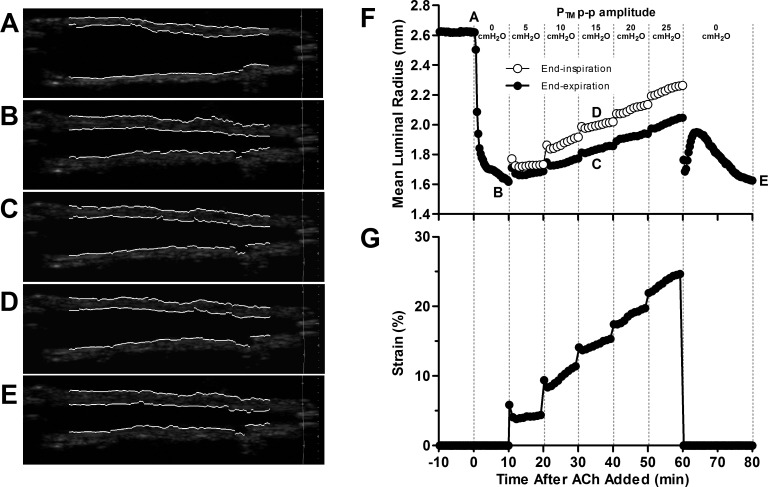
Representative trace of airway's mean luminal radius (F) and strain amplitude (G), along with processed ultrasound images (A–E) corresponding to five distinct points along these curves during protocol 1, with Ptm oscillations applied above a Ptm simulating a normal FRC. At position A, the intact airway is in a relaxed state at its baseline radius. A moderate dose of ACh (10−5 M) was then added to bath, and the airway narrows for 10 min to its statically constricted radius at position B. Ptm oscillations of increasing p-p amplitude (5–25 cmH2O) were then applied. The mean luminal radius at a Ptm corresponding to FRC (5 cmH2O, ●) and end-inspiration (○) were extracted from the ultrasound images. Representative images are shown during 15-cmH2O Ptm p-p amplitude oscillations at end-expiration (position C, Ptm = 5 cmH2O) and end-inspiration (position D, Ptm = 20 cmH2O). Following the largest amplitude oscillation, the perturbations were stopped, and the airway was held statically for 20 min, returning to its final steady-state radius at position E. Small tidal Ptm oscillations (5-cmH2O p-p amplitude) provide minimal bronchodilation, despite 4% strain. The airway dilates more as the Ptm p-p amplitude and strains increase.
Fig. 4.
Fig. 4.
Impact of strain imposed by each Ptm p-p amplitude on percent recovery of a statically constricted airway. Ptm oscillations applied above an FRC of 1 cmH2O resulted in about twice the strain and bronchodilation as the same sized Ptm oscillation imposed above a normal FRC of 5 cmH2O. Degree of recovery from a statically constricted airway is proportional to strain imposed by the Ptm oscillations (R2 = 0.99).
Fig. 5.
Fig. 5.
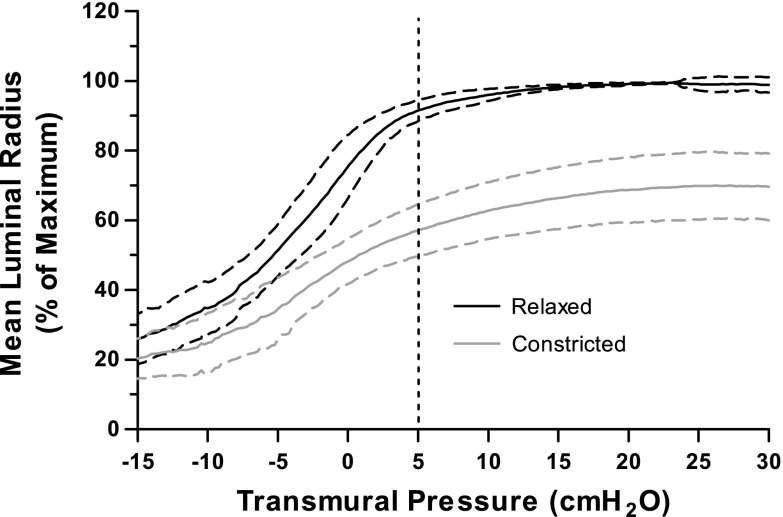
Quasi-static deflation Ptm-radius curves at the very beginning of each protocol (relaxed, black) and after constriction, just before washout of the ACh (10−5 M) (constricted, gray). Airways were normalized by the radius achieved at total lung capacity (30 cmH2O) in the relaxed state and then averaged. Curves are mean (solid lines) ± SD (dashed lines).
Fig. 6.
Fig. 6.
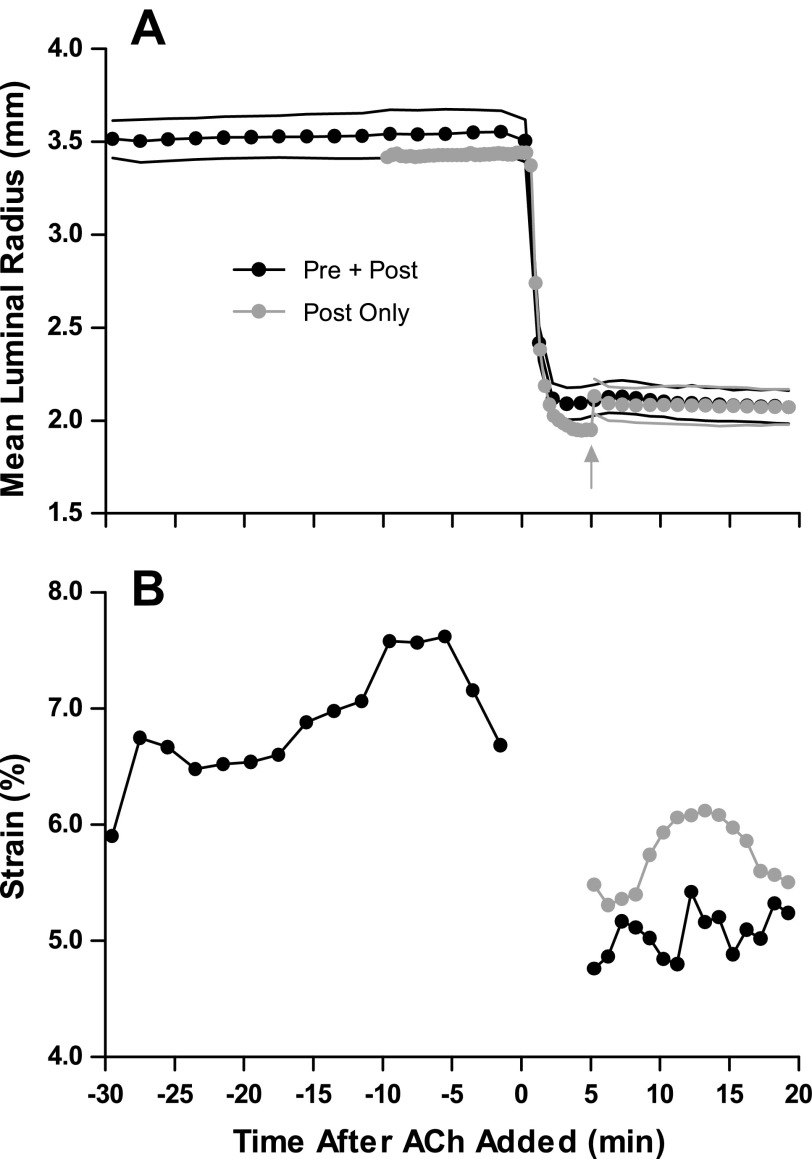
Representative trace of airway's mean luminal radius (A) and strain amplitude (B) during protocol 2. A: circles represent luminal radius at 12.5 cmH2O, while the black line below and above the circles represents the end-expiratory (5 cmH2O) and end-inspiratory (20 cmH2O) radii, respectively. The airway constricts to a similar steady-state radius under both loading conditions (Pre + Post: black, Post Only: gray). The gray arrow depicts where the oscillations of the Post Only condition commence (Static loading condition). B: the strain in the Pre + Post loading condition remains constant before activation with ACh and decreases slightly after activation, suggesting a stiffer airway. In this airway, the strain was greater in the Post Only loading condition. Strain data are omitted during the first 5 min after the addition of ACh in the Pre + Post condition as the airway is constricting.
Fig. 7.
Fig. 7.
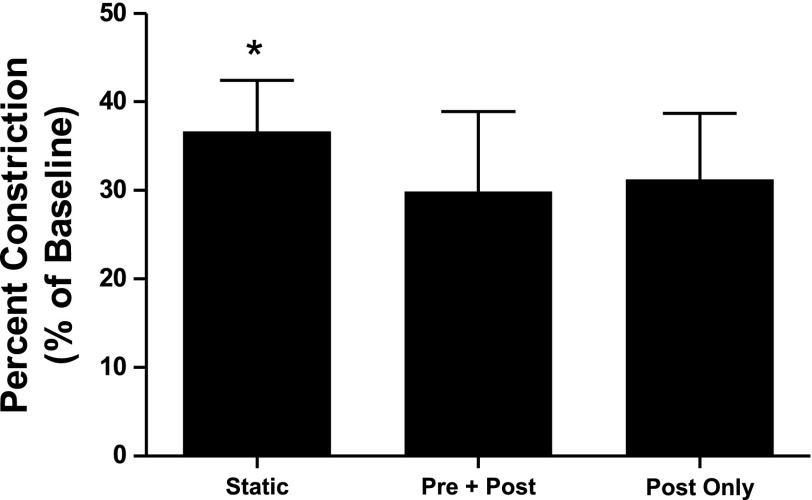
Airways constricted to a significantly greater degree when no oscillations were imposed (Static) than when large oscillations (5–20 cmH2O) were applied (Pre + Post and Post Only) (*P < 0.05). However, whether the oscillations were applied exclusively after the constriction (Post Only) or before and after the constriction (Pre + Post) had no effect on the final amount of constriction (P = 0.44).

References

    1. Ansell TK, Noble PB, Mitchell HW, West AR, Fernandes LB, McFawn PK. Effects of simulated tidal and deep breathing on immature airway contraction to acetylcholine and nerve stimulation. Respirology 14: 991–998, 2009 - PubMed
    1. Arold SP, Bartolák-Suki E, Suki B. Variable stretch pattern enhances surfactant secretion in alveolar type II cells in culture. Am J Physiol Lung Cell Mol Physiol 296: L574–L581, 2009 - PMC - PubMed
    1. Bates JHT, Maksym GN. Mechanical determinants of airways hyperresponsiveness. Crit Rev Biomed Eng 39: 281–296, 2011 - PubMed
    1. Bendixen HH, Smith GM, Mead J. Pattern of ventilation in young adults. J Appl Physiol 19: 195–198, 1964 - PubMed
    1. Berry EM, Edmonds JF, Wyllie H. Release of prostaglandin E2 and unidentified factors from ventilated lungs. Br J Surg 58: 189–192, 1971 - PubMed

Publication types