. 2012 Feb 1;30(1):1-31.
doi: 10.1007/s11049-011-9145-1.

When does a system become phonological? Handshape production in gesturers, signers, and homesigners

Affiliations

When does a system become phonological? Handshape production in gesturers, signers, and homesigners

Diane Brentari et al. Nat Lang Linguist Theory. .

Abstract

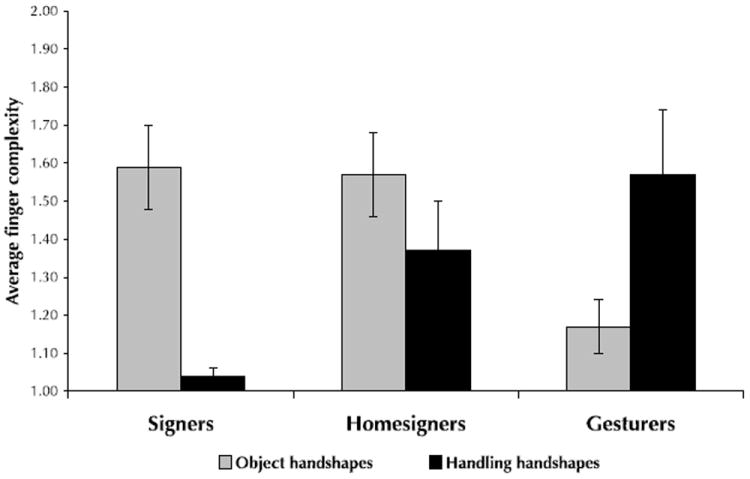
Sign languages display remarkable crosslinguistic consistencies in the use of handshapes. In particular, handshapes used in classifier predicates display a consistent pattern in finger complexity: classifier handshapes representing objects display more finger complexity than those representing how objects are handled. Here we explore the conditions under which this morphophonological phenomenon arises. In Study 1, we ask whether hearing individuals in Italy and the United States, asked to communicate using only their hands, show the same pattern of finger complexity found in the classifier handshapes of two sign languages: Italian Sign Language (LIS) and American Sign Language (ASL). We find that they do not: gesturers display more finger complexity in handling handshapes than in object handshapes. The morphophonological pattern found in conventional sign languages is therefore not a codified version of the pattern invented by hearing individuals on the spot. In Study 2, we ask whether continued use of gesture as a primary communication system results in a pattern that is more similar to the morphophonological pattern found in conventional sign languages or to the pattern found in gesturers. Homesigners have not acquired a signed or spoken language and instead use a self-generated gesture system to communicate with their hearing family members and friends. We find that homesigners pattern more like signers than like gesturers: their finger complexity in object handshapes is higher than that of gesturers (indeed as high as signers); and their finger complexity in handling handshapes is lower than that of gesturers (but not quite as low as signers). Generally, our findings indicate two markers of the phonologization of handshape in sign languages: increasing finger complexity in object handshapes, and decreasing finger complexity in handling handshapes. These first indicators of phonology appear to be present in individuals developing a gesture system without benefit of a linguistic community. Finally, we propose that iconicity, morphology and phonology each play an important role in the system of sign language classifiers to create the earliest markers of phonology at the morphophonological interface.

Keywords: Sign language; classifier predicates; gesture; handshape; historical change; homesign; language evolution; morphology; phonology.


Figures
None
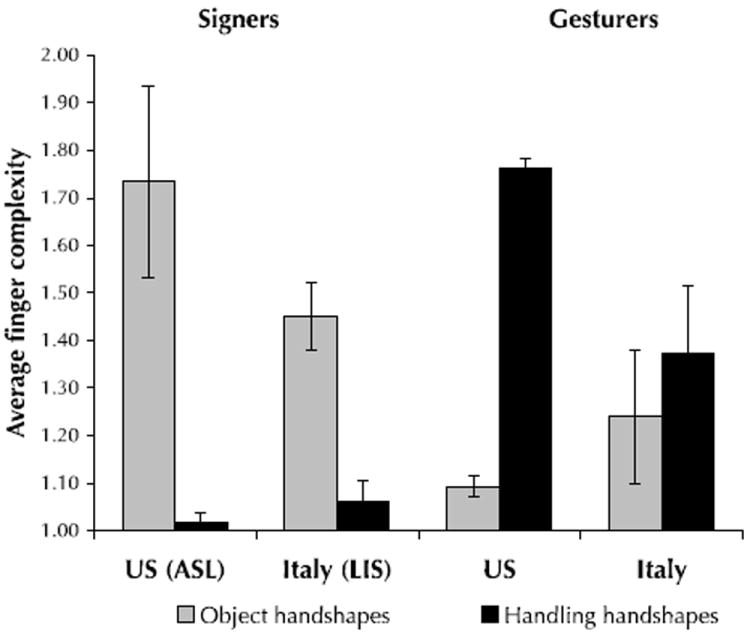
Observed values for average finger complexity and standard error for Object-HSs and Handling-HSs for signers and gesturers by Country with error bars indicated.
None
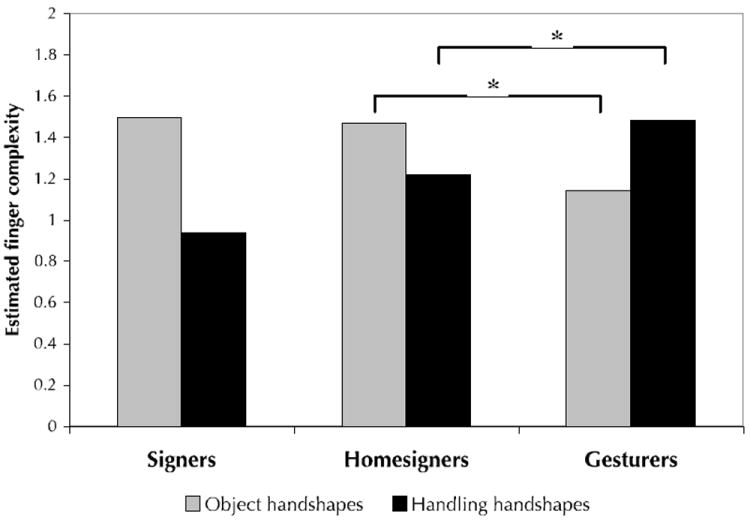
Observed values for average finger complexity for signers, homesigners, and gesturers, collapsing across country, with error bars indicated.
Figure 1
Figure 1
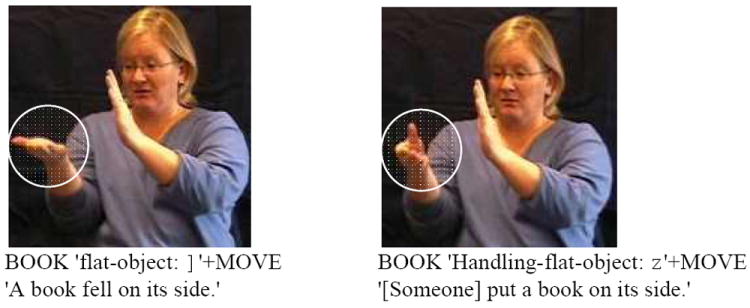
Example of Object and Handling classifier handshapes in ASL. The circled hand in the left panel (a) is an Object classifier representing ‘book’; the circled hand in the right panel (b) is a Handling classifier representing ‘Handling book’. The hand not circled in both examples represents a second book on the shelf.
Figure 2
Figure 2
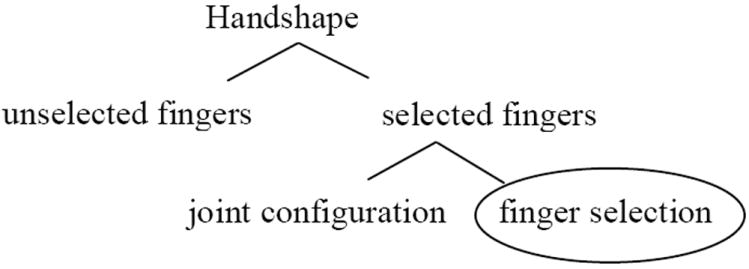
A schematized hierarchical representation of handshape (cf. Brentari 1998). The handshape node branches into selected fingers and unselected fingers feature classes, and the selected fingers node further branches into joint complexity and finger complexity feature classes.
Figure 3
Figure 3
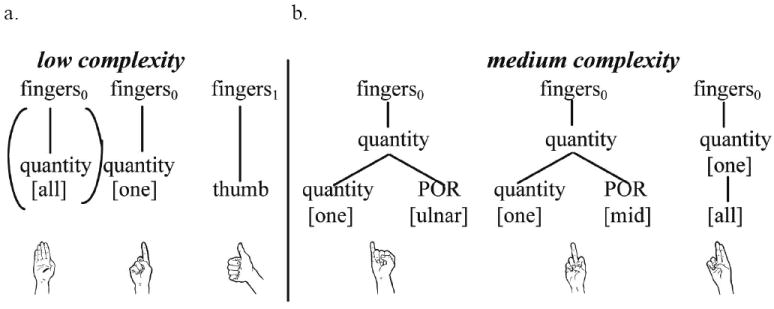
Finger groups with low and medium finger complexity (Brentari 1998). The low complexity finger groups (a) are characterized by a single, non-branching elaboration of the fingers node. The medium complexity finger groups (b) have one more elaboration, either a branching structure or an extra association line. The parentheses around the l- finger group indicate that it is the default finger group in the system.
Figure 4
Figure 4
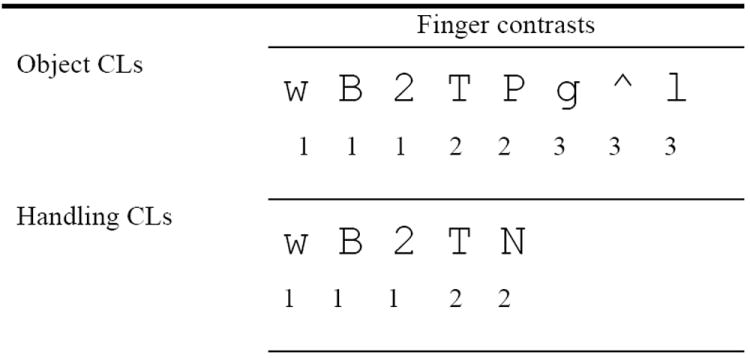
Finger groups found in Object and Handling classifiers in ASL, HKSL, and DSGS (cf. Eccarius 2008). The finger complexity score for each handshape is listed below it. Note that finger complexity is, on average, higher for the Object-CLs than for the Handling-CLs.
Figure 5
Figure 5
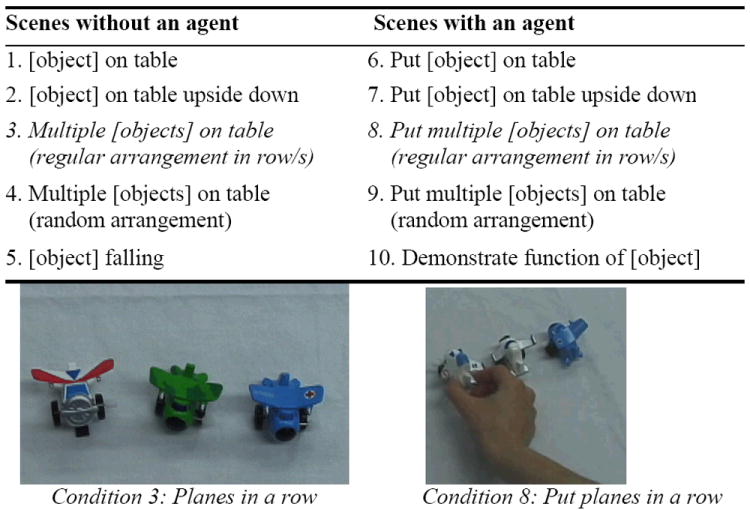
Description of the 10 conditions in which each of the 11 objects appeared (top), and examples of two airplane vignettes (a frame from the ‘no agent’ condition #3; a frame from the corresponding ‘agent’ condition #8).
Figure 6
Figure 6
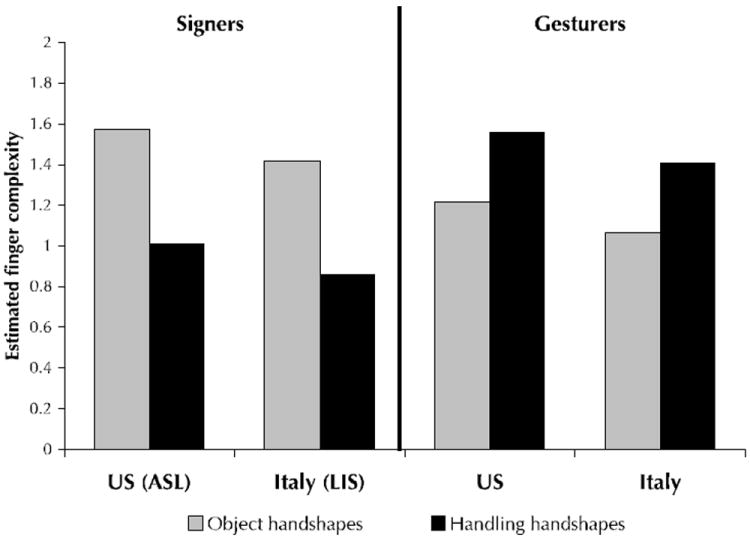
Estimated mean finger complexity for Object-HSs and Handling-HSs in signers and gesturers by Country. Signers in both countries replicated the previous cross-linguistic findings (higher finger complexity for Object-HSs than for Handling-HSs). Gesturers in both countries showed the opposite pattern (higher finger complexity for Handling-HSs than for Object-HSs). The estimated values provided by the model reflect the effects of removing covariates (such as stimulus item and participant) and, in this sense, provide a more accurate picture of the underlying patterns in the dataset than the observed values (which can be found in Appendix A). Because these are estimated values provided by the model, their values can be less than 1, which was the minimum finger complexity value assigned in our system.
Figure 7
Figure 7
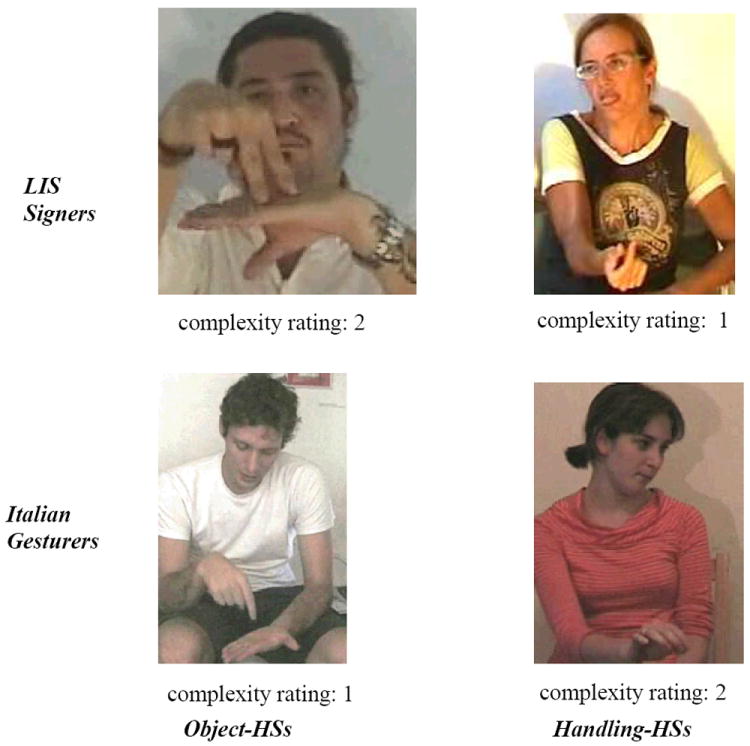
Example handshapes from the Italian group illustrating the sign pattern and the gesture pattern. Replicating previously found cross-linguistic patterns, LIS signers showed higher finger complexity in Object-HSs than in Handling-HSs. Italian gesturers showed the opposite pattern, higher finger complexity in Handling-HSs than in Object-HSs.
Figure 8
Figure 8
Estimated mean finger complexity for Object-HSs and Handling-HSs in signers, homesigners, and gesturers. Signers displayed significantly higher finger Object-HSs than in Handling-HSs. Gesturers displayed significantly higher finger complexity in Handling-HSs than in Object-HSs. The homesigners’ pattern resembled the signers’ pattern and was significantly different from the gesturers’ pattern. The estimated values provided by the model reflect the effects of removing covariates (such as stimulus item and participant) and, in this sense, provide a more accurate picture of the underlying patterns in the dataset than the observed values (which can be found in Appendix B). Because these are estimated values provided by the model, their values can be less than 1, which was the minimum finger complexity value assigned in our system.
Figure 9
Figure 9
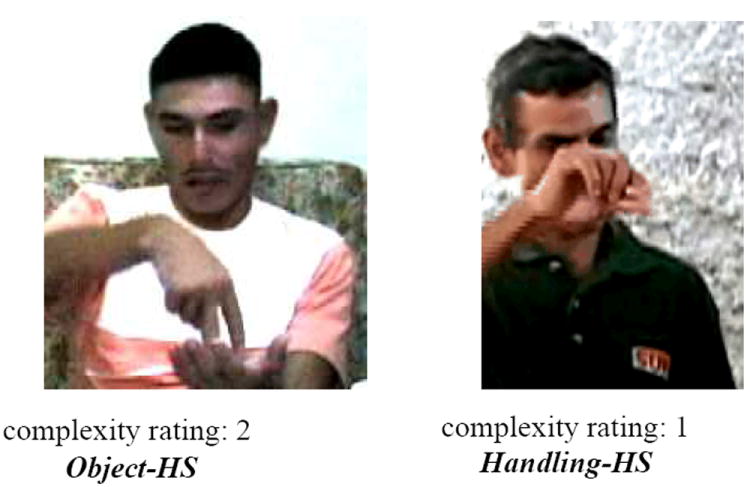
Example handshapes illustrating the pattern found in three of the four homesigners: higher finger complexity in Object-HSs than in Handling-HSs.

References

    1. Aronoff Mark, Sandler Wendy. Al-Sayyid Bedouin Sign Language: An Autochthonous Sign Language of the Negev Desert. paper presented at the American Association for the Advancement of Science; February, 15; Chicago, IL. 2009.
    1. Aronoff Mark, Meir Irit, Sandler Wendy. The Paradox of Sign Language Morphology. Language. 2005;81(2):301–344. - PMC - PubMed
    1. Aronoff Mark, Meir Irit, Padden Carol, Sandler Wendy. Classifier Constructions and Morphology in Two Sign Languages. In: Emmorey K, editor. Perspectives On Classifier Constructions In Sign Languages. Lawrence Erlbaum Associates; Mahwah, NJ: 2003. pp. 53–86.
    1. Benedicto Elena, Brentari Diane. Where did all the arguments go?: Argument-changing Properties of Classifiers in ASL. Natural Language and Linguistic Theory. 2004;22(4):1–68.
    1. Boyes Braem Penny. Ph D dissertation. University of California; Berkeley, California: 1981. Distinctive Features of the Handshapes of American Sign Language.

LinkOut - more resources