


Bright light therapy as part of a multicomponent management program improves sleep and functional outcomes in delirious older hospitalized adults
- PMID: 23723696
- PMCID: PMC3666546
- DOI: 10.2147/CIA.S44926
Bright light therapy as part of a multicomponent management program improves sleep and functional outcomes in delirious older hospitalized adults
Abstract
Objective: Delirium is associated with poor outcomes following acute hospitalization. A specialized delirium management unit, the Geriatric Monitoring Unit (GMU), was established. Evening bright light therapy (2000-3000 lux; 6-10 pm daily) was added as adjunctive treatment, to consolidate circadian activity rhythms and improve sleep. This study examined whether the GMU program improved sleep, cognitive, and functional outcomes in delirious patients.
Method: A total of 228 patients (mean age = 84.2 years) were studied. The clinical characteristics, delirium duration, delirium subtype, Delirium Rating Score (DRS), cognitive status (Chinese Mini-Mental State Examination), functional status (modified Barthel Index [MBI]), and chemical restraint use during the initial and predischarge phase of the patient's GMU admission were obtained. Nurses completed hourly 24-hour patient sleep logs, and from these, the mean total sleep time, number of awakenings, and sleep bouts (SB) were computed.
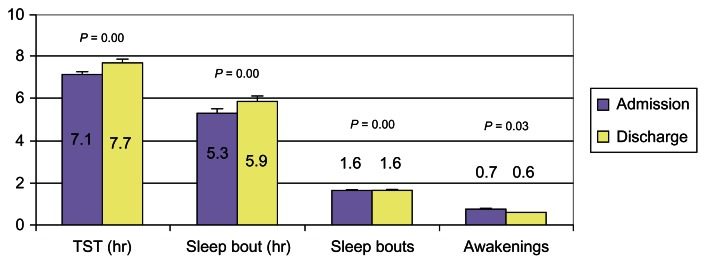
Results: The mean delirium duration was 6.7 ± 4.6 days. Analysis of the delirium subtypes showed that 18.4% had hypoactive delirium, 30.2% mixed delirium, and 51.3% had hyperactive delirium. There were significant improvements in MBI scores, especially for the hyperactive and mixed delirium subtypes (P < 0.05). Significant improvements were noted on the DRS sleep-wake disturbance subscore, for all delirium-subtypes. The mean total sleep time (7.7 from 6.4 hours) (P < 0.05) and length of first SB (6.0 compared with 5.3 hours) (P < 0.05) improved, with decreased mean number of SBs and awakenings. The sleep improvements were mainly seen in the hyperactive delirium subtype.
Conclusion: This study shows initial evidence for the clinical benefits (longer total sleep time, increased first SB length, and functional gains) of incorporating bright light therapy as part of a multicomponent delirium management program. The benefits appear to have occurred mainly in patients with hyperactive delirium, which merits further in-depth, randomized controlled studies.
Keywords: delirium; elderly; function; sleep.
Figures
References
-
- Agnostini JV. Inouye Sk. Delirium. In: Hazzard WR, Blass JP, Halter JB, Ouslander JG, Tinetti ME, editors. Principles of Geriatric Medicine and Gerontology. 5th ed. New York: McGraw-Hill; 2003. pp. 1503–1515.
-
- Inouye SK. Delirium in hospitalized older patients. Clin Geriatr Med. 1998;14(4):745–764. - PubMed
-
- Mograss MA, Guillem F, Brazzini-Poisson V, Godbout R. The effects of total sleep deprivation on recognition memory processes: a study of event-related potential. Neurobiol Learn Mem. 2009;91(4):343–352. - PubMed
-
- Fisher S. The microstructure of dual-task interaction. Sleep deprivation and the control of attention. Perception. 1980;9(3):327–337. - PubMed
-
- Feedman NS, Gazendam J, Leval L, Pack AI, Schwab RJ. Abnormal sleep/wake cycles and the effect of environmental noise on sleep disruption in the intensive care unit. Am J Respir Crit Care Med. 2001;163(2):451–457. - PubMed
Publication types
MeSH terms
LinkOut - more resources
Full Text Sources
Other Literature Sources
Medical
