


Innovative community-based approaches doubled tuberculosis case notification and improve treatment outcome in Southern Ethiopia
- PMID: 23723975
- PMCID: PMC3664633
- DOI: 10.1371/journal.pone.0063174
Innovative community-based approaches doubled tuberculosis case notification and improve treatment outcome in Southern Ethiopia
Abstract
Background: TB Control Programmes rely on passive case-finding to detect cases. TB notification remains low in Ethiopia despite major expansion of health services. Poor rural communities face many barriers to service access.
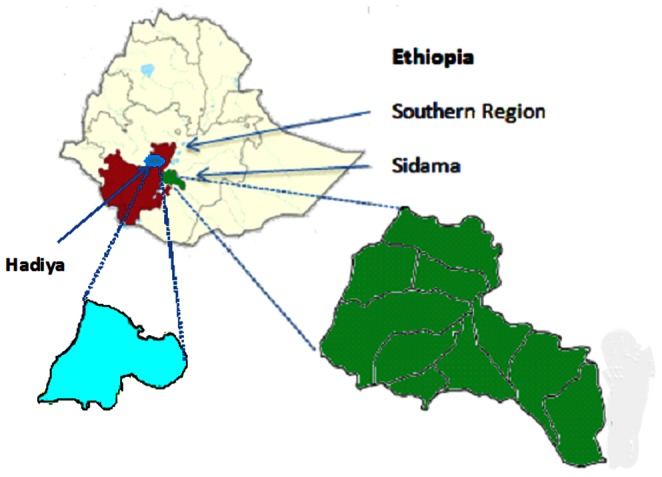
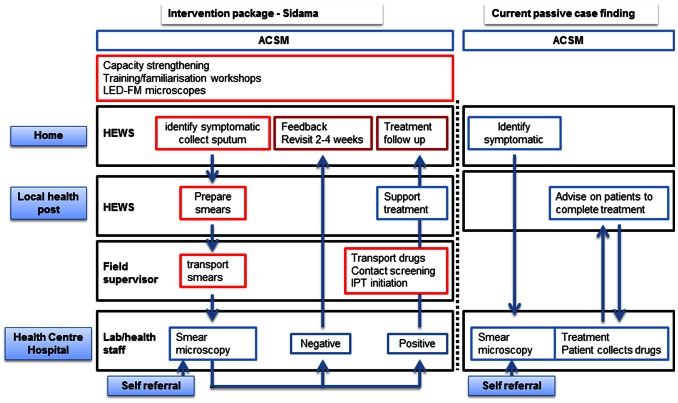
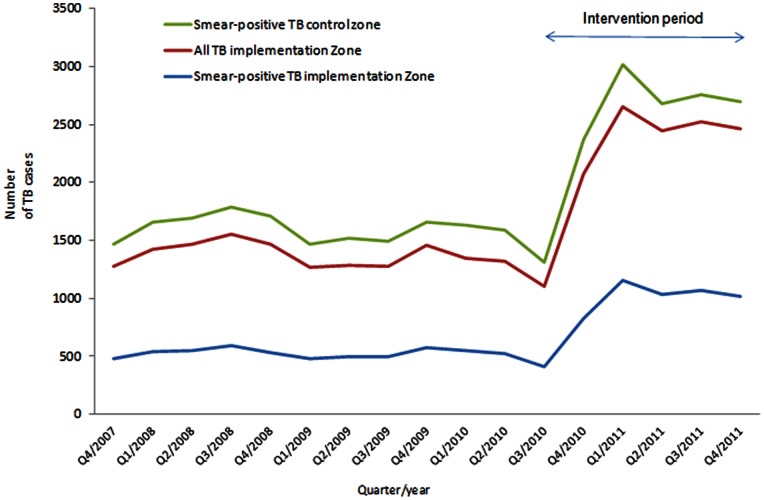
Methods and findings: A community-based intervention package was implemented in Sidama zone, Ethiopia. The package included advocacy, training, engaging stakeholders and communities and active case-finding by female Health Extension Workers (HEWs) at village level. HEWs conducted house-to-house visits, identified individuals with a cough for two or more weeks, with or without other symptoms, collected sputum, prepared smears and supervised treatment. Supervisors transported smears for microscopy, started treatment, screened contacts and initiated Isoniazid preventive therapy (IPT) for children. Outcomes were compared with the pre-implementation period and a control zone. Qualitative research was conducted to understand community and provider perceptions and experiences. HEWs screened 49,857 symptomatic individuals (60% women) from October 2010 to December 2011. 2,262 (4·5%) had smear-positive TB (53% women). Case notification increased from 64 to 127/100,000 population/year resulting in 5,090 PTB+ and 7,071 cases of all forms of TB. Of 8,005 contacts visited, 1,949 were symptomatic, 1,290 symptomatic were tested and 69 diagnosed with TB. 1,080 children received IPT. Treatment success for smear-positive TB increased from 77% to 93% and treatment default decreased from 11% to 3%. Service users and providers found the intervention package highly acceptable.
Conclusions: Community-based interventions made TB diagnostic and treatment services more accessible to the poor, women, elderly and children, doubling the notification rate and improving treatment outcome. This approach could improve TB diagnosis and treatment in other high burden settings.
Conflict of interest statement
Figures
References
-
- WHO World Health Organization Website. Global TB Report 2010. Available: http://www.who.int/tb/country/data/download/en/index.html. Accessed 2013.
-
- Harries AD, Nyirenda TE, Godfrey-Faussett P, Salaniponi FM (2003) Defining and assessing the maximum number of visits patients should make to a health facility to obtain a diagnosis of pulmonary tuberculosis. Int J Tuberc Lung Dis 7: 953–958. - PubMed
-
- Uplekar MW, Rangan S, Weiss MG, Ogden J, Borgdorff MW, et al. (2001) Attention to gender issues in tuberculosis control. Int J Tuberc Lung Dis 5: 220–224. - PubMed
-
- Yassin MA, Cuevas LE (2003) How many sputum smears are necessary for case finding in pulmonary tuberculosis? Trop Med Int Health 8: 927–932. - PubMed
Publication types
MeSH terms
LinkOut - more resources
Full Text Sources
Other Literature Sources
