


Cell envelope of corynebacteria: structure and influence on pathogenicity
- PMID: 23724339
- PMCID: PMC3658426
- DOI: 10.1155/2013/935736
Cell envelope of corynebacteria: structure and influence on pathogenicity
Abstract
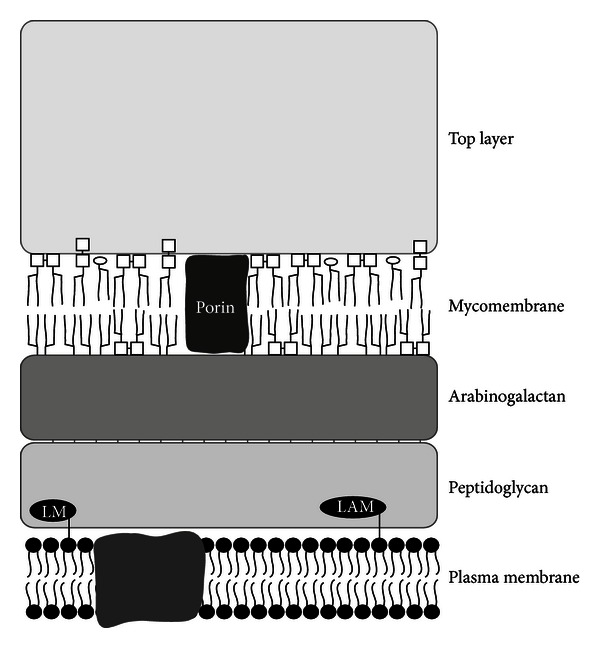
To date the genus Corynebacterium comprises 88 species. More than half of these are connected to human and animal infections, with the most prominent member of the pathogenic species being Corynebacterium diphtheriae, which is also the type species of the genus. Corynebacterium species are characterized by a complex cell wall architecture: the plasma membrane of these bacteria is followed by a peptidoglycan layer, which itself is covalently linked to a polymer of arabinogalactan. Bound to this, an outer layer of mycolic acids is found which is functionally equivalent to the outer membrane of Gram-negative bacteria. As final layer, free polysaccharides, glycolipids, and proteins are found. The composition of the different substructures of the corynebacterial cell envelope and their influence on pathogenicity are discussed in this paper.
Figures
References
-
- Zhi XY, Li WJ, Stackebrandt E. An update of the structure and 16S rRNA gene sequence-based definition of higher ranks of the class Actinobacteria, with the proposal of two new suborders and four new families and emended descriptions of the existing higher taxa. International Journal of Systematic and Evolutionary Microbiology. 2009;59(3):589–608. - PubMed
-
- Becker J, Wittmann C. Bio-based production of chemicals, materials and fuels—Corynebacterium glutamicum as versatile cell factory. Current Opinion in Biotechnology. 2012;23(4):631–640. - PubMed
-
- Vertes AA, Inui M, Yukawa H. Postgenomic approaches to using corynebacteria as biocatalysts. Annual Review of Microbiology. 2012;66:521–550. - PubMed
LinkOut - more resources
Full Text Sources
Other Literature Sources
Research Materials
