. 2013 Jun 1:12:83.
doi: 10.1186/1476-511X-12-83.

Loss of fatty acid synthase inhibits the "HER2-PI3K/Akt axis" activity and malignant phenotype of Caco-2 cells

Affiliations

Loss of fatty acid synthase inhibits the "HER2-PI3K/Akt axis" activity and malignant phenotype of Caco-2 cells

Nan Li et al. Lipids Health Dis. .

Abstract

Background: Fatty acid synthase (FASN) is frequently activated and overexpressed in human cancers, and plays a crucial role in the carcinogenesis of various cancers. In this study, our aims were to explore the role of FASN in regulating the "HER2-PI3K/Akt axis" activity and malignant phenotype of colorectal cancer.

Methods: Caco-2 cells with a high expression of both HER2 and FASN were selected for functional characterization. Caco-2 cells were transfected with either the FASN specific RNAi plasmid or the negative control RNAi plasmid, followed by the RT-qPCR and western blot to examine the expression of FASN, HER2, PI3K and Akt. The MTT and colony formation assays were used to assess the proliferation potential. The migration was investigated by the transwell, and the apoptosis and cell cycle were assayed by the flow cytometry.

Results: Notably, the expression of FASN, HER2, PI3K and Akt were downregulated upon a silence of FASN. The proliferation was decreased after a downregulation of FASN, which was consistent with an increased apoptosis rate. The migration was also impaired in FASN-silenced cells.

Conclusion: A downregulation of FASN effectively inhibits the activity of "HER2-PI3K/Akt axis" and alters the malignant phenotype in colorectal cancer cells.


Figures
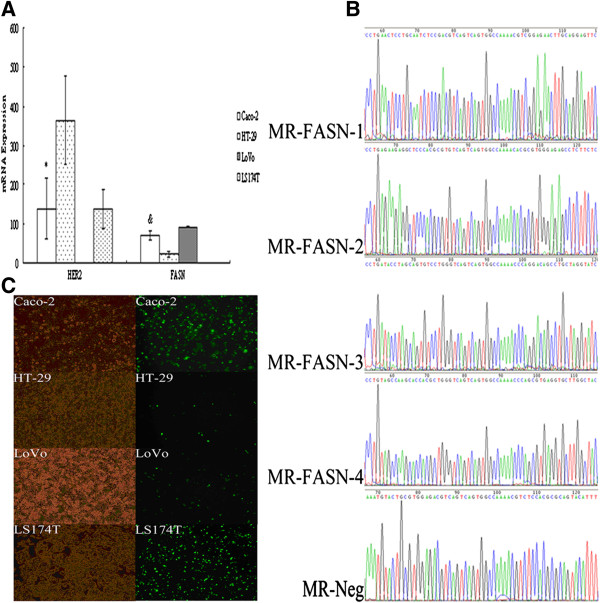
Figure 1
Figure 1
Cell selection. (A) HER2 and FASN mRNA expression of Caco-2, HT-29, LoVo and LS174T cells. * Compared with HT-29 and LoVo cells, P < 0.05; Compared with LS174T cells, P > 0.05. & Compared with HT-29, LoVo and LS174T cells, P < 0.05. (B) The sequencing of four different FASN specific RNAi plasmids and the negative control RNAi plasmid. (C) The white light and fluorescent photographs of Caco-2, HT-29, LoVo and LS174T cells transiently transfected with the negative control RNAi plasmid for 24 h (×100 magnification).
Figure 2
Figure 2
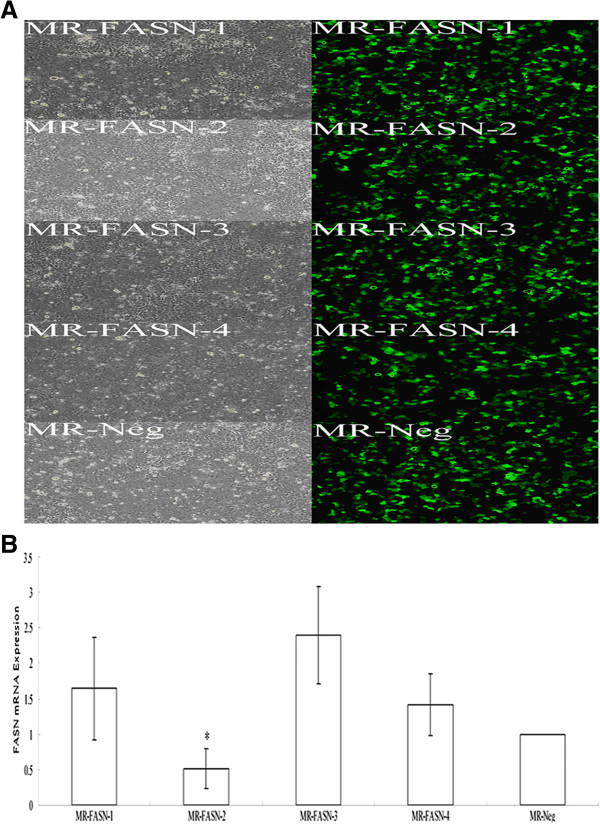
Plasmid selection. (A) The white light and fluorescent photographs of transfection efficiency of Caco-2 cells transiently transfected with four different FASN specific RNAi plasmids and the negative control RNAi plasmid for 24 h (×100 magnification). (B) FASN mRNA expression of Caco-2 cells transiently transfected with four different FASN specific RNAi plasmids and the negative control RNAi plasmid for 24 h. * Compared with other groups, P < 0.05.
Figure 3
Figure 3
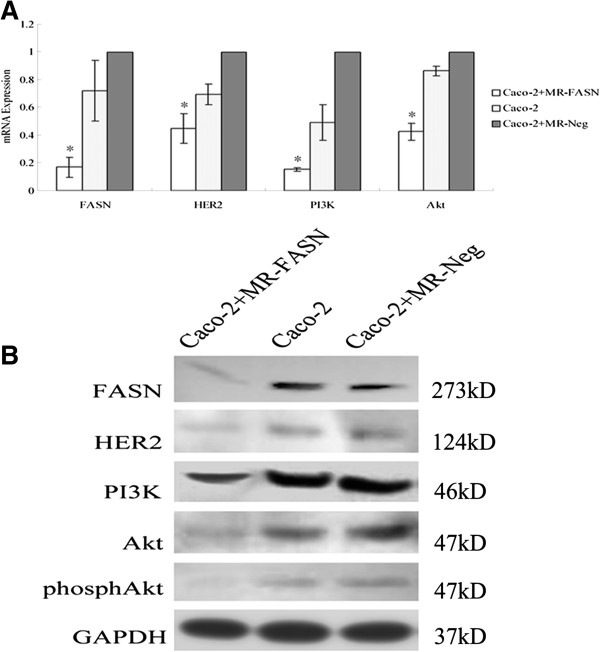
FASN, HER2, PI3K and Akt expression of Caco-2 cells by RNA interference. (A) FASN, HER2, PI3K and Akt mRNA expression. * Compared with two control groups, P < 0.05. (B) FASN, HER2, PI3K, Akt and phosphAkt protein expression.
Figure 4
Figure 4
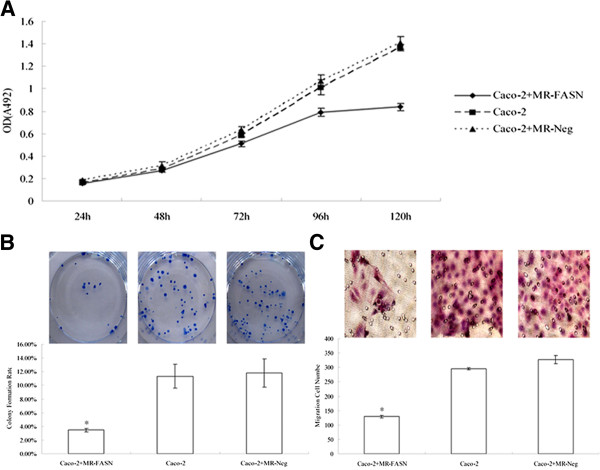
The proliferation and migration of Caco-2 cells by RNA interference. (A) The proliferation curve. Compared with two control groups, P < 0.05. (B) The colony formation Rate. * Compared with two control groups, P < 0.05. (C) The migration cell number. * Compared with two control groups, P < 0.05 (HE, ×200 magnification).
Figure 5
Figure 5
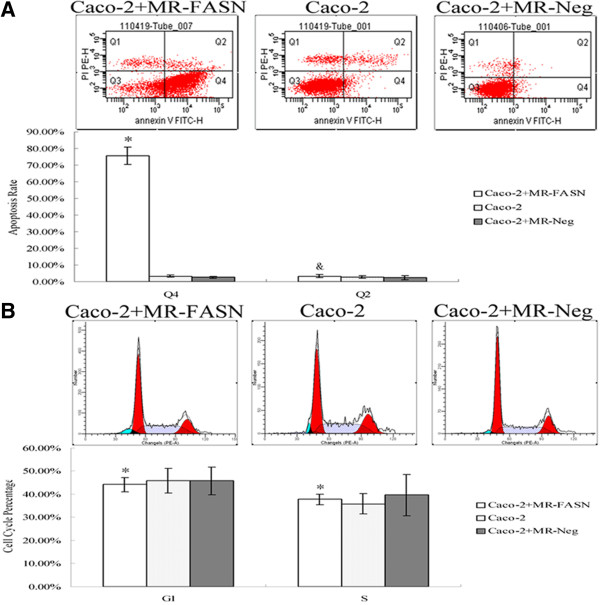
The apoptosis and cell cycle of Caco-2 cells by RNA interference. (A) The apoptosis rate. * Compared with two control groups, P < 0.05. & Compared with two control groups, P > 0.05. (B) The cell cycle percentage. * Compared with two control groups, P > 0.05.

References

    1. Little JL, Kridel SJ. Fatty acid synthase activity in tumor cells. Subcell Biochem. 2008;49:169–194. doi: 10.1007/978-1-4020-8831-5_7. - DOI - PubMed
    1. Kusakabe T, Maeda M, Hoshi N, Sugino T, Watanabe K, Fukuda T, Suzuki T. Fatty acid synthase is expressed mainly in adult hormone-sensitive cells or cells with high lipid metabolism and in proliferating fetal cells. J Histochem Cytochem. 2000;48(5):613–622. doi: 10.1177/002215540004800505. - DOI - PubMed
    1. López M, Lelliott CJ, Vidal-Puig A. Hypothalamic fatty acid metabolism: a housekeeping pathway that regulates food intake. Bioessays. 2007;29(3):248–261. doi: 10.1002/bies.20539. - DOI - PubMed
    1. Pizer ES, Lax SF, Kuhajda FP, Pasternack GR, Kurman RJ. Fatty acid synthase expression in endometrial carcinoma: correlation with cell proliferation and hormone receptors. Cancer. 1998;83(3):528–537. doi: 10.1002/(SICI)1097-0142(19980801)83:3<528::AID-CNCR22>3.0.CO;2-X. - DOI - PubMed
    1. Anderson SM, Rudolph MC, McManaman JL, Neville MC. Key stages in mammary gland development. Secretory activation in the mammary gland: it’s not just about milk protein synthesis! Breast Cancer Res. 2007;9(1):204. doi: 10.1186/bcr1653. - DOI - PMC - PubMed

Publication types

MeSH terms