


Deletion of virulence associated genes from attenuated African swine fever virus isolate OUR T88/3 decreases its ability to protect against challenge with virulent virus
- PMID: 23725691
- PMCID: PMC3709090
- DOI: 10.1016/j.virol.2013.04.028
Deletion of virulence associated genes from attenuated African swine fever virus isolate OUR T88/3 decreases its ability to protect against challenge with virulent virus
Abstract
African swine fever virus (ASFV) causes an acute haemorrhagic disease of domestic pigs against which there is no effective vaccine. The attenuated ASFV strain OUR T88/3 has been shown previously to protect vaccinated pigs against challenge with some virulent strains including OUR T88/1. Two genes, DP71L and DP96R were deleted from the OUR T88/3 genome to create recombinant virus OUR T88/3ΔDP2. Deletion of these genes from virulent viruses has previously been shown to reduce ASFV virulence in domestic pigs. Groups of 6 pigs were immunised with deletion virus OUR T88/3ΔDP2 or parental virus OUR T88/3 and challenged with virulent OUR T88/1 virus. Four pigs (66%) were protected by inoculation with the deletion virus OUR T88/3ΔDP2 compared to 100% protection with the parental virus OUR T88/3. Thus the deletion of the two genes DP71L and DP96R from OUR T88/3 strain reduced its ability to protect pigs against challenge with virulent virus.
Crown Copyright © 2013. Published by Elsevier Inc. All rights reserved.
Figures
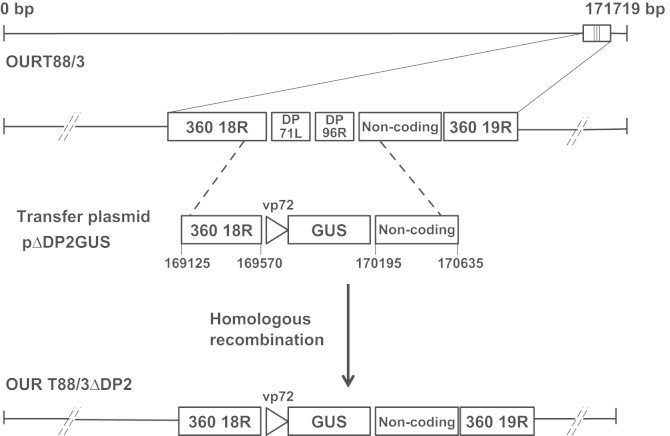
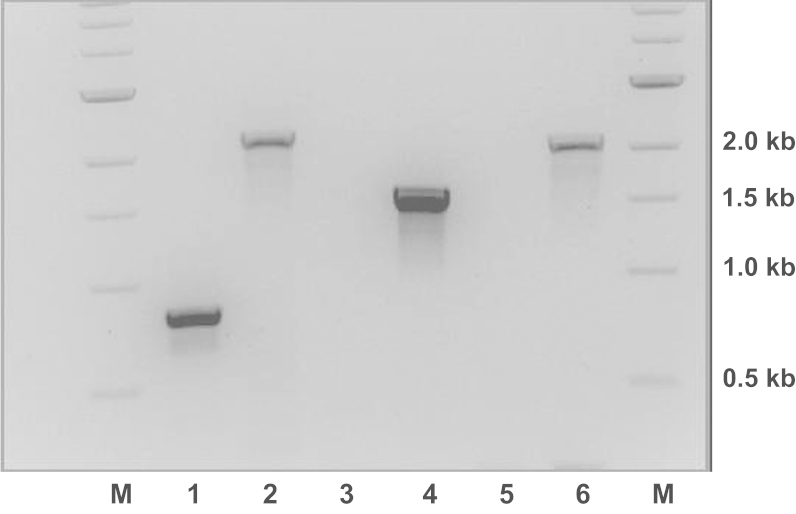
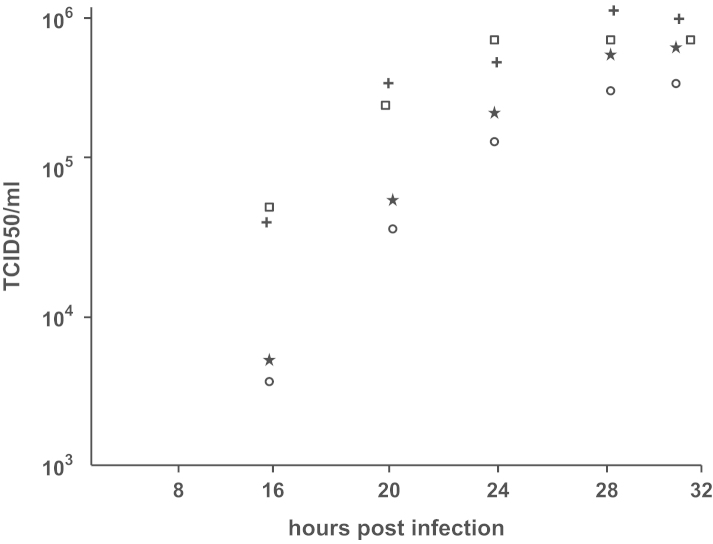
 and low m.o.i.
  ; OUR T88/3ΔDP2 high m.o.i.
 and low m.o.i.
  are indicated.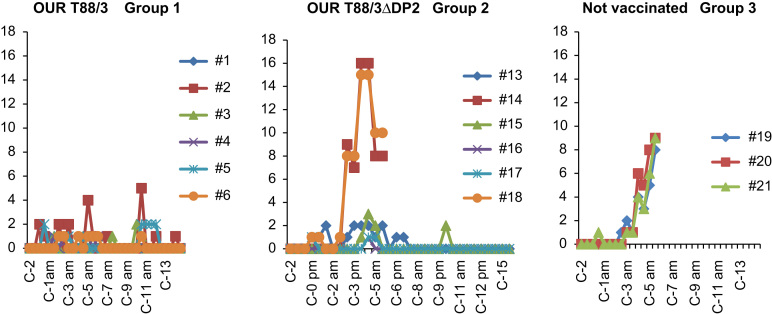
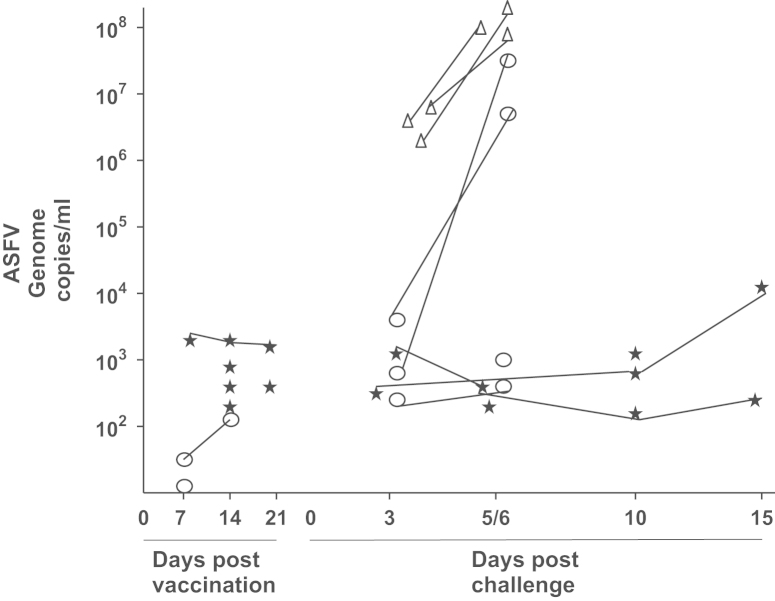 , Group 2 OUR T88/3ΔDP2 and Group 3 unvaccinated
  . Five pigs had no detectable ASFV DNA in blood post-immunisation (pig 1—Group 1, pigs 14, 15, 17 and 18—Group 2). Four pigs had no detectable levels of ASFV DNA in blood post-challenge (pigs 1 and 5—Group1, pigs 16 and 17—Group 2).
References
-
- Afonso C.L., Zsak L., C. Carrillo C., Borca M.V., Rock, D.L. M.V. African swine fever virus NL gene is not required for virus virulence. J. Gen. Virol. 1998;79:2543–2547. - PubMed
-
- Alcamí A., Viñuela E. Fc receptors do not mediate African swine fever virus replication in macrophages. Virology. 1991;181:756–759. - PubMed
-
- Bastos A.D., Penrith M.L., Crucière C., Edrich J.L., Hutchings G., Roger F., Couacy-Hymann E.R., Thomson G. Genotyping field strains of African swine fever virus by partial p72 gene characterisation. Arch. Virol. 2003;148:693–706. - PubMed
Publication types
MeSH terms
Substances
Grants and funding
LinkOut - more resources
Full Text Sources
Other Literature Sources
