


Risk factors for delayed initiation of combination antiretroviral therapy in rural north central Nigeria
- PMID: 23727981
- PMCID: PMC3818360
- DOI: 10.1097/QAI.0b013e31829ceaec
Risk factors for delayed initiation of combination antiretroviral therapy in rural north central Nigeria
Abstract
Background: Timely initiation of combination antiretroviral therapy (ART) in eligible HIV-infected patients is associated with substantial reduction in mortality and morbidity. Nigeria has the second largest number of persons living with HIV/AIDS in the world. We examined patient characteristics, time to ART initiation, retention, and mortality at 5 rural facilities in Kwara and Niger states of Nigeria.
Methods: We analyzed program-level cohort data for HIV-infected ART-naive clients (≥15 years) enrolled from June 2009 to February 2011. We modeled the probability of ART initiation among clients meeting national ART eligibility criteria using logistic regression with splines.
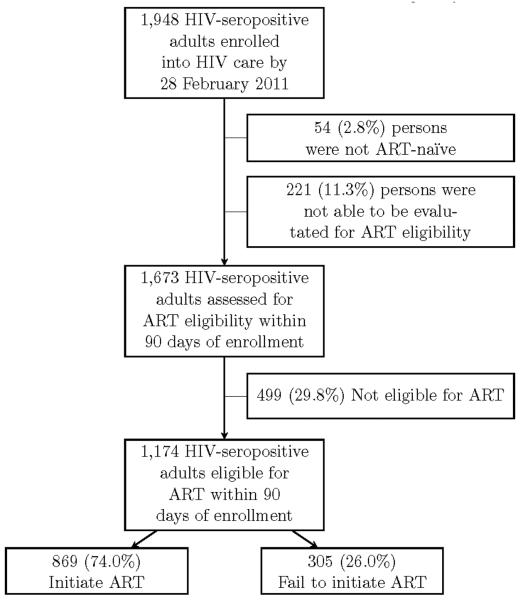
Results: We enrolled 1948 ART-naive adults/adolescents into care, of whom, 1174 were ART eligible (62% female). Only 74% of the eligible patients (n = 869) initiated ART within 90 days after enrollment. The median CD4 count for eligible clients was 156 cells/μL (interquartile range: 81-257), with 67% in WHO stage III/IV disease. Adjusting for CD4 count, WHO stage, functional status, hemoglobin, body mass index, sex, age, education, marital status, employment, clinic of attendance, and month of enrollment, we found that immunosuppression [CD4 350 vs. 200, odds ratio (OR) = 2.10, 95% confidence interval (CI): 1.31 to 3.35], functional status [bedridden vs. working, OR = 4.17 (95% CI: 1.63 to 10.67)], clinic of attendance [Kuta Hospital vs. referent: OR = 5.70 (95% CI: 2.99 to 10.89)], and date of enrollment [December 2010 vs. June 2009: OR = 2.13 (95% CI: 1.19 to 3.81)] were associated with delayed ART initiation.
Conclusions: Delayed initiation of ART was associated with higher CD4 counts, lower functional status, clinic of attendance, and later dates of enrollment among ART-eligible clients. Our findings provide targets for quality improvement efforts that may help reduce attrition and improve ART uptake in similar settings.
Figures
References
-
- UNGASS [Accessed 02/28/2012];UNGASS Country Progress Report: Nigeria. 2010 http://www.unaids.org/en/dataanalysis/monitoringcountryprogress/2010prog....
-
- UNAIDS . Global report: UNAIDS Report on the Global AIDS Epidemic 2010. Joint United Nations Programme on HIV/AIDS; New York: 2010. [Accessed 03/08/2012]. http://www.unaids.org/globalreport/Global_report.htm.
-
- WHO/UNAIDS/UNICEF . Progress report 2011. World Health Organization; Geneva: 2011. [Accessed 03/01/12]. Global HIV/AIDS response: Epidemic update and health services progress toward universal access. http://whqlibdoc.who.int/publications/2011/9789241502986_eng.pdf.
-
- National Agency for the Control of AIDS (NACA) Country Progress Report, Nigeria, GARPR 2012. Abuja: 2012. [Accessed 09/01/12]. Federal Republic of Nigeria Global AIDS Response. http://www.unaids.org/en/dataanalysis/knowyourresponse/countryprogressre....
-
- National Agency for the Control of AIDS (NACA) Research and New Technologies. NACA; Abuja: 2009. [Accessed 10/01/12]. National HIV/AIDS Policy Review Report. http://naca.gov.ng/index2.php?option=com_docman&task=doc_view&gid=67&Ite....
Publication types
MeSH terms
Substances
Grants and funding
LinkOut - more resources
Full Text Sources
Other Literature Sources
Medical
Research Materials
