. 2013 Jun 27;498(7455):516-20.
doi: 10.1038/nature12210. Epub 2013 Jun 2.

Functional roles of enhancer RNAs for oestrogen-dependent transcriptional activation

Affiliations

Functional roles of enhancer RNAs for oestrogen-dependent transcriptional activation

Wenbo Li et al. Nature. .

Abstract

The functional importance of gene enhancers in regulated gene expression is well established. In addition to widespread transcription of long non-coding RNAs (lncRNAs) in mammalian cells, bidirectional ncRNAs are transcribed on enhancers, and are thus referred to as enhancer RNAs (eRNAs). However, it has remained unclear whether these eRNAs are functional or merely a reflection of enhancer activation. Here we report that in human breast cancer cells 17β-oestradiol (E2)-bound oestrogen receptor α (ER-α) causes a global increase in eRNA transcription on enhancers adjacent to E2-upregulated coding genes. These induced eRNAs, as functional transcripts, seem to exert important roles for the observed ligand-dependent induction of target coding genes, increasing the strength of specific enhancer-promoter looping initiated by ER-α binding. Cohesin, present on many ER-α-regulated enhancers even before ligand treatment, apparently contributes to E2-dependent gene activation, at least in part by stabilizing E2/ER-α/eRNA-induced enhancer-promoter looping. Our data indicate that eRNAs are likely to have important functions in many regulated programs of gene transcription.


Figures

Fig1
Fig1. E2induction of eRNA in breast cancer cells
(a) Heat map of GRO-seq showing bidirectional eRNA transcription at enhancers induced by E2. (b) UP-enhancers are closer to the UP-gene cohort [median ~52kb] in comparison to enhancers with non-upregulated eRNAs [median ~270kb]. (c) ERα binds more robustly to UP-enhancers than to the enhancers with nonupregulated eRNA. (d) Among the UP-enhancers, those within 200kb from any E2-upregulated gene TSSs exhibit higher ERα binding intensity than the cohort of UP-enhancers located farther. (e) Most of the UP-enhancers are close to E2-upregulated coding genes. (f) ERα binding intensity on UP-enhancers is higher than on 112 promoters of E2-activated genes, which itself is higher than 790 ERα-bound promoters of non-E2-upregulated genes. A log10 scale is used for panels b,c and f. p-values are given using Student's t-test.
Fig2
Fig2. Importance of eRNA for target gene activation
(a,b) siRNA/LNA knock-down of eRNAs. Efficacy and effects on coding gene transcription assessed by QPCR for the TFF1, FOXC1, and CA12 eRNAs and coding transcription units. (c) QPCR analysis showing no significant change of several E2-target coding genes when FOXC1 eRNA was knocked-down using LNA. (d) Lack of effect of NRIP1, TFF1, or CA12 eRNA knock-down on expression of other coding genes located much more distal, including USP25 (520kb from NRIPe), RSPH1, (120kb from TFF1e) and APHIb (110kb from the CA12e). (e) GRO-seq data from FOXC1e LNA treated cells showing its inhibitory effect on the transcription of FOXC1 coding locus, but not on the targeted enhancer region itself. The bar graph (right) shows that the FOXC1e LNA knocked-down E2-induction of FOXC1 mRNA (tag counts over the whole gene length), but not transcription of the enhancer region. (f) A similar snapshot as in panel e showing the lack of effect from FOXC1e LNA on GAPDH transcription. Data represent mean±SEM (a,b) and mean±SD (c,d). (n=3). *p<0.05, **p<0.01.
Fig3
Fig3. Ligand-induced eRNA is functionally important
(a) Schematic diagram of the Box-b-λN tethering system on FOXC1 enhancer which is upstream of a FOXC1 native promoter-linked luciferase cassette. 5XUAS sites are fused downstream to FOXC1 enhancer. GAL4-λN fusion tethers Box-b-FOXC1 eRNA to the 5XUAS sites. Bar graph shows the effects of the FOXC1 eRNA on FOXC1 promoter-driven luciferase activity in the presence of E2 (24hrs). Blue bars: the activating function of the native full length enhancer (Bar:2) over random DNA (Bar:1) is lost when sense eRNA cassette is substituted with 5XUAS site (Bar:3). Orange bars: this loss was largely rescued upon FOXC1 eRNA tethering to sense eRNA deleted enhancer cassette (Bar 6). (b) eRNA function is sequence-specific: FOXC1e sense eRNA but not anti-sense strand (- strand) eRNA could rescue the activity of sense eRNA deleted enhancer, in the Box-b tethering assay. (c) Gel picture showing plasmid-based eRNA expression from full length enhancer but not from sense eRNA deleted enhancer construct. (d) Bar graph showing efficiency of GAL4 tethering on various pGL3b constructs. (e) 3D-DSL data for the P2RY2 locus, revealing enhanced promoter:enhancer interaction over the basal conditions after 1hr E2 treatment. For all 3D-DSL data, the y-axis exhibits the log10 intensities of interaction counts plus 1 or 0.25 for presentation purpose, and the x-axis depicts coordinates from UCSC genome browser. Interaction data are overlaid with positions of enhancer, ERα and HindIII sites on the regions interrogated. The pertinent promoter:enhancer interaction is shown in red and other interactions are shown in blue. (f) 3D-DSL data for the KCNK5 locus after 1hr E2 treatment. (g) LNA knock-down of NRIP1e eRNA effectively reduced the level of both eRNA and associated coding gene transcripts. (h) 3D-DSL data demonstrating significant reduction in promoter:enhancer interaction upon NRIP1e eRNA-specific LNA treatment. (i) GREB1e siRNA knock-down diminished the levels of eRNA and associated coding gene transcript. (j) 3D-DSL data for the GREB1 locus showing significantly reduced enhancer:promoter looping as well as other genomic interaction, after GREB1e specific siRNA treatment. Mean±SD. (n=3). *p<0.05, **p<0.01.
Fig4
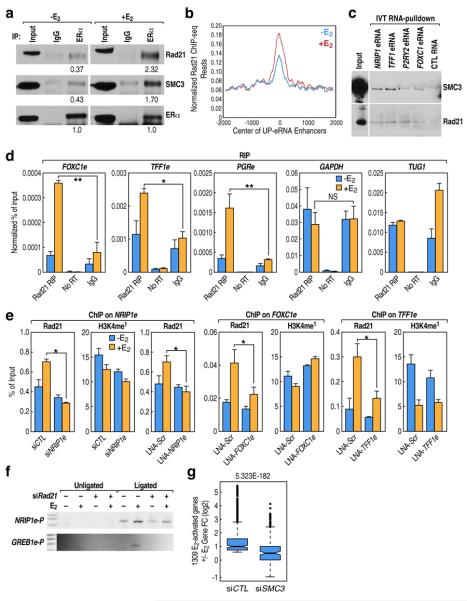
Fig4. Role of eRNA in Cohesin-dependent gene activation
(a) Co-immunoprecipitation of Rad21 and SMC3 with ERα from E2 or ethanol treated MCF7 whole cell extracts showing physical interaction between ERα and Cohesin subunits, which is further enhanced by E2 treatment. Numbers below blots depict the band density (Image J) relative to that of corresponding density of ERα. (b) Rad21 enrichment centered at UP-enhancers as determined by ChIP-seq, which shows moderate E2-induced increase. (c) In vitro transcribed (IVT) RNA pull-down assay showing the interaction between Cohesin subunits and eRNAs, but not a control RNA (RNA fragment of Xenopus elongation factor α). (d) RIP-QPCR showing binding of Rad21 to selected regulated eRNAs but not to GAPDH or TUG1. (e) ChIP-QPCR analyses represent the inhibitory effect from knock-down of NRIP1e (siRNA and LNA), FOXC1e or TFF1e on E2-indcued Rad21 additional recruitment, but not on H3K4me1. (f) Effect of Rad21 depletion on physical interaction between promoter:enhancer for the GREB1 and NRIP1 genes, assessed by 3C assay. (g) 1,309 E2-induced coding genes were defined by GRO-seq from siCTL (±E2) group and then their fold change (log2 FC) in siCTL versus siSMC3 transfected MCF7 cells was plotted). Mean ± SD. (n=3). *p<0.05, **p<0.01.

Comment in

References

    1. Newman JJ, Young RA. Connecting transcriptional control to chromosome structure and human disease. Cold Spring Harb Symp Quant Biol. 2010;75:227–35. Review. - PubMed
    1. Bulger M, Groudine M. Functional and mechanistic diversity of distal transcription enhancers. Cell. 2011;144(3):327–39. - PMC - PubMed
    1. Ong CT, Corces VG. Enhancer function: new insights into the regulation of tissue-specific gene expression. Nat Rev Genet. 2011;12(4):283–93. Review. - PMC - PubMed
    1. Guttman M, Rinn JL. Modular regulatory principles of large non-coding RNAs. Nature. 2012;482(7385):339–46. Review. - PMC - PubMed
    1. Wang KC, Chang HY. Molecular mechanisms of long noncoding RNAs. Mol Cell. 2011;43(6):904–14. - PMC - PubMed

Publication types

MeSH terms

Associated data