. 2013 Jun 27;498(7455):511-5.
doi: 10.1038/nature12209. Epub 2013 Jun 2.

Rev-Erbs repress macrophage gene expression by inhibiting enhancer-directed transcription

Affiliations

Rev-Erbs repress macrophage gene expression by inhibiting enhancer-directed transcription

Michael T Y Lam et al. Nature. .

Abstract

Rev-Erb-α and Rev-Erb-β are nuclear receptors that regulate the expression of genes involved in the control of circadian rhythm, metabolism and inflammatory responses. Rev-Erbs function as transcriptional repressors by recruiting nuclear receptor co-repressor (NCoR)-HDAC3 complexes to Rev-Erb response elements in enhancers and promoters of target genes, but the molecular basis for cell-specific programs of repression is not known. Here we present evidence that in mouse macrophages Rev-Erbs regulate target gene expression by inhibiting the functions of distal enhancers that are selected by macrophage-lineage-determining factors, thereby establishing a macrophage-specific program of repression. Remarkably, the repressive functions of Rev-Erbs are associated with their ability to inhibit the transcription of enhancer-derived RNAs (eRNAs). Furthermore, targeted degradation of eRNAs at two enhancers subject to negative regulation by Rev-Erbs resulted in reduced expression of nearby messenger RNAs, suggesting a direct role of these eRNAs in enhancer function. By precisely defining eRNA start sites using a modified form of global run-on sequencing that quantifies nascent 5' ends, we show that transfer of full enhancer activity to a target promoter requires both the sequences mediating transcription-factor binding and the specific sequences encoding the eRNA transcript. These studies provide evidence for a direct role of eRNAs in contributing to enhancer functions and suggest that Rev-Erbs act to suppress gene expression at a distance by repressing eRNA transcription.


Figures
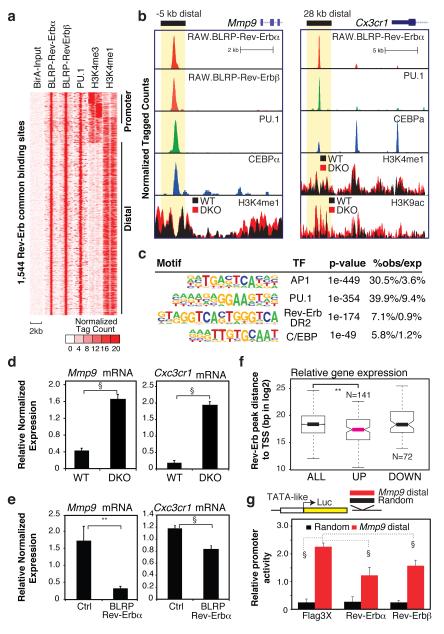
Figure 1
Figure 1. Rev-Erb binding and function at macrophage-specific enhancers
a, Cluster plot of ChIP-Seq signals for the indicated transcription factors and histone marks flanking 2 kb from the center of 1,544 Rev-Erb binding sites. b, Genomic loci of Mmp9 and Cx3cr1 with ChIP-Seq signals for the indicated transcription factors and histone marks. The locations of the −5 kb Mmp9 and 28 kb Cx3cr1 enhancers are indicated at top. c, Top-enriched transcription factor motifs identified by de novo motif discovery at Rev-Erb bound loci. d, Q-PCR analysis of Mmp9 and Cx3cr1 mRNA in Rev-Erb DKO macrophages (N = 8, and N WT DKO = 7) and e, in RAW264.7 macrophages engineered to stably express BLRP-Rev-Erbα (Nctrl = 17, Nalpha = 18 independent lines). Data represent mean + s.e.m. P-value **, P < 0.01, §, P < 0.005 versus control by two tail Student’s t-test.. f, Box and whisker plot of distances of nearest Rev-Erb binding sites to genes exhibiting significant up or down regulation in Rev-Erb DKO macrophages in comparison to all genes. The edges of the box represent the first and third quartile, and the whiskers indicated 1.5X of the interquartile range. ** p<0.005. g, Assessment of enhancer activity of the −5 kb Mmp9 Rev-Erb binding region. Luciferase reporter was cotransfected with an empty (Flag3X), Rev-Erbα or Rev-Erbβ expression construct. §, P < 0.005, ANOVA by Tukey HSD test.
Figure 2
Figure 2. Rev-Erb negatively regulates enhancer transcription
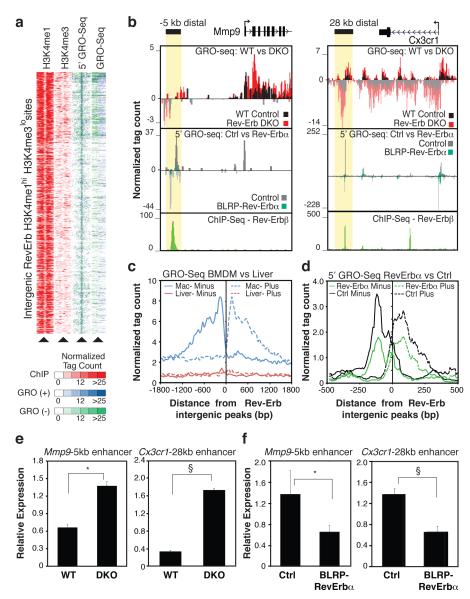
a, Cluster plot of tag counts for H3K4me1 and H3K4me3 ChIP-Seq, 5’GRO-Seq and GRO-Seq at 544 intergenic Rev-Erb bound, H3K4me1hi H3K4me3lo regions. b. Genomic loci for Mmp9 and Cx3cr1 showing indicated tag counts for GRO-Seq, 5’GRO-Seq and Rev-Erbβ. c, Distribution of averaged macrophage GRO-Seq eRNA signal in macrophages flanking Rev-Erb intergenic sites defined in macrophages (n = 544, blue) and Rev-Erb intergenic sites defined in liver (n = 521, red). d, Distribution of average 5’GRO-Seq signal from Rev-Erbα overexpressing (green) and control RAW264.7 macrophages (black) flanking the top 100 Rev-Erb-sites. e, Q-PCR analysis of the −5kb Mmp9 and 28kb Cx3cr1 eRNAs in Rev-Erb DKO (top, N WT = 6, and N DKO = 5) and f, Rev-Erbα overexpressing RAW264.7 macrophages (bottom, Nctrl = 13, Nalpha = 14 independent lines). Data represent mean + s.e.m. *, P < 0.01, § P < 0.005, versus control by two tail Student’s t-test.
Figure 3
Figure 3. Reduction of eRNA expression results in reduced expression of nearby mRNAs
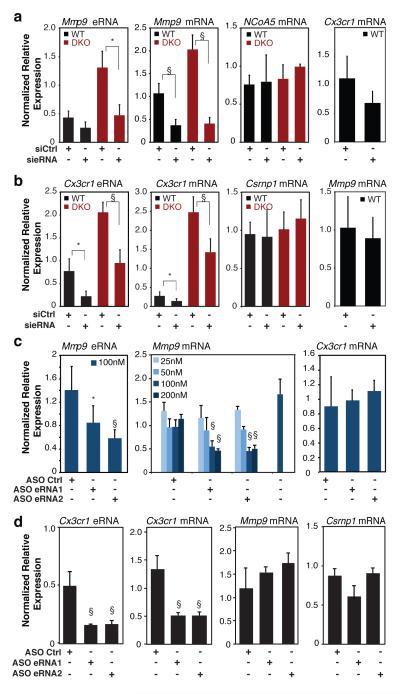
a, Q-PCR analysis of Mmp9 eRNA, and Mmp9, NCoA5 and Cx3cr1 mRNAs for wildtype and Rev-Erb DKO thioglycollate-elicited macrophages transfected with Ctrl or Mmp9 eRNA siRNA (N WT = 4, and N DKO = 4). b, Q-PCR analysis of Cx3cr1 eRNA, and Cx3cr1, Csrnp1 and Mmp9 mRNAs for wildtype and Rev-Erb DKO bone marrow-derived macrophages transfected with siRNA targeting Cx3cr1 eRNA (N WT = 6, and N DKO = 5). c, Q-PCR analysis of Mmp9 eRNA and Mmp9 and Cx3cr1 mRNAs in thioglycollate-elicited macrophages transfected with the indicated antisense oligonucleotides (ASO, n = 3-7 per condition). d, Q-PCR analysis of Cx3cr1 eRNA and Cx3cr1, Mmp9 and Csrnpl mRNAs in BMDMs transfected with the indicated antisense oligonucleotides (ASO, n = 3-7 per condition). Data in a-d represent mean + s.d., with expression normalized to 36B4 in all cases. For a-b, statistical significance was determined by two tails Student’s t-test; for c-d, one-way ANOVA with Tukey HSD test. P value, * P < 0.05, § P < 0.005 versus control.
Figure 4
Figure 4. eRNA contribution to enhancer activity and consequences of knockdown in vivo
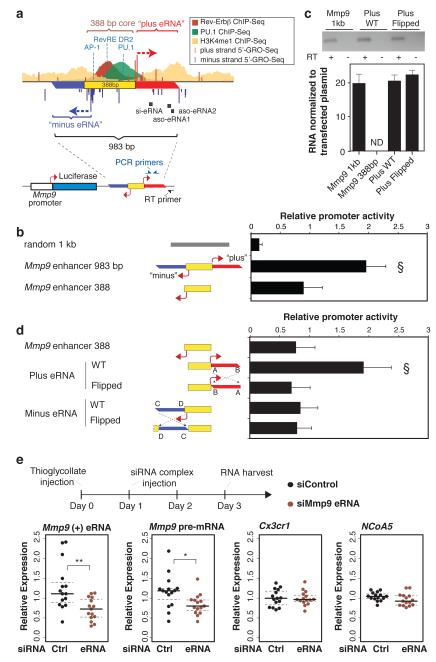
a, Experimental design for testing eRNA coding sequences. 983 bp of the Mmp9 enhancer was cloned downstream of the luciferase reporter gene driven by the Mmp9 promoter. The yellow box represents the 388 bp core mediating transcription factor binding as indicated by the ChIP-Seq tracks. Positions of transcription factor motifs are indicated in blue. Directional arrows represent eRNA transcription start sites defined by 5’GRO-Seq that give rise to ‘Plus eRNA’ and ‘minus eRNA’ as indicated. The locations of RT and PCR primers for detecting plasmid-directed eRNAs are indicated. b, Luciferase activity of the indicated reporter constructs in RAW264.7 macrophages. Bars represent mean normalized values from 8 independent experiments + s.d, (§ P < 0.005 versus all other indicated conditions). c, RT-PCR of Mmp9 plus eRNA normalized to the copy number of the indicated transfected plasmid DNA. Gel electrophoresis of PCR with or without RT is indicated on top. ND = not detected. d, Enhancer reporter assays performed as in b with the indicated luciferase reporters. Dashed lines represent inversions of the plus or minus DNA sequence relative to the core enhancer element (yellow) (bars represent mean normalized values from 5 independent experiments + s.d., § P < 0.005 versus all other indicated conditions). Statistical significance was determined by one-way ANOVA followed by Tukey HSD test. e, Sterile peritonitis was initiated by intraperitoneal injection of thioglycollate on day 0. Mice were injected with lipofectamine-siRNA complexes on day 1, and peritoneal exudate cells were recovered for analysis of Mmp9 eRNA, Mmp9 primary RNA, NCoA5, and Cx3cr1 mRNA on day 3 (n = 15 per condition). Values were normalized to the average of 36B4 and cyclopilin A mRNA. *, P < 0.05 versus siControl as determined by two tailed Student’s t-test.

Comment in

References

    1. Preitner N, et al. The orphan nuclear receptor REV-ERBalpha controls circadiantranscription within the positive limb of the mammalian circadian oscillator. Cell. 2002;110(2):251–260. - PubMed
    1. Liu AC, et al. Redundant Function of REV-ERBá and â and Non-Essential Role for Bmal1 Cycling in Transcriptional Regulation of Intracellular Circadian Rhythms. PLoS Genetics. 2008;4(2):e1000023. - PMC - PubMed
    1. Raspé E, et al. Identification of Rev-erbalpha as a physiological repressor of apoC-III gene transcription. J Lipid Res. 2002;43(12):2172–2179. - PubMed
    1. Le Martelot G, et al. REV-ERBá Participates in Circadian SREBP Signaling and Bile Acid Homeostasis. PLoS Biol. 2009;7(9):e1000181. - PMC - PubMed
    1. Gibbs JE, et al. The nuclear receptor REV-ERBá mediates circadian regulation of innate immunity through selective regulation of inflammatory cytokines. Proc Natl Acad Sci USA. 2012;109(2):582–587. - PMC - PubMed

Publication types

MeSH terms

Substances

Associated data