


Effects of shielding on the induction of 53BP1 foci and micronuclei after Fe ion exposures
- PMID: 23728321
- PMCID: PMC3885111
- DOI: 10.1093/jrr/rrt078
Effects of shielding on the induction of 53BP1 foci and micronuclei after Fe ion exposures
Abstract
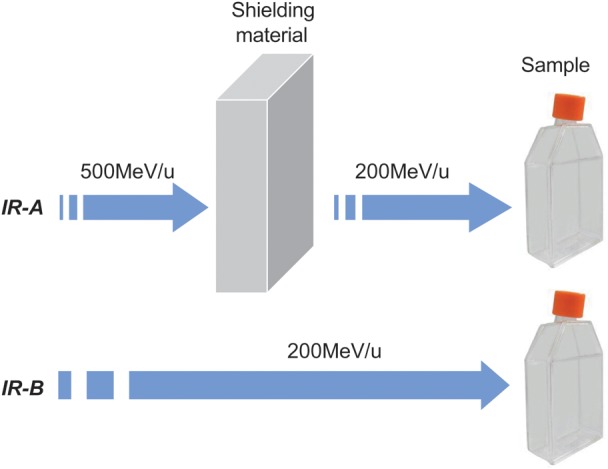
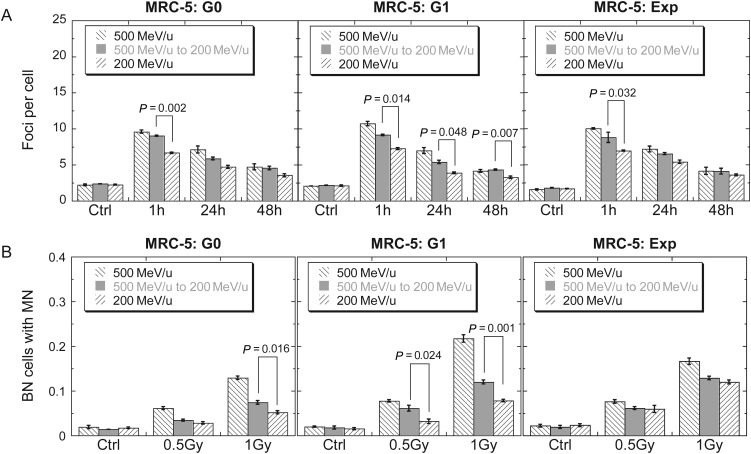
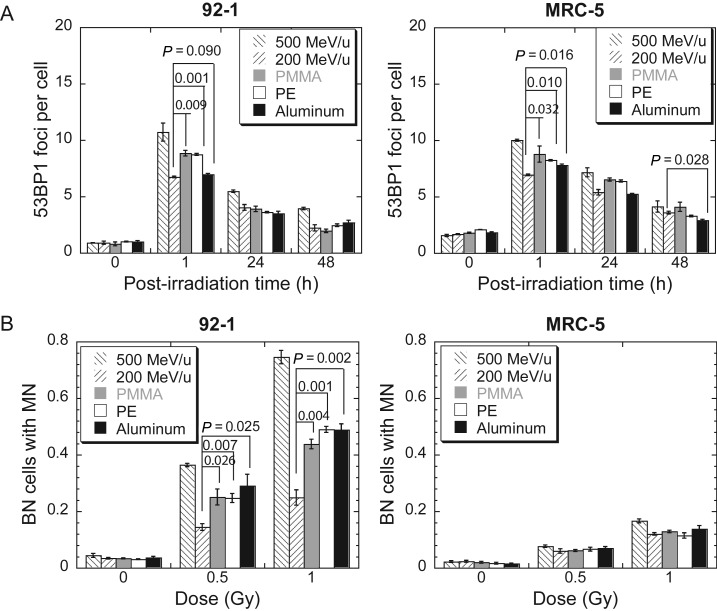
High atomic number and high-energy (HZE) particles in deep space are of low abundance but substantially contribute to the biological effects of space radiation. Shielding is so far the most effective way to partially protect astronauts from these highly penetrating particles. However, simulated calculations and measurements have predicted that secondary particles resulting from the shielding of cosmic rays produce a significant fraction of the total dose and dose equivalent. In this study, we investigated the biological effects of secondary radiation with two cell types, and with cells exposed in different phases of the cell cycle, by comparing the biological effects of a 200 MeV/u iron beam with a shielded beam in which the energy of the iron ion beam was decreased from 500 MeV/u to 200 MeV/u with PMMA, polyethylene (PE), or aluminum. We found that beam shielding resulted in increased induction of 53BP1 foci and micronuclei in a cell-type-dependent manner compared with the unshielded 200 MeV/u Fe ion beam. These findings provide experimental proof that the biological effects of secondary particles resulting from the interaction between HZE particles and shielding materials should be considered in shielding design.
Keywords: DNA damage; secondary particles; shielding; space radiation; survival.
Figures
References
-
- Durante M, Cucinotta FA. Heavy ion carcinogenesis and human space exploration. Nat Rev Cancer. 2008;8:465–72. - PubMed
-
- Sutherland BM, Bennett PV, Cintron-Torres N, et al. Clustered DNA damages induced in human hematopoietic cells by low doses of ionizing radiation. J Radiat Res. 2002;43(S):149–52. - PubMed
-
- Hada M, Georgakilas AG. Formation of clustered DNA damage after high-LET irradiation: a review. J Radiat Res. 2008;49:203–10. - PubMed
-
- Yatagai F. Mutations induced by heavy charged particles. Uchu Seibutsu Kagaku. 2004;18:224–34. - PubMed
Publication types
MeSH terms
Substances
LinkOut - more resources
Full Text Sources
Other Literature Sources
Research Materials
Miscellaneous
