


Polygenic transmission and complex neuro developmental network for attention deficit hyperactivity disorder: genome-wide association study of both common and rare variants
- PMID: 23728934
- PMCID: PMC4321789
- DOI: 10.1002/ajmg.b.32169
Polygenic transmission and complex neuro developmental network for attention deficit hyperactivity disorder: genome-wide association study of both common and rare variants
Abstract
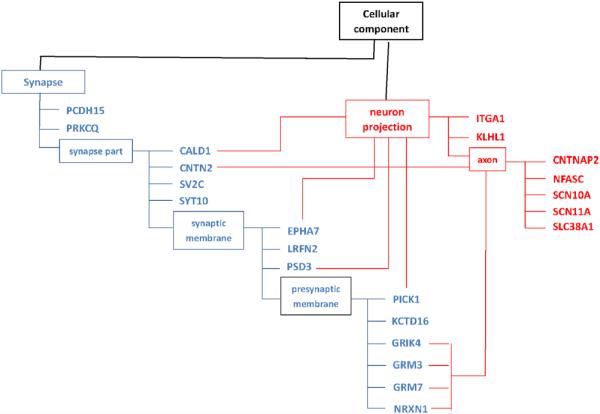
Attention-deficit hyperactivity disorder (ADHD) is a complex polygenic disorder. This study aimed to discover common and rare DNA variants associated with ADHD in a large homogeneous Han Chinese ADHD case-control sample. The sample comprised 1,040 cases and 963 controls. All cases met DSM-IV ADHD diagnostic criteria. We used the Affymetrix6.0 array to assay both single nucleotide polymorphisms (SNPs) and copy number variants (CNVs). Genome-wide association analyses were performed using PLINK. SNP-heritability and SNP-genetic correlations with ADHD in Caucasians were estimated with genome-wide complex trait analysis (GCTA). Pathway analyses were performed using the Interval enRICHment Test (INRICH), the Disease Association Protein-Protein Link Evaluator (DAPPLE), and the Genomic Regions Enrichment of Annotations Tool (GREAT). We did not find genome-wide significance for single SNPs but did find an increased burden of large, rare CNVs in the ADHD sample (P = 0.038). SNP-heritability was estimated to be 0.42 (standard error, 0.13, P = 0.0017) and the SNP-genetic correlation with European Ancestry ADHD samples was 0.39 (SE 0.15, P = 0.0072). The INRICH, DAPPLE, and GREAT analyses implicated several gene ontology cellular components, including neuron projections and synaptic components, which are consistent with a neurodevelopmental pathophysiology for ADHD. This study suggested the genetic architecture of ADHD comprises both common and rare variants. Some common causal variants are likely to be shared between Han Chinese and Caucasians. Complex neurodevelopmental networks may underlie ADHD's etiology.
Copyright © 2013 Wiley Periodicals, Inc.
Figures
References
-
- Barkley RA. Attention-deficit hyperactivity disorder: A handbook for diagnosis and treatment. xii. Guilford Press; New York: 1998. p. 628.
-
- Cherlyn SY, Woon PS, Liu JJ, Ong WY, Tsai GC, Sim K. Genetic association studies of glutamate, GABA and related genes in schizophrenia and bipolar disorder: A decade of advance. Neurosci Biobehav Rev. 2010;34(6):958–977. - PubMed
-
- Dalvie S, Horn N, Nossek C, van der Merwe L, Stein DJ, Ramesar R. Psychosis and relapse in bipolar disorder are related to GRM3, DAOA, and GRIN2B genotype. Afr J Psychiatry (Johannesbg) 2010;13(4):297–301. - PubMed
-
- Doherty JL, O'Donovan MC, Owen MJ. Recent genomic advances in schizophrenia. Clin Genet. 2012;81(2):103–109. - PubMed
Publication types
MeSH terms
Grants and funding
- R01MH58277/MH/NIMH NIH HHS/United States
- R01 MH058277/MH/NIMH NIH HHS/United States
- R13MH059126/MH/NIMH NIH HHS/United States
- R01 MH081803/MH/NIMH NIH HHS/United States
- R01MH62873/MH/NIMH NIH HHS/United States
- MOP 44070/CAPMC/ CIHR/Canada
- MOP 64277/CAPMC/ CIHR/Canada
- P30 HD004612/HD/NICHD NIH HHS/United States
- U01MH085515/MH/NIMH NIH HHS/United States
- WT_/Wellcome Trust/United Kingdom
- K23MH066275-01/MH/NIMH NIH HHS/United States
- U01MH085518/MH/NIMH NIH HHS/United States
- G9810900/MRC_/Medical Research Council/United Kingdom
- MOP 74699/CAPMC/ CIHR/Canada
- U01 MH085518/MH/NIMH NIH HHS/United States
- R01MH081803/MH/NIMH NIH HHS/United States
- R01 MH062873/MH/NIMH NIH HHS/United States
- U01 MH085515/MH/NIMH NIH HHS/United States
- R13 MH059126/MH/NIMH NIH HHS/United States
- K23 MH066275/MH/NIMH NIH HHS/United States
LinkOut - more resources
Full Text Sources
Other Literature Sources
Medical
Miscellaneous
