. 2013 Aug;94(2):377-83.
doi: 10.1189/jlb.0912441. Epub 2013 May 31.

Regulatory T cell epitopes (Tregitopes) in IgG induce tolerance in vivo and lack immunogenicity per se

Affiliations

Regulatory T cell epitopes (Tregitopes) in IgG induce tolerance in vivo and lack immunogenicity per se

Yan Su et al. J Leukoc Biol. 2013 Aug.

Abstract

Tregitopes are a set of epitopes, derived from IgG, that bind to MHCII, activate nTregs, and promote tolerance. We have now confirmed that coadministration of Tregitopes with a range of proteins (autoantigens and nominal antigens, such as OVA) in vitro and in vivo leads to suppression of T cell and antibody responses to the test antigens. In this study, we demonstrate that Tregitopes are not immunogenic in vivo even when emulsified with strong adjuvants, such as IFA or CFA. Moreover, in vivo administration of Tregitopes with IFA or CFA does not induce Th1 or Th2 cytokine expression under restimulation conditions in vitro. We investigated tolerance induction by codelivering Tregitopes with OVA using B cells. When B cells were pulsed with OVA plus Tregitopes and transferred into naïve mice, we found that cellular and humoral immune responses to the OVA were suppressed. As a result of their ability to induce Tregs and the absence of immunogenicity in the context of strong adjuvants, Tregitopes might be considered a novel immunomodulatory approach for the suppression of immune responses to protein therapeutics (such as FVIII and mAb), as well as for treatment of autoimmune diseases.

Keywords: IVIg; Treg; immunomodulation.


Figures
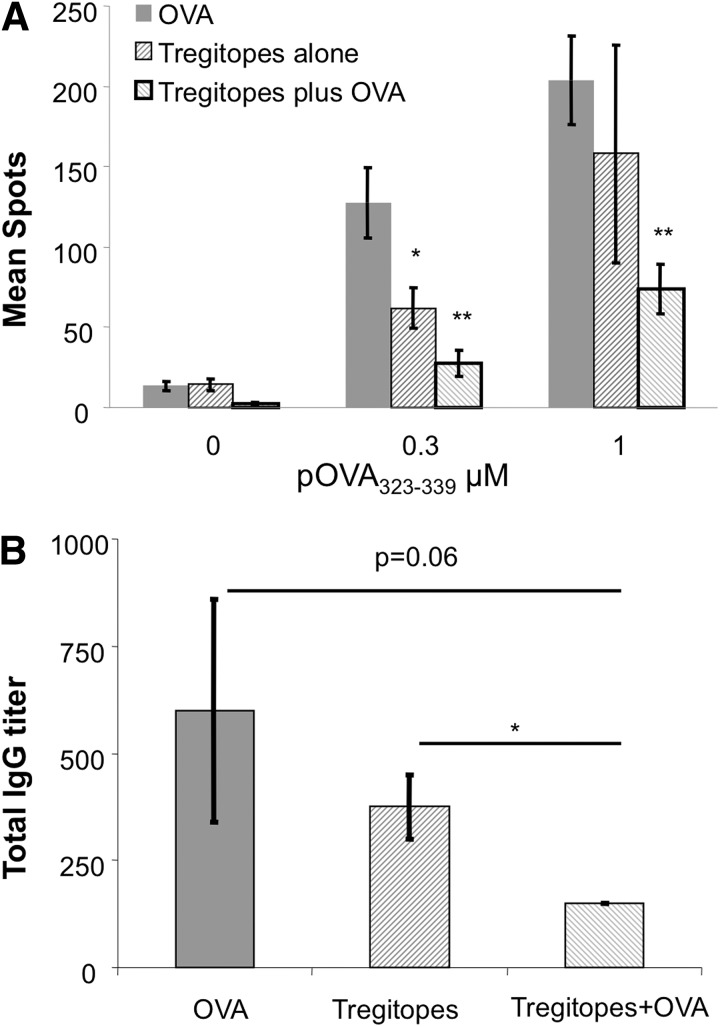
Figure 1.
Figure 1.. Tregitopes/OVA-pulsed B cells reduce anti-OVA response in vivo.
(A) LPS-activated C57BL/6 B cells were pulsed with Tregitopes, OVA protein, or Tregitopes plus OVA protein in vitro, and then 107-treated B cells were transferred into naïve C57BL/6 recipients. On Day 7 postinjection, animals were immunized in a hind footpad and the base of tail with 25 μg OVA323–339 peptide (pOVA323–339) emulsified in CFA. Two weeks postimmunization, animals were killed, and draining LNs were removed. T cell proliferation was assayed by measuring IFN-γ production by Elispot. Cells were incubated for 48 h with indicated concentrations of OVA323–339 peptide. Data represent mean spots ± se for four animals. This is a representative of two independent experiments (**P<0.01; *P≤0.05). (B) Treatment is same as A. Sera were collected 2 weeks after immunization and analyzed by ELISA, and ELISA plates were coated with 10 μg/ml OVA protein. Data represent mean anti-IgG titers ± se for four animals.
Figure 2.
Figure 2.. Tregitopes elicit a low or nonexistent immune response in vivo.
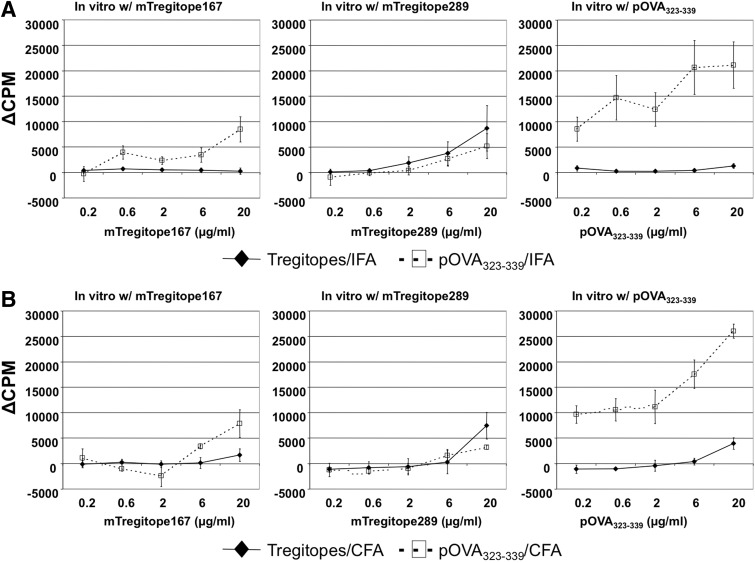
Tregitopes (mixture of mTregitope167 and mTregitope289) or OVA323–339 peptide were emulsified with IFA (A) or CFA (B) and then injected in one footpad of C57BL/6 mice. Two weeks later, draining popliteal and inguinal LNs were removed and assayed for T cell proliferation by [3H] thymidine incorporation. Cells (5×10⁵) were seeded/well in 96-well plates in the presence of mTregitope167, mTregitope289, or OVA323–339 peptide. Forty-eight hours later, cells were pulsed with 1 μg/ml [3H] thymidine and cultured for another 16–20 h. Data represent mean Δcpm ± se for four animals. This is a representative of two independent experiments.
Figure 3.
Figure 3.. Tregitopes have a low or no immunogenicity in BALB/c mice.
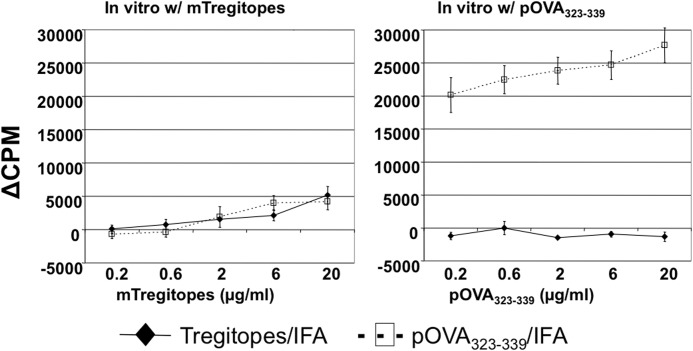
BALB/c mice were treated with IFA-emulsified Tregitopes (mixture of mTregitope167 and mTregitope289) or OVA323–339 peptide. Two weeks later, T cell proliferation assay was performed (same as in Fig. 2). Cells (5×10⁵) were seeded/well in 96-well plates in the presence of mTregitope167/mTregitope289 or OVA323–339 peptide. Forty-eight hours later, cells were pulsed with 1 μg/ml [3H] thymidine and cultured for another 16–20 h. Data represent mean Δcpm ± se for four animals. This is a representative of two independent experiments.
Figure 4.
Figure 4.. Tregitopes elicit low or no Th1 and Th2 cytokine production.
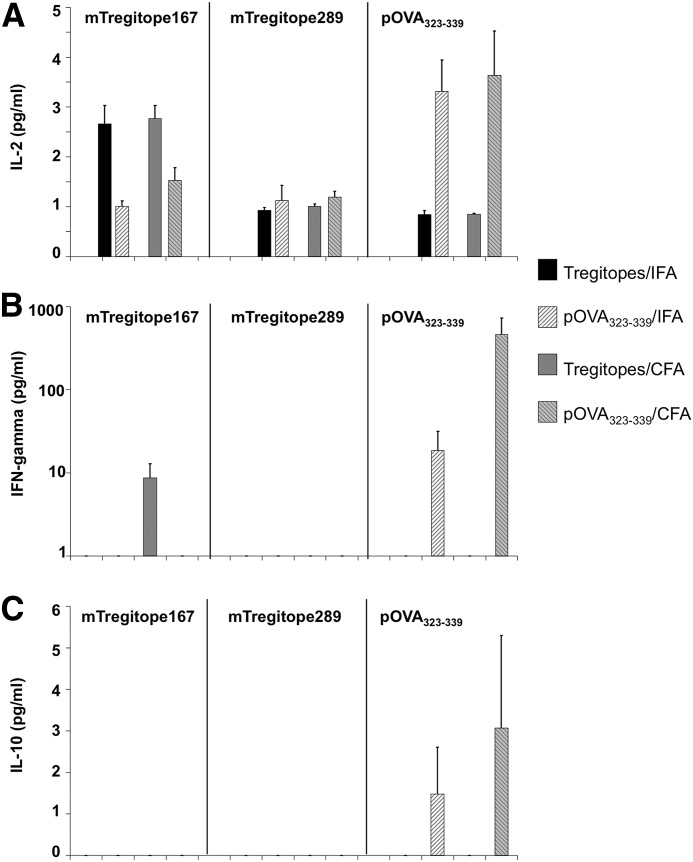
Mice were treated as described in Fig. 2. Supernatants were collected from 2 μg/ml antigen-treated cells after 48 h cell culture. Samples were examined for the production of IL-2 (A), IFN-γ (B), and IL-10 (C) and IL-4, IL-5, IL-6, IL-12p40, and TGF-β (data not shown). Data represent mean concentration ± se for four animals. This is a representative of two similar experiments.
Figure 5.
Figure 5.. Tregitopes have a modest effect on the expression of T-bet mRNA.
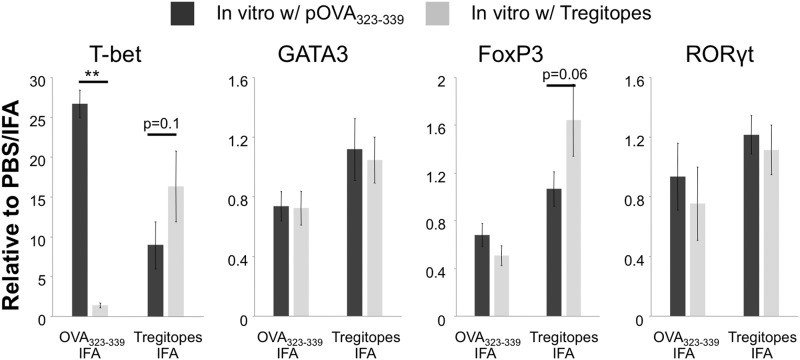
C57BL/6 mice were immunized with Tregitopes (mixture of mTregitope167 and mTregitope289; n=5), OVA323–339 peptide (n=4), or PBS (n=1) in IFA. Two weeks later, draining popliteal and inguinal LNs were removed, and cells were cultured with a mixture of Tregitopes or OVA323–339 peptide. Forty-eight hours later, RNA samples were extracted for detecting the expression of T-bet, GATA-3, RORγt, and Foxp3. Individual samples were normalized to the detected Ct values of control gene GADPH, and data were presented as the relative expression to the PBS/IFA control. Data represent mean ± se. This is a representative of two similar experiments (**P<0.01).

References

    1. Bluestone J. A., Abbas A. K. (2003) Natural versus adaptive regulatory T cells. Nat. Rev. Immunol. 3, 253–257 - PubMed
    1. Tang Q., Bluestone J. A. (2008) The Foxp3+ regulatory T cell: a jack of all trades, master of regulation. Nat. Immunol. 9, 239–244 - PMC - PubMed
    1. Gambineri E., Torgerson T. R., Ochs H. D. (2003) Immune dysregulation, polyendocrinopathy, enteropathy, and X-linked inheritance (IPEX), a syndrome of systemic autoimmunity caused by mutations of FOXP3, a critical regulator of T-cell homeostasis. Curr. Opin. Rheumatol. 15, 430–435 - PubMed
    1. Malek T. R., Yu A., Vincek V., Scibelli P., Kong L. (2002) CD4 regulatory T cells prevent lethal autoimmunity in IL-2Rβ-deficient mice. Implications for the nonredundant function of IL-2. Immunity 17, 167–178 - PubMed
    1. Kim J. M., Rasmussen J. P., Rudensky A. Y. (2007) Regulatory T cells prevent catastrophic autoimmunity throughout the lifespan of mice. Nat. Immunol. 8, 191–197 - PubMed

Publication types