Review
doi: 10.1101/cshperspect.a012567.
Ancient DNA damage
Affiliations
- PMID: 23729639
- PMCID: PMC3685887
- DOI: 10.1101/cshperspect.a012567
Item in Clipboard
Review
Ancient DNA damage
Cold Spring Harb Perspect Biol.
.
Abstract
Under favorable conditions DNA can survive for thousands of years in the remains of dead organisms. The DNA extracted from such remains is invariably degraded to a small average size by processes that at least partly involve depurination. It also contains large amounts of deaminated cytosine residues that are accumulated toward the ends of the molecules, as well as several other lesions that are less well characterized.
Figures
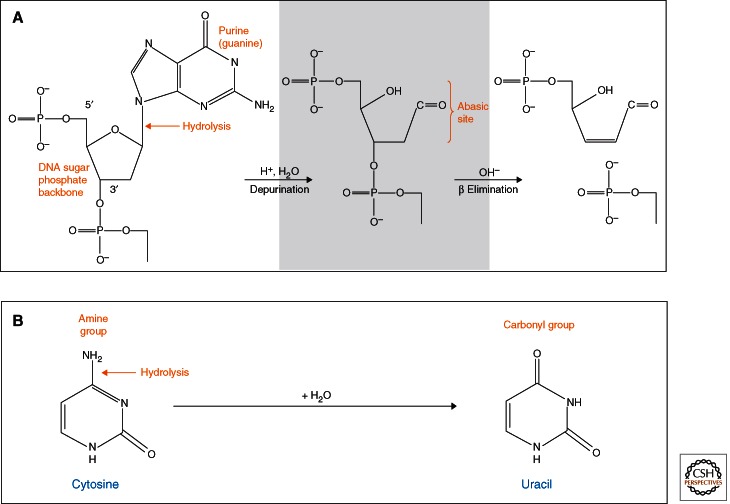
Fragmentation and deamination. (A) A likely cause of fragmentation in ancient DNA is depurination, in which the N-glycosyl bond between a sugar and an adenine or guanine residue is cleaved, resulting in an abasic site. The DNA strand is then fragmented through β elimination, leaving 3′-aldehydic and 5′-phosphate ends. (B) Deamination of cytosine to uracil is the major mechanism leading to miscoding lesions in ancient DNA. DNA polymerases will incorporate an A across from the U, and in turn a T across from the A, causing apparent G to A and C to T substitutions.
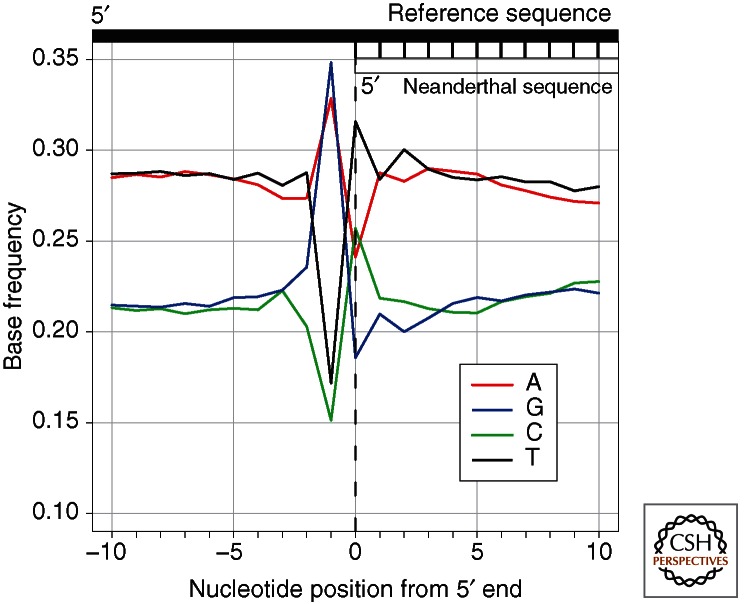
Base frequencies of the human reference genome around 5′ ends of Neanderthal DNA fragments. An excess of A and G immediately outside of the Neanderthal sequence indicates that an elevated number of DNA fragments begin adjacent to purines, supporting the hypothesis that depurination is a major mechanism of fragmentation of ancient DNA.
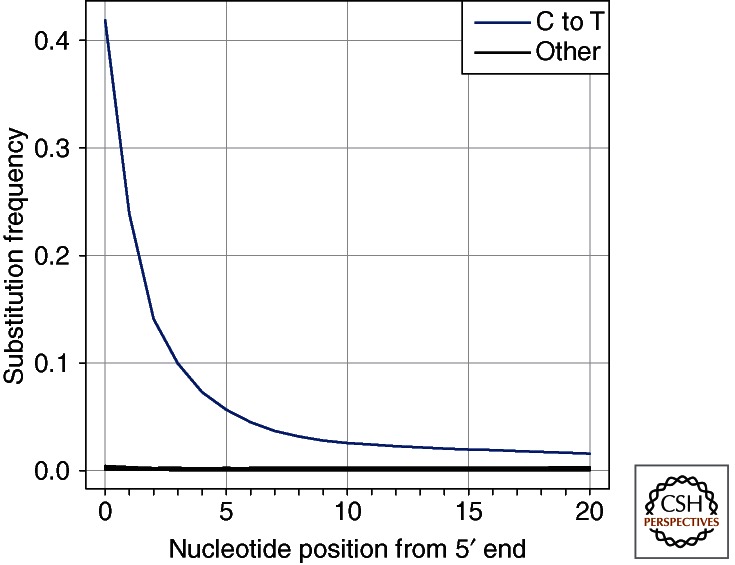
Nucleotide substitution frequencies at the 5′ end of Neanderthal sequences. The frequencies of all possible differences to the human reference genome sequence are plotted in relation to their location in Neanderthal DNA sequences. Cytosine to thymine substitutions are the most frequent, and they occur most often at ends of molecule. All remaining nucleotide substitutions are indicated by the black line.
References
-
- Binladen J, Willerslev E 2010. Why study ancient DNA damage? J Nordic Archaeol Sci 14: 11–14
Publication types
MeSH terms
Substances
LinkOut - more resources
Full Text Sources
Other Literature Sources