. 2013 Feb 6:(264):11-45.
doi: 10.3897/zookeys.264.4440. Print 2013.

Cryptic species within cryptic moths: new species of Dunama Schaus (Notodontidae, Nystaleinae) in Costa Rica

Affiliations

Cryptic species within cryptic moths: new species of Dunama Schaus (Notodontidae, Nystaleinae) in Costa Rica

Isidro A Chacón et al. Zookeys. .

Abstract

Based on almost 1,700 recently reared and wild-collected specimens, the genus Dunama Schaus (Notodontidae, Nystaelinae) in Costa Rica is reviewed. Eight species are recorded of which seven are newly described: Dunama jessiehillae Chacón, Dunama jessiebarronae Chacón, Dunama janewaldronae Chacón, Dunama jessiebancroftae Chacón, Dunama janecoxae Chacón, Dunama biosise Chacón, Dunama indereci Chacón. Dunama angulinea Schaus is redescribed and associated with its correct genitalia. Dunama tuna (Schaus), previously listed as ocurring in Costa Rica, is restricted to Colombia. Most species are described through their distinctive CO1 barcodes, genitalia and life histories. Dunama adults and caterpillars, their foodplants, and their parasites in Area de Conservación Guanacaste (ACG) in northwestern Costa Rica are described where known. Many life history stages are illustrated.

Keywords: Area de Conservacion Guanacaste; Arecaceae; DNA barcodes; Dunama; Heliconia; INBio; Musa; caterpillars; inventory; moths; tropical forest.


Figures

Figures 1–6.
Figures 1–6.
Dunama angulinea 1, 2 Male Holotype dorsal and ventral Type # 17505 USNM 3 Male Holotype labels 4 Male genitalia 5 Male St8 6 Phallus.
Figures 7–14.
Figures 7–14.
Dunama jessiehillae 7, 8 Male dorsal and ventral 99-SRNP-4120 9, 10 Female dorsal and ventral 04-SRNP-42836 11 Male St8 12 Male genitalia99-SRNP-4120 13 Phallus 14 Female genitalia04-SRNP-42836.
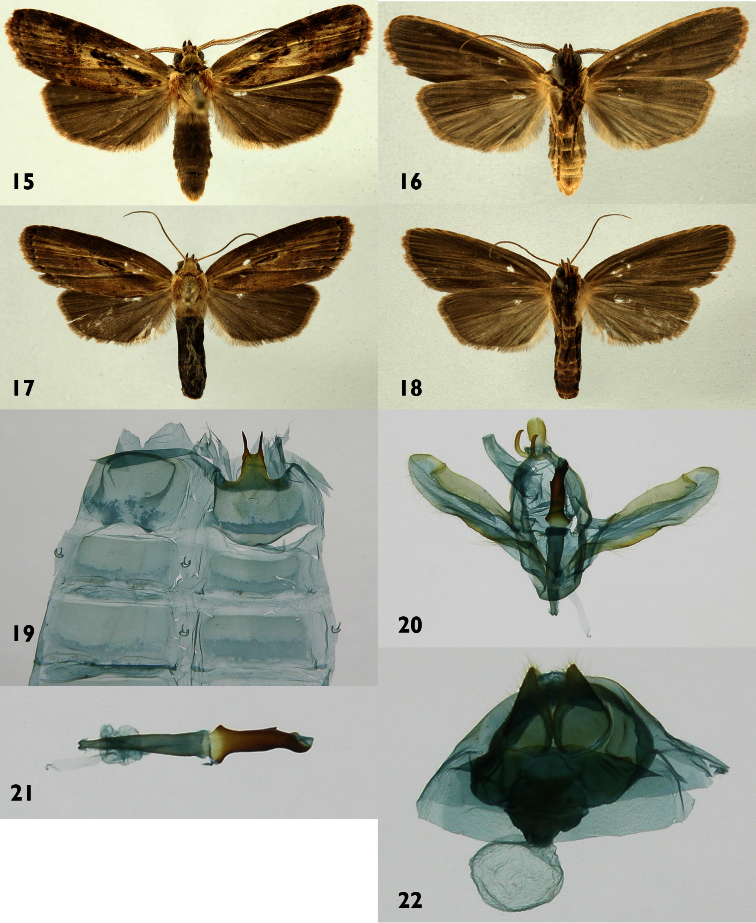
Figures 15–22.
Figures 15–22.
Dunama jessiebarronae 15, 16 Male dorsal and ventral 04-SRNP-4063 17, 18 Female dorsal and ventral 04-SRNP-4060 19 Male St8 20 Male genitalia 04-SRNP-4063 21 Phallus 22 Female genitalia04-SRNP-4060.
Figures 23–30.
Figures 23–30.
Dunama janewaldronae 23, 24 Male dorsal and ventral 08-SRNP-430 25, 26 Female dorsal and ventral 00-SRNP-21518 27 Male St8 28 Male genitalia 08-SRNP-430 29 Phallus 30 Female genitalia 00-SRNP-21518.
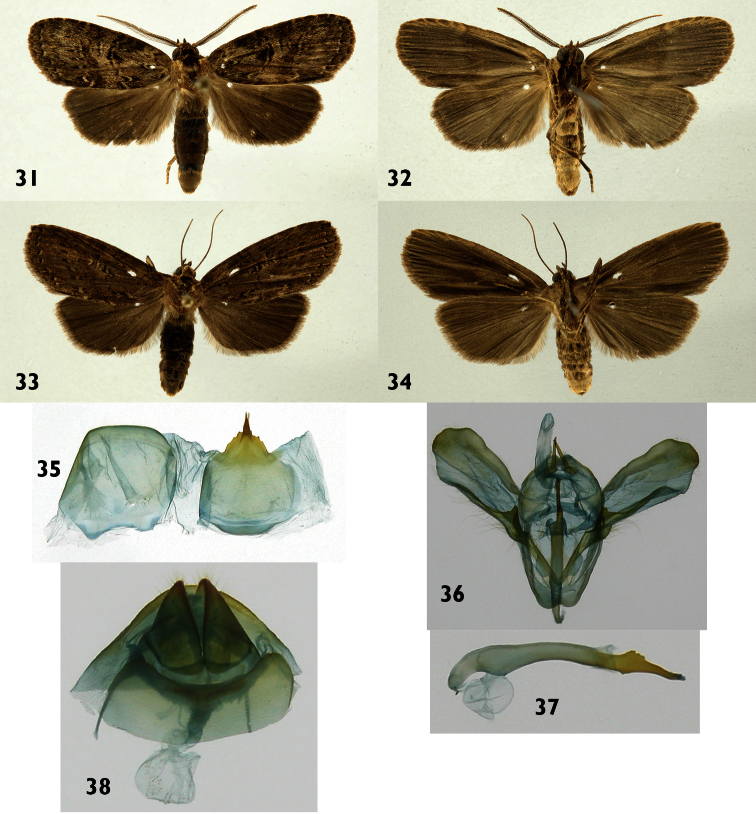
Figures 31–38.
Figures 31–38.
Dunama jessiebancroftae 31, 32 Male dorsal and ventral 09-SRNP-56330 33, 34 female dorsal and ventral 06-SRNP-36773 35 Male St8 36 Male genitalia 09-SRNP-56330 37 Phallus 38 Female genitalia 06-SRNP-36773.
Figures 39–46.
Figures 39–46.
Dunama janecoxae 39, 40 Male dorsal and ventral 03-SRNP-36040 41, 42 Female dorsal and ventral 03-SRNP-3223 43 Male St8 44 Male genitalia 03-SRNP-36040 45 Phallus 46 Female genitalia 03-SRNP-3223.
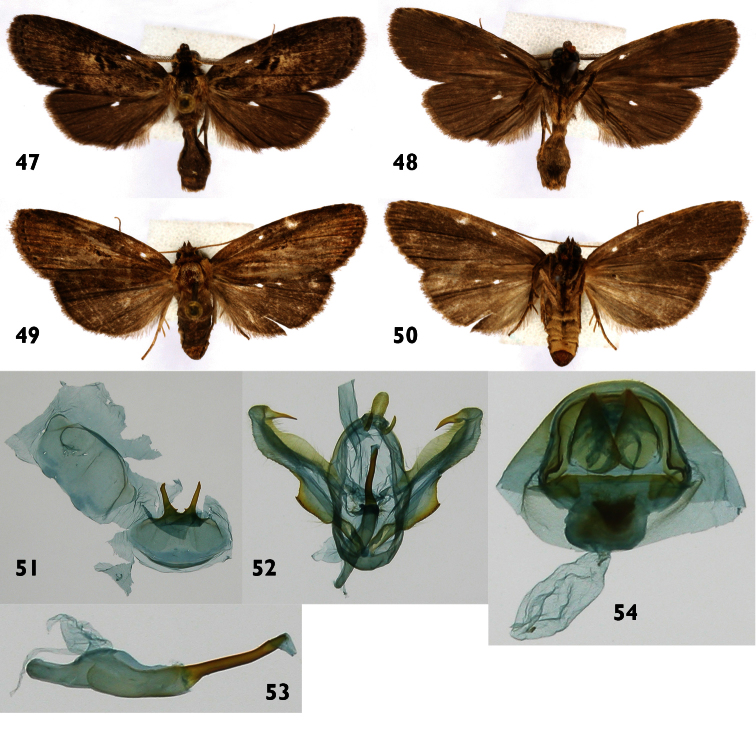
Figures 47–54.
Figures 47–54.
Dunama biosise 47, 48 Male dorsal and ventral INB0003558870 49, 50 Female dorsal and ventral INBIOCRI002527271 51 Male St8 52 Male genitalia INB0003558870 53 Phallus 54 Female genitalia INBIOCRI002527271.
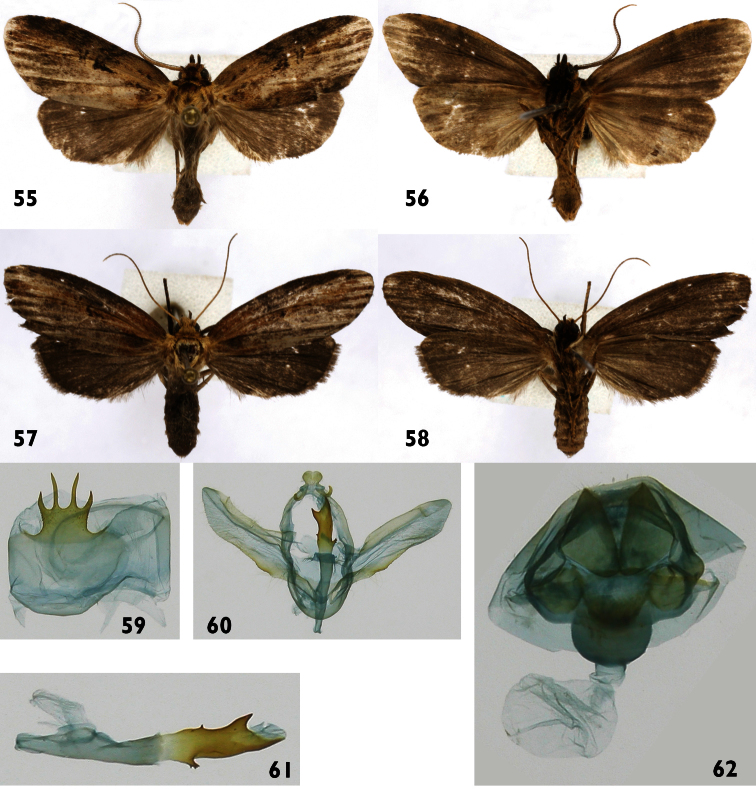
Figures 55–62.
Figures 55–62.
Dunama indereci 55, 56 Male dorsal and ventral INB0004251736 57, 58 Female dorsal and ventral INB0004251730 59 Male St8 60 Male genitalia INB0004251736 61 Phallus 62 Female genitalia INB0004251730.
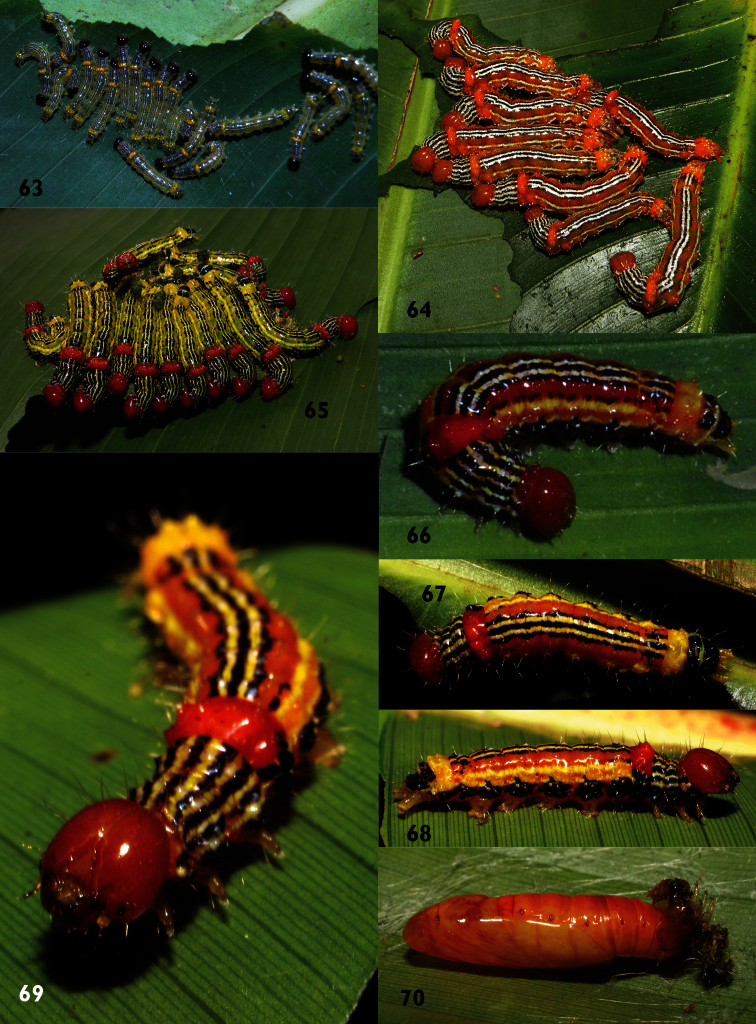
Figures 63–70.
Figures 63–70.
Instars of Dunama indereci and Dunama jessiebarronae on food plants Musa and Heliconia 63 Intermediate instar Dunama indereci 64 Last instar Dunama indereci 65 Penultimate instar Dunama jessiebarronae 66–69 Last instar Dunama jessiebarronae 06-SRNP-40360 70 Pupa of Dunama jessiebarronae 06-SRNP-40401.
Figures 71–84.
Figures 71–84.
Instars of Dunamaon food plant (Arecaceae) 71–73 Last instar Dunama janecoxae 03-SRNP-3122 74 Eggs of Dunama jessiehillae 75–77 Last instar of Dunama janewaldronae 02-SRNP-6497 78 Pupa of Dunama janewaldronae 09-SRNP-40001 79 Penultimate instar Dunama jessiehillae 00-SRNP-11377 80 Last instar Dunama jessiehillae 99-SRNP-4114 81 Prepupa of Dunama jessiehillae 06-SRNP-4940 82–84 Last instar Dunama jessiebancroftae 09-SRNP-56324.
Figure 85.
Figure 85.
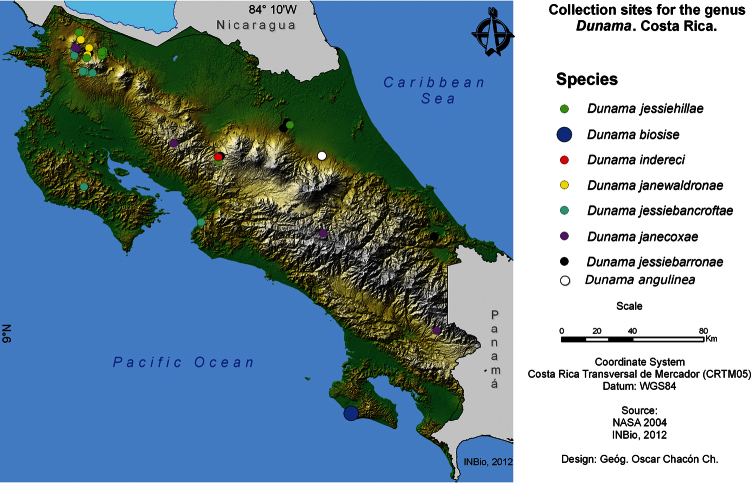
Map of Costa Rican collection sites for the eight species of Dunama (Notodontidae) discussed here.
Figure 86.
Figure 86.
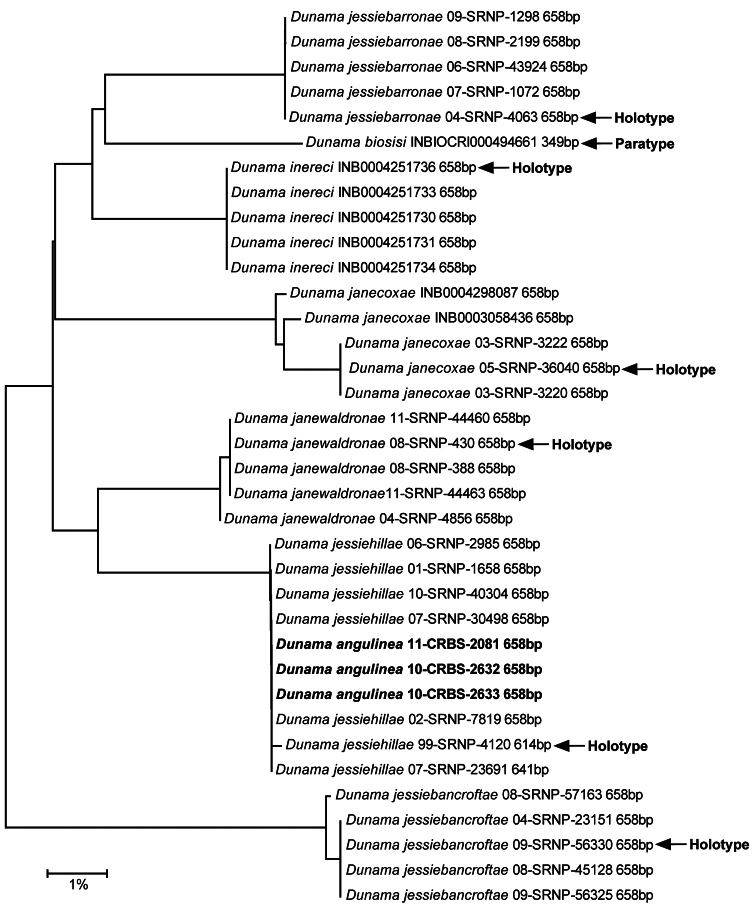
The Dunama species from Costa Rica in an NJ barcoding tree. Sample sizes are restricted to a haphazardly selected set of five specimens for each species. Many specimens were reared from wildcaught caterpillars and further information on each can be found at Janzen and Hallwachs (2012).

References

    1. Burns JM, Janzen DH, Hajibabaei M, Hallwachs W, Hebert PDN. (2007) DNA barcodes of closely related (but morphologically and ecologically distinct) species of skipper butterflies (Hesperiidae) can differ by only one to three nucleotides. Journal of the Lepidopterists’ Society 61: 138-153.
    1. Burns JM, Janzen DH, Hajibabaei M, Hallwachs W, Hebert PDN. (2008) DNA barcodes and cryptic species of skipper butterflies in the genus Perichares in Area de Conservación Guanacaste, Costa Rica. Proceedings of the National Academy of Sciences 105: 6350-6355. doi: 10.1073/pnas.0712181105 - DOI - PMC - PubMed
    1. Dognin P. (1914) Hétérocères nouveaux de l’Amérique du Sud. Fascicule 7: 1–32. Oberthür, Rennes.
    1. Dognin P. (1916) Hétérocères nouveaux de l’Amérique du Sud. Fascicule 12: 1–34. Oberthür, Rennes.
    1. Draudt M. (1932) Die Amerikanischen Spinner und Schwämer. Vol. 6. In: Seitz A (1913–1940) Die Gross-Schmetterlinge der Erde. Die Gross-Schmetterlinge des Amerikanischen Faunengebietes. Alfred Kernen, Stuttgard, 358 pp.

LinkOut - more resources