. 2013 May 17:4:121.
doi: 10.3389/fmicb.2013.00121. eCollection 2013.

Rise and dissemination of aminoglycoside resistance: the aac(6')-Ib paradigm

Affiliations

Rise and dissemination of aminoglycoside resistance: the aac(6')-Ib paradigm

María S Ramirez et al. Front Microbiol. .

Abstract

Enzymatic modification is a prevalent mechanism by which bacteria defeat the action of antibiotics. Aminoglycosides are often inactivated by aminoglycoside modifying enzymes encoded by genes present in the chromosome, plasmids, and other genetic elements. The AAC(6')-Ib (aminoglycoside 6'-N-acetyltransferase type Ib) is an enzyme of clinical importance found in a wide variety of gram-negative pathogens. The AAC(6')-Ib enzyme is of interest not only because of his ubiquity but also because of other characteristics, it presents significant microheterogeneity at the N-termini and the aac(6')-Ib gene is often present in integrons, transposons, plasmids, genomic islands, and other genetic structures. Excluding the highly heterogeneous N-termini, there are 45 non-identical AAC(6')-Ib related entries in the NCBI database, 32 of which have identical name in spite of not having identical amino acid sequence. While some variants conserved similar properties, others show dramatic differences in specificity, including the case of AAC(6')-Ib-cr that mediates acetylation of ciprofloxacin representing a rare case where a resistance enzyme acquires the ability to utilize an antibiotic of a different class as substrate. Efforts to utilize antisense technologies to turn off expression of the gene or to identify enzymatic inhibitors to induce phenotypic conversion to susceptibility are under way.

Keywords: acetyltransferase; aminoglycoside; antibiotic resistance; inhibition; integron; mobile elements; transposon.


Figures
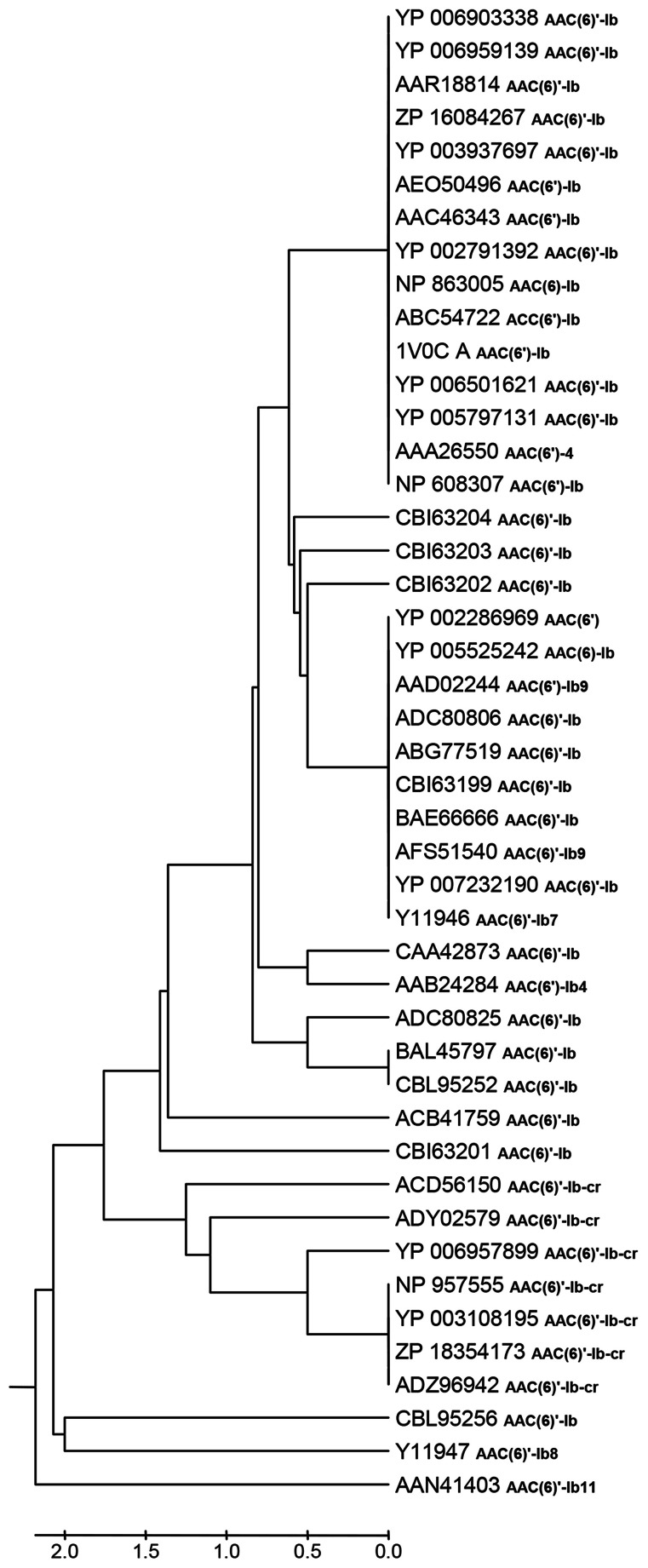
Figure 1
Figure 1
UPGMA clustering analyses of 45 AAC(6′)-Ib protein sequences. The optimal tree with the sum of branch length = 20.70628249 is shown. The evolutionary distances were computed using the number of differences method and are in the units of the number of amino acid differences per sequence. All positions containing gaps and missing data were eliminated. There were a total of 181 positions in the final dataset. Evolutionary analyses were conducted in MEGA5.
Figure 2
Figure 2
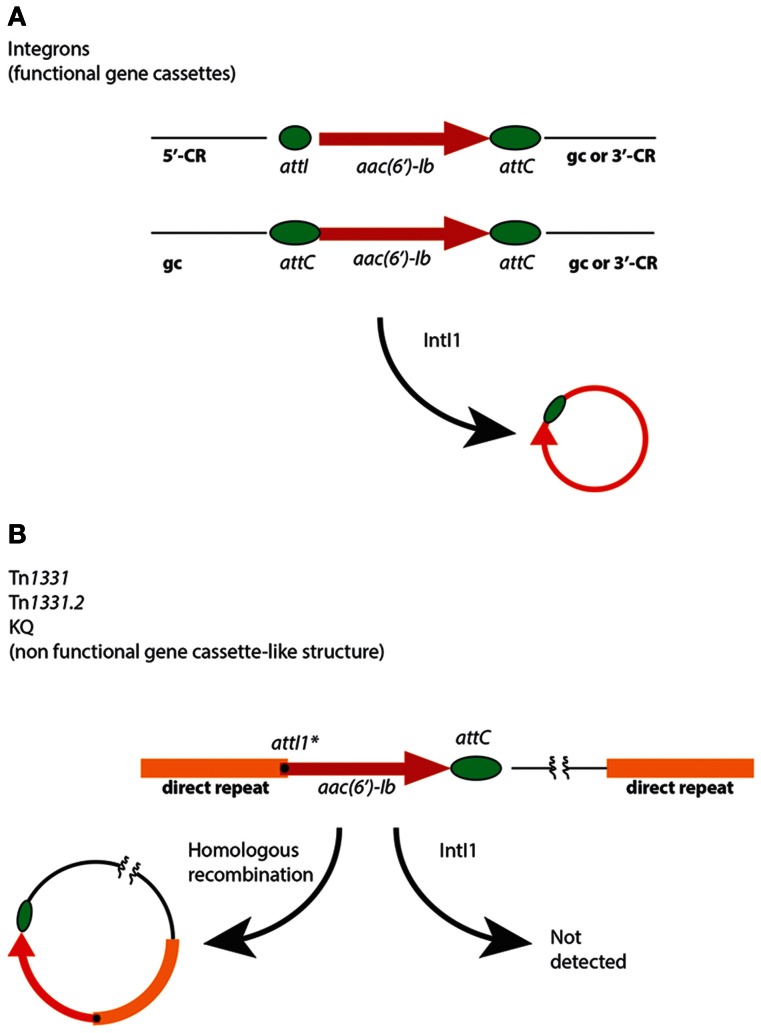
Mobilization of aac(6′)-Ib. (A) Generic genetic maps of integrons in which an aac(6′)-Ib gene cassette is located immediately following the 5′ conserved region (5′-CR) (top map) or following one or more gene cassettes (gc) inside the variable portion, and followed by other gene cassettes or the 3′ conserved region (3′-CR) (bottom map). The small green ellipse represents attI and the big green ellipses represent attC. (B) Relevant portion of the Tn1331, Tn1331.2, and KQ elements (Tolmasky and Crosa, ; Tolmasky et al., ; Sarno et al., ; Rice et al., 2008). For clarity Tn1332, which has a more complicated structure in its direct repeats (Poirel et al., 2006), is not shown, but it could experience mobilization by homologous recombination as shown. The black dot represents attI1*. The homologous recombination pathway for generation of an aac(6′)-Ib-containing circular molecule has been proposed by Zong et al. (2009).

References

    1. Avent M. L., Rogers B. A., Cheng A. C., Paterson D. L. (2011). Current use of aminoglycosides: indications, pharmacokinetics and monitoring for toxicity. Intern. Med. J. 41, 441–449 10.1111/j.1445-5994.2011.02452.x - DOI - PubMed
    1. Bakker E. P. (1992). Aminoglycoside and aminocyclitol antibiotics: hygromycin B is an atypical bactericidal compound that exerts effects on cells of Escherichia coli characteristics for bacteriostatic aminocyclitols. J. Gen. Microbiol. 138, 563–569 - PubMed
    1. Belousoff M. J., Graham B., Spiccia L., Tor Y. (2009). Cleavage of RNA oligonucleotides by aminoglycosides. Org. Biomol. Chem. 7, 30–33 10.1039/b813252f - DOI - PubMed
    1. Bidou L., Allamand V., Rousset J. P., Namy O. (2012). Sense from nonsense: therapies for premature stop codon diseases. Trends Mol. Med. 18, 679–688 10.1016/j.molmed.2012.09.008 - DOI - PubMed
    1. Boehr D. D., Draker K. A., Koteva K., Bains M., Hancock R. E., Wright G. D. (2003). Broad-spectrum peptide inhibitors of aminoglycoside antibiotic resistance enzymes. Chem. Biol. 10, 189–196 10.1016/S1074-5521(03)00026-7 - DOI - PubMed