


Effect of allopurinol on blood pressure: a systematic review and meta-analysis
- PMID: 23730993
- PMCID: PMC8033809
- DOI: 10.1111/j.1751-7176.2012.00701.x
Effect of allopurinol on blood pressure: a systematic review and meta-analysis
Abstract
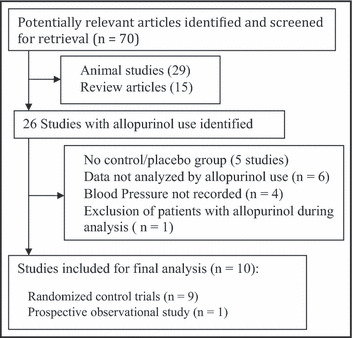
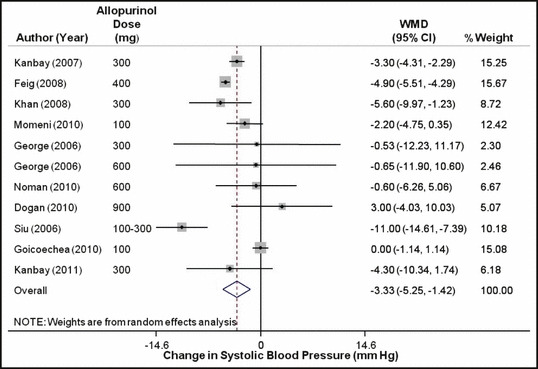
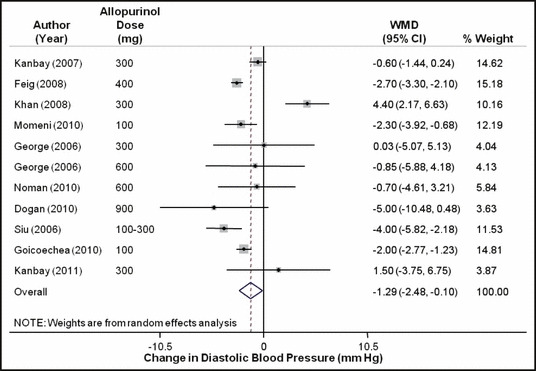
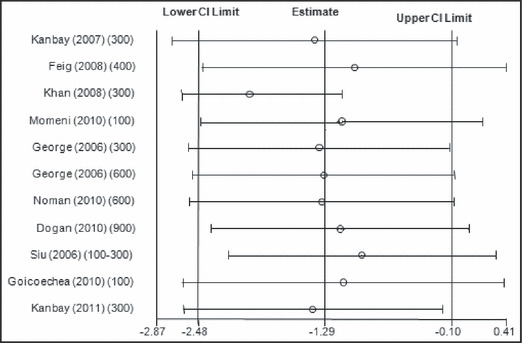
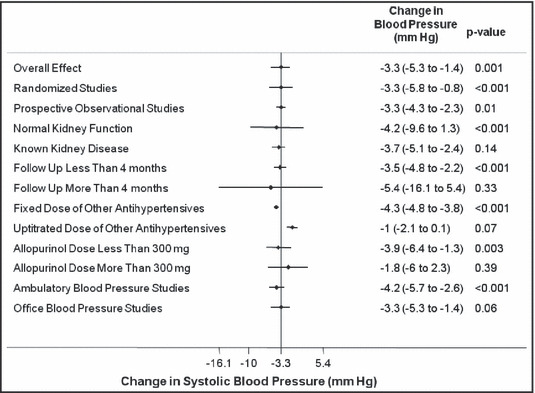
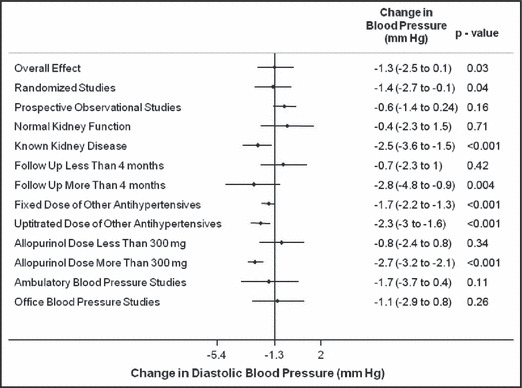
Allopurinol is a potent xanthine oxidase inhibitor that is used in hyperuricemic patients to prevent gout. It has also been shown to decrease cardiovascular complications in a myriad of cardiovascular conditions. However, studies have reported conflicting evidence on its effects on blood pressure (BP). A systematic review was conducted using Medline, PubMed, Embase, and the Cochrane Library for all the longitudinal studies that assessed the efficacy of allopurinol on systolic and diastolic BP. A total of 10 clinical studies with 738 participants were included in the analysis. Compared with the control group, systolic BP decreased by 3.3 mm Hg (95% confidence interval [CI], 1.4-5.3 mm Hg; P=.001) and diastolic BP decreased by 1.3 mm Hg (95% CI, 0.1-2.5 mm Hg; P=.03) in patients treated with allopurinol. When analysis was restricted to the higher-quality randomized controlled trials, similar changes in systolic and diastolic BPs were found: 3.3 mm Hg (95% CI, 0.8-5.8 mm Hg; P<.001) and 1.4 mm Hg (95% CI, 0.1-2.7 mm Hg; P=.04), respectively. Allopurinol is associated with a small but significant reduction in BP. This effect can be potentially exploited to aid in controlling BP in hypertensive patients with hyperuricemia.
© 2012 Wiley Periodicals, Inc.
Figures
Comment in
-
Allopurinol on hypertension: insufficient evidence to recommend.J Clin Hypertens (Greenwich). 2013 Sep;15(9):700. doi: 10.1111/jch.12154. Epub 2013 Jun 25. J Clin Hypertens (Greenwich). 2013. PMID: 24034666 Free PMC article. No abstract available.
-
Effect of allopurinol on blood pressure (author response to Allopurinol on hypertension: insufficient evidence to recommend).J Clin Hypertens (Greenwich). 2013 Sep;15(9):701. doi: 10.1111/jch.12152. Epub 2013 Jun 25. J Clin Hypertens (Greenwich). 2013. PMID: 24034667 Free PMC article. No abstract available.
References
-
- Cannon PJ, Stason WB, Demartini FE, et al. Hyperuricemia in primary and renal hypertension. N Engl J Med. 1966;275:457–464. - PubMed
-
- Nagahama K, Inoue T, Iseki K, et al. Hyperuricemia as a predictor of hypertension in a screened cohort in Okinawa, Japan. Hypertens Res. 2004;27:835–841. - PubMed
-
- Verdecchia P, Schillaci G, Reboldi G, et al. Relation between serum uric acid and risk of cardiovascular disease in essential hypertension. The PIUMA study. Hypertension. 2000;36:1072–1078. - PubMed
-
- Kanbay M, Ozkara A, Selcoki Y, et al. Effect of treatment of hyperuricemia with allopurinol on blood pressure, creatinine clearence, and proteinuria in patients with normal renal functions. Int Urol Nephrol. 2007;39:1227–1233. - PubMed
Publication types
MeSH terms
Substances
LinkOut - more resources
Full Text Sources
Medical
