


Frailty and early hospital readmission after kidney transplantation
- PMID: 23731461
- PMCID: PMC4000567
- DOI: 10.1111/ajt.12300
Frailty and early hospital readmission after kidney transplantation
Abstract
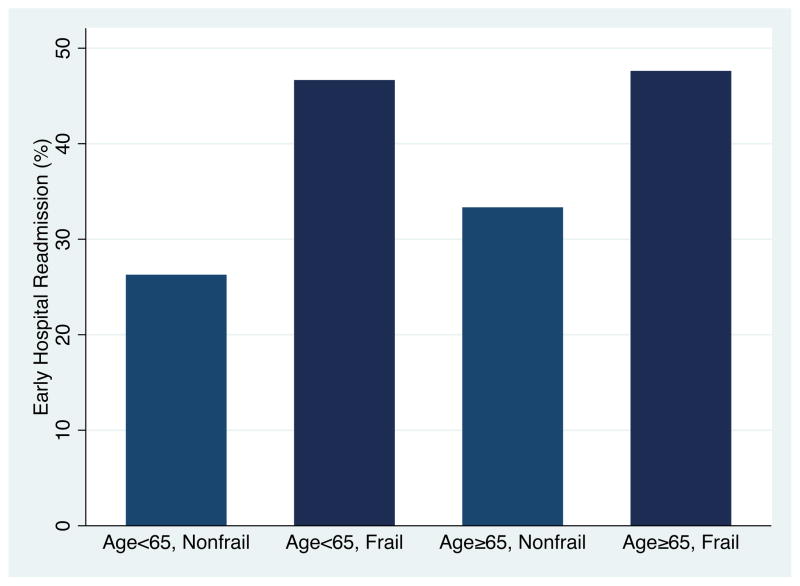
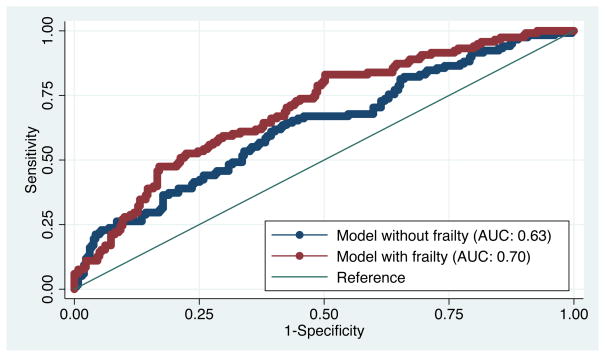
Early hospital readmission (EHR) after kidney transplantation (KT) is associated with increased morbidity and higher costs. Registry-based recipient, transplant and center-level predictors of EHR are limited, and novel predictors are needed. We hypothesized that frailty, a measure of physiologic reserve initially described and validated in geriatrics and recently associated with early KT outcomes, might serve as a novel, independent predictor of EHR in KT recipients of all ages. We measured frailty in 383 KT recipients at Johns Hopkins Hospital. EHR was ascertained from medical records as ≥1 hospitalization within 30 days of initial post-KT discharge. Frail KT recipients were much more likely to experience EHR (45.8% vs. 28.0%, p = 0.005), regardless of age. After adjusting for previously described registry-based risk factors, frailty independently predicted 61% higher risk of EHR (adjusted RR = 1.61, 95% CI: 1.18-2.19, p = 0.002). In addition, frailty improved EHR risk prediction by improving the area under the receiver operating characteristic curve (p = 0.01) as well as the net reclassification index (p = 0.04). Identifying frail KT recipients for targeted outpatient monitoring and intervention may reduce EHR rates.
Keywords: Frailty; readmission; transplantation.
© Copyright 2013 The American Society of Transplantation and the American Society of Transplant Surgeons.
Conflict of interest statement
DISCLOSURE
The authors of this manuscript have no conflicts of interest to disclose as described by the
Figures
Comment in
-
Transplantation: early hospital readmissions after kidney transplantation.Nat Rev Nephrol. 2014 Apr;10(4):188-9. doi: 10.1038/nrneph.2014.32. Epub 2014 Mar 4. Nat Rev Nephrol. 2014. PMID: 24595039
-
Re: frailty and early hospital readmission after kidney transplantation.J Urol. 2014 May;191(5):1366. doi: 10.1016/j.juro.2014.02.016. Epub 2014 Feb 20. J Urol. 2014. PMID: 24745533 No abstract available.
References
-
- McAdams-Demarco MA, Grams ME, Hall EC, Coresh J, Segev DL. Early hospital readmission after kidney transplantation: patient and center-level associations. American journal of transplantation: official journal of the American Society of Transplantation and the American Society of Transplant Surgeons. 2012;12(12):3283–3288. - PubMed
-
- Medicare Payment Policy. Washington DC: Medicare Payment Advisory Committee; 2007. Report to Congress.
-
- Hunter T, Nelson JR, Birmingham J. Preventing Readmissions Through Comprehensive Discharge Planning. Professional case management. 2013;18(2):56–63. - PubMed
-
- QualityNet. Readmission measures overview: publicly reporting risk standardized, 30-day readmission for AMI, HF, and Ph. 2011 [cited 2011 October 25, 2011]; Available from: qualitynet.org.
Publication types
MeSH terms
Grants and funding
LinkOut - more resources
Full Text Sources
Other Literature Sources
Medical
