


Review
doi: 10.1186/gb-2013-14-5-205.
Machine learning and genome annotation: a match meant to be?
- PMID: 23731483
- PMCID: PMC4053789
- DOI: 10.1186/gb-2013-14-5-205
Item in Clipboard
Review
Machine learning and genome annotation: a match meant to be?
Genome Biol.
.
Abstract
By its very nature, genomics produces large, high-dimensional datasets that are well suited to analysis by machine learning approaches. Here, we explain some key aspects of machine learning that make it useful for genome annotation, with illustrative examples from ENCODE.
Figures
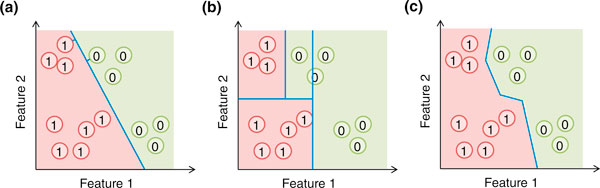
Some commonly used machine learning methods. For illustration, each genomic region is represented by a circle and described by two features. (a) A support vector machine (SVM) forms an affine decision surface (a straight line in the case of two dimensions) in the original feature space or a vector space defined by the similarity matrix (the kernel), to separate the positive and negative examples and maximize the distance of it from the closest training examples (the support vectors, those with a perpendicular line from the decision surface drawn). It predicts the label of a genomic region based on its direction from the decision surface. In the case a kernel is used, the decision surface in the original feature space could be highly non-linear. (b) A basic decision tree uses feature-parallel decision surfaces to repeatedly partition the feature space, and predicts the label of a genomic region based on the partition it falls within. (c) The one-nearest neighbor (1-NN) method predicts the label of a genomic region based on the label of its closest labeled example. In all three cases, the areas predicted to be positive and negative are indicated by the red and green background colors, respectively.
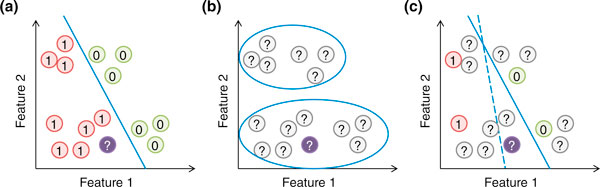
Supervised, unsupervised and semi-supervised learning. (a) In supervised learning, the model (blue line) is learned based on the positive and negative training examples, and the genomic region without a known class label (purple circle) is classified as positive according to the model. (b) In unsupervised learning, all examples are unlabeled, and they are grouped according to the data distribution. (c) In semi-supervised learning, information of both labeled and unlabeled examples is used to learn the parameters of the model. In this illustration, a purely supervised model (dashed blue line) classifies the purple object as negative, while a semi-supervised model that avoids cutting at regions with a high density of genomic regions (solid blue line) classifies it as positive.
References
-
- Lander ES, Linton LM, Birren B, Nusbaum C, Zody MC, Baldwin J, Devon K, Dewar K, Doyle M, FitzHugh W, Funke R, Gage D, Harris K, Heaford A, Howland J, Kann L, Lehoczky J, LeVine R, McEwan P, McKernan K, Meldrim J, Mesirov JP, Miranda C, Morris W, Naylor J, Raymond C, Rosetti M, Santos R, Sheridan A, Sougnez C. et al. Initial sequencing and analysis of the human genome. Nature. 2001;14:860–921. doi: 10.1038/35057062. - DOI - PubMed
-
- Venter JC, Adams MD, Myers EW, Li PW, Mural RJ, Sutton GG, Smith HO, Yandell M, Evans CA, Holt RA, Gocayne JD, Amanatides P, Ballew RM, Huson DH, Wortman JR, Zhang Q, Kodira CD, Zheng XH, Chen L, Skupski M, Subramanian G, Thomas PD, Zhang J, Gabor Miklos GL, Nelson C, Broder S, Clark AG, Nadeau J, McKusick VA, Zinder N. et al. The sequence of the human genome. Science. 2001;14:1304–1351. doi: 10.1126/science.1058040. - DOI - PubMed
-
- Alpaydin E. Introduction to Machine Learning. Cambridge, Massachusettes: The MIT Press; 2004.
-
- Baldi P, Brunak S. Bioinformatics: The Machine Learning Approach. 2. Cambridge, Massachusettes: MIT Press; 2001.
-
- Mitchell T. Machine Learning. New York: McGraw Hill; 1997.
Publication types
MeSH terms
LinkOut - more resources
Full Text Sources
Other Literature Sources
