Review
. 2013 Aug;18(15-16):716-23.
doi: 10.1016/j.drudis.2013.05.015. Epub 2013 May 31.

The Tox21 robotic platform for the assessment of environmental chemicals--from vision to reality

Affiliations
Review

The Tox21 robotic platform for the assessment of environmental chemicals--from vision to reality

Matias S Attene-Ramos et al. Drug Discov Today. 2013 Aug.

Abstract

Since its establishment in 2008, the US Tox21 inter-agency collaboration has made great progress in developing and evaluating cellular models for the evaluation of environmental chemicals as a proof of principle. Currently, the program has entered its production phase (Tox21 Phase II) focusing initially on the areas of modulation of nuclear receptors and stress response pathways. During Tox21 Phase II, the set of chemicals to be tested has been expanded to nearly 10,000 (10K) compounds and a fully automated screening platform has been implemented. The Tox21 robotic system combined with informatics efforts is capable of screening and profiling the collection of 10K environmental chemicals in triplicate in a week. In this article, we describe the Tox21 screening process, compound library preparation, data processing, and robotic system validation.


Conflict of interest statement

Conflicts of interest

None

Figures

Figure 1
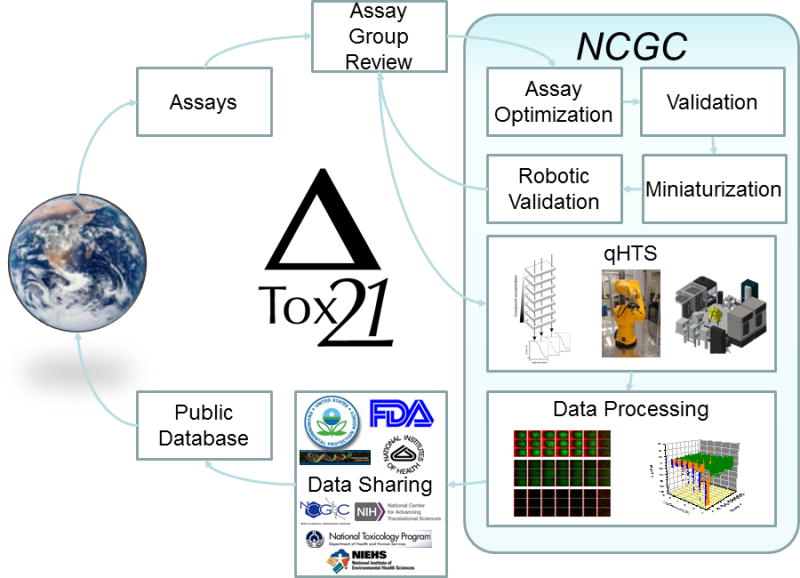
Figure 1. The Tox21 screening process
After the nominated assays are reviewed and approved by the Tox21 Pathways/Assays group and the Tox21 leadership, the selected assay is optimized, validated, and miniaturized into a 1536-well plate format, followed by the robotic validation. Robotic qHTS against the Tox21 10K library is then run, followed by data processing. The screening results are first shared by EPA, NCGC, NTP and FDA, and then are made publicly accessible. Abbreviations: qHTS: quantitative high-throughput screening; NCGC: NIH Chemical Genomics Center.
Figure 2
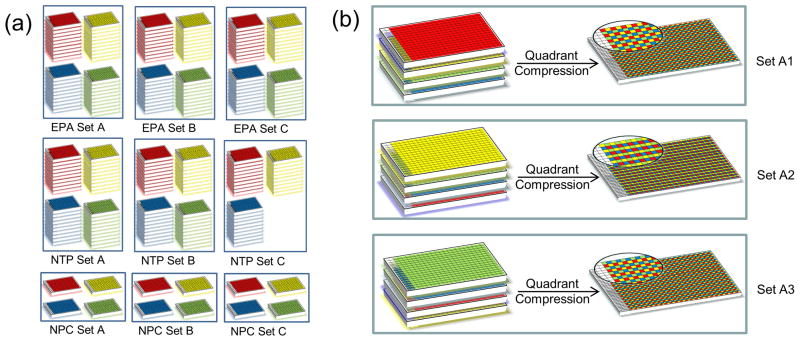
Figure 2
(a) The EPA, NTP, and NPC collections were divided into three distinct sets of unique compounds called Set A, Set B, and Set C. The EPA and NTP sets contained 10 copies of different 384-well plates called Quadrants. The NPC sets contained one copy of each quadrant. (b) The 384-well plates from each quadrant of every set are arranged in three different orders and compressed to 1536-well compound plates achieving three different plating configurations of the same compounds used for triplicate screening. Abbreviations: EPA: Environmental Protection Agency’s; NTP: National Toxicology Program; NPC: NCGC Pharmaceutical Collection.
Figure 3
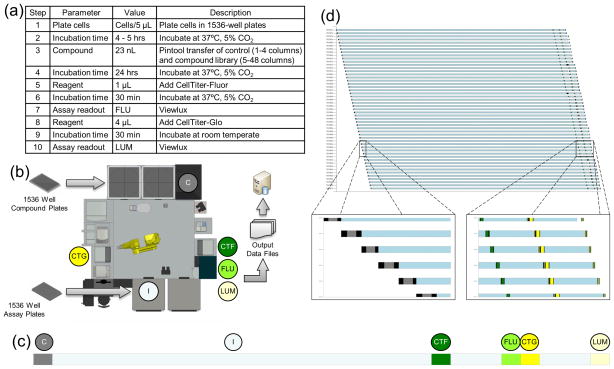
Figure 3. HTS system workflow
The assay protocol (a) is run on the Tox21 robotic system (b), represented graphically as a Gantt chart element (c). The entire run is represented by a combined Gantt Chart (d), with each element of the Y-axis representing the steps each individual assay plate undergoes while completing each step of the protocol, with the X-axis representing time. Abbreviations: C: compound addition; I: incubation; CTF: CellTiter-Fluor addition; CTG: CellTiter-Glo addition; FLU: fluorescence reading; LUM: luminescence reading.
Figure 4
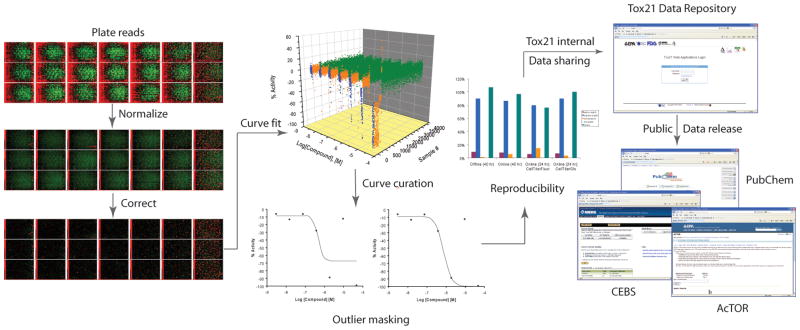
Figure 4. Tox21 data pipeline
After the qHTS data come off the robot, the raw plate reads are normalized, corrected, and pivoted to form concentration response curves (CRCs). The CRCs are fit to the Hill equation and classified into different curve classes based on potency, efficacy and quality of curve fit. The curve fits are further inspected manually to correct any misfit curves. The ‘clean’ curve fitting results are then assessed for activity reproducibility to determine the final assay performance. After the initial data parsing and assessment at the NCGC are complete, the qHTS data are shared with the Tox21 partners through an access controlled site – the Tox21 data repository, where the data are further scrutinized for quality and utility. The data will then be released to the public domain in a number of public databases, including PubChem [27], CEBS [13] and ACToR [14].

References

    1. NTP. A National Toxicology Program for the 21st Century: A Roadmap for the Future 2004
    1. NRC. Toxicity Testing in the 21st Century: A Vision and a Strategy. The National Academies Press; 2007.
    1. EPA. [[accessed 2 April 2013]]; http://www.epa.gov/ncct. [RE1]
    1. Collins FS, et al. Toxicology. Transforming environmental health protection. Science. 2008;319:906–907. - PMC - PubMed
    1. Krewski D, et al. Toxicity testing in the 21st century: a vision and a strategy. Journal of toxicology and environmental health. Part B, Critical reviews. 2010;13:51–138. - PMC - PubMed

Publication types

MeSH terms

Substances