


Laninamivir octanoate for post-exposure prophylaxis of influenza in household contacts: a randomized double blind placebo controlled trial
- PMID: 23732307
- PMCID: PMC3738841
- DOI: 10.1007/s10156-013-0622-9
Laninamivir octanoate for post-exposure prophylaxis of influenza in household contacts: a randomized double blind placebo controlled trial
Abstract
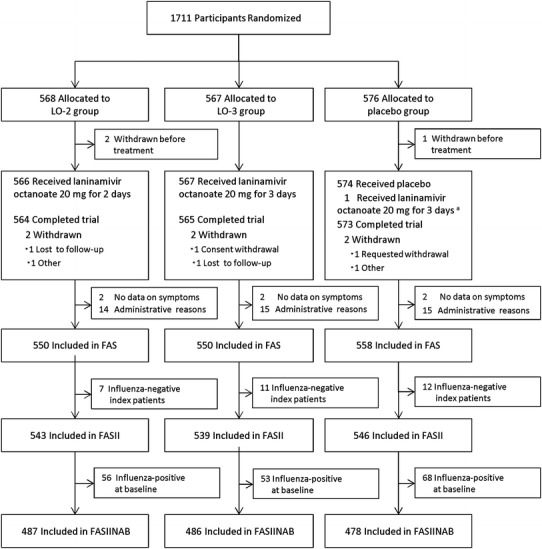
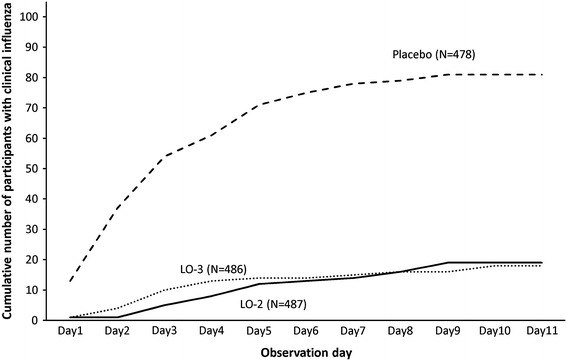
Laninamivir octanoate, a long-acting neuraminidase inhibitor, is an effective treatment for influenza. However, its effectiveness for the prevention of influenza has not yet been demonstrated. We conducted a double-blind, multicenter, randomized, placebo-controlled trial to determine whether laninamivir octanoate was superior to a placebo for post-exposure prophylaxis of influenza in household contacts. Eligible participants, who were household members who did not have influenza and were in contact with an influenza-infected index patient, were randomly assigned (1:1:1) to one of three groups: 20 mg of laninamivir octanoate once daily for 2 days (LO-2), 20 mg of laninamivir octanoate once daily for 3 days (LO-3), or a placebo. The primary endpoint was the proportion of participants who developed clinical influenza during a 10-day period. A total of 1711 participants were enrolled, and 1451 participants were included in the primary analysis. The proportion of participants with clinical influenza was 3.9 % (19/487) in the LO-2 group, 3.7 % (18/486) in the LO-3 group, and 16.9 % (81/478) in the placebo group (P < 0.001 for each of the laninamivir octanoate group). The relative risk reductions, compared with the placebo group, were 77.0 % [95 % confidence interval (CI) 62.7-85.8] and 78.1 % (95 % CI 64.1-86.7 %) for the LO-2 and LO-3 groups, respectively. The incidences of adverse events in the laninamivir octanoate groups were similar to that in the placebo group. The inhalation of 20 mg of laninamivir octanoate once daily for 2 or 3 days was well tolerated and effectively prevented the development of influenza in household contacts.
Figures
References
-
- Fox JP, Hall CE, Cooney MK, Foy HM. Influenza virus infections in Seattle families. Am J Epidemiol. 1982;116:212–242. - PubMed
-
- Fiore AE, Fry A, Shay D, Gubareva L, Bresee JS, Uyeki TM. Antiviral agents for the treatment and chemoprophylaxis of influenza—recommendations of the Advisory Committee on Immunization Practices (ACIP) MMWR Recomm Rep. 2011;60:1–24. - PubMed
-
- Kashiwagi S, Kudoh S, Watanabe A, Yoshimura I. Efficacy and safety of the selective oral neuraminidase inhibitor oseltamivir for prophylaxis against influenza–placebo-controlled double-blind multicenter phase III trial. Kansenshogaku Zasshi. 2000;74(12):1062–1076. - PubMed
Publication types
MeSH terms
Substances
LinkOut - more resources
Full Text Sources
Other Literature Sources
Medical
