Review
. 2013 Jun 1;5(6):a012666.
doi: 10.1101/cshperspect.a012666.

DNA repair at telomeres: keeping the ends intact

Affiliations
Review

DNA repair at telomeres: keeping the ends intact

Christopher J Webb et al. Cold Spring Harb Perspect Biol. .

Abstract

The molecular era of telomere biology began with the discovery that telomeres usually consist of G-rich simple repeats and end with 3' single-stranded tails. Enormous progress has been made in identifying the mechanisms that maintain and replenish telomeric DNA and the proteins that protect them from degradation, fusions, and checkpoint activation. Although telomeres in different organisms (or even in the same organism under different conditions) are maintained by different mechanisms, the disparate processes have the common goals of repairing defects caused by semiconservative replication through G-rich DNA, countering the shortening caused by incomplete replication, and postreplication regeneration of G tails. In addition, standard DNA repair mechanisms must be suppressed or modified at telomeres to prevent their being recognized and processed as DNA double-strand breaks. Here, we discuss the players and processes that maintain and regenerate telomere structure.


Figures
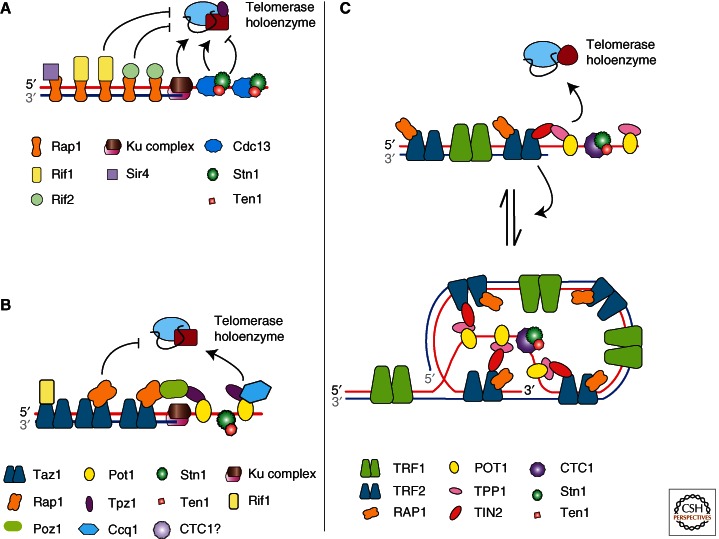
Figure 1.
Figure 1.
Model structures and associated proteins of budding yeast, fission yeast, and human telomeres. (A) DNA structure and associated proteins of budding yeast telomeres. Arrows and blunt arrows denote up-regulation and down-regulation of telomerase recruitment, respectively (see Table 1 for abbreviations). (B) DNA structure and associated proteins of fission yeast telomeres (3′ end fold back and double-stranded DNA [dsDNA] invasion to form a t-loop is a potential alternate structure that is not shown [Tomaska et al. 2004]). (C) DNA structure and associated proteins of human telomeres.
Figure 2.
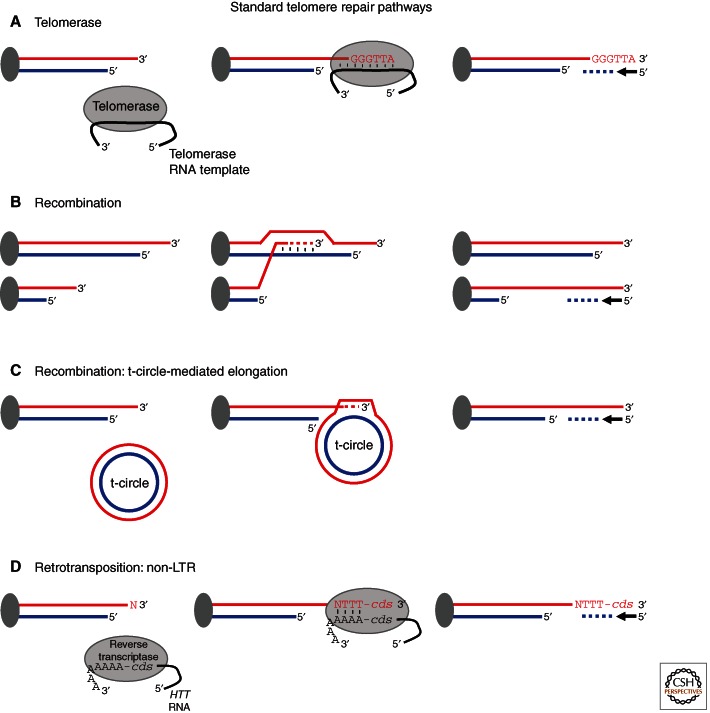
Figure 2.
Standard telomere repair pathways. Pathways are represented from left to right with DNA strands in red and blue. Centromeres are shown as dark ovals and relevant proteins and complexes are shown as labeled ovals. (A) Telomerase, a telomere-dedicated reverse transcriptase mechanism used in most eukaryotes. (B) Nonreciprocal recombination, used by a minority of eukaryotes, but is used as a survival strategy by most cells that survive without telomerase. (C) Recombination: t-circle-mediated elongation, a method of elongation that is best understood in yeasts in which circular DNA is used to template the addition of a new sequence to the end of the telomere. The new sequence can spread to other telomeres by nonreciprocal recombination. (D) Retrotransposition: tandem arrays of non-LTR (long terminal repeat) retrotransposons are added to the ends of telomeres. Retrotransposition is targeted only to telomeres probably because the transposon does not encode an endonuclease.
Figure 3.
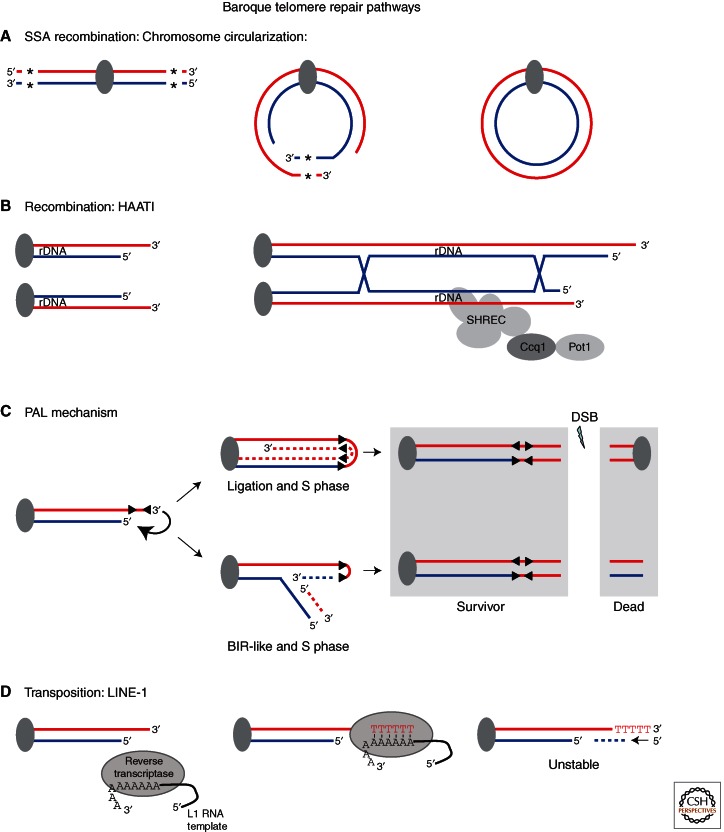
Figure 3.
Baroque telomere repair pathways. Pathways are represented from left to right with DNA strands in red and blue. Centromeres are shown as dark ovals and relevant proteins and complexes are shown as labeled ovals. (A) Single-strand annealing recombination: chromosome circularization, a telomerase minus cell bypass mechanism found in fission yeast telomerase minus cells that is dependent on regions of homology, which are used to prime DNA synthesis and fuse the two ends of a single chromosome. *Denotes regions of homology. (In the absence of Taz1 nonhomologous end joining is used to fuse the ends [not shown] [Ferreira and Cooper 2001; Wang and Baumann 2008].) (B) Recombination: HAATI, a mode of telomere maintenance in fission yeast telomerase minus cells that maintains chromosome ends by recombination between rDNA arrays and recruitment of protective factors by heterochromatic interactions. (C) PAL-mechanism, a bypass mechanism in telomerase and C-strand degradation deficient budding yeast cells that uses palindromic sequence to generate a telomeric hairpin structure, which can undergo two pathways that both generate a single survivor after cell division. Palindromic sequences are depicted as mirrored black triangles. (D) Transposition: LINE-1, a process so far only observed in Chinese hamster ovary cells in which dysfunctional telomeres serve as substrates for LINE-1 endonuclease-independent retrotransposition. cds, coding sequence; SSA, single-strand annealing; SHREC, Snf2/Hdac-containing repressor complex; BIR, break-induced recombination (also see Table 1).

References

    1. Abad JP, Villasante A 1999. The 3′ non-coding region of the Drosophila melanogaster HeT-A telomeric retrotransposon contains sequences with propensity to form G-quadruplex DNA. FEBS Lett 453: 59–62 - PubMed
    1. Armanios M 2012. An emerging role for the conserved telomere component 1 (CTC1) in human genetic disease. Pediatr Blood Cancer 59: 209–210 - PubMed
    1. Arneric M, Lingner J 2007. Tel1 kinase and subtelomere-bound Tbf1 mediate preferential elongation of short telomeres by telomerase in yeast. EMBO Rep 8: 1080–1085 - PMC - PubMed
    1. Arnoult N, Van Beneden A, Decottignies A 2012. Telomere length regulates TERRA levels through increased trimethylation of telomeric H3K9 and HP1α. Nat Struct Mol Biol 19: 948–956 - PubMed
    1. Azam M, Lee JY, Abraham V, Chanoux R, Schoenly KA, Johnson FB 2006. Evidence that the S. cerevisiae Sgs1 protein facilitates recombinational repair of telomeres during senescence. Nucleic Acids Res 34: 506–516 - PMC - PubMed

Publication types

LinkOut - more resources