Replicative DNA polymerases
- PMID: 23732474
- PMCID: PMC3660833
- DOI: 10.1101/cshperspect.a012799
Replicative DNA polymerases
Abstract
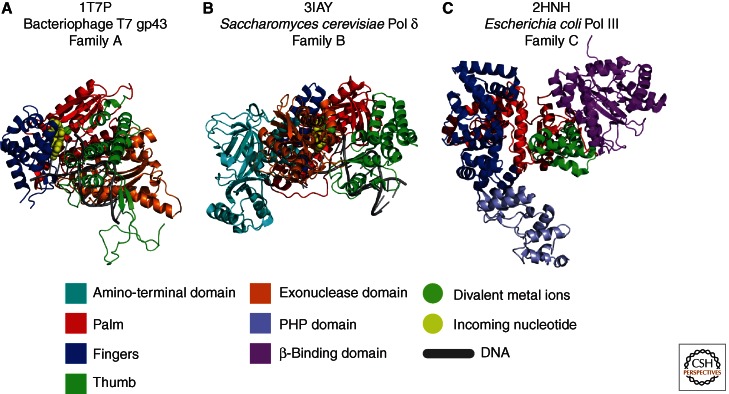
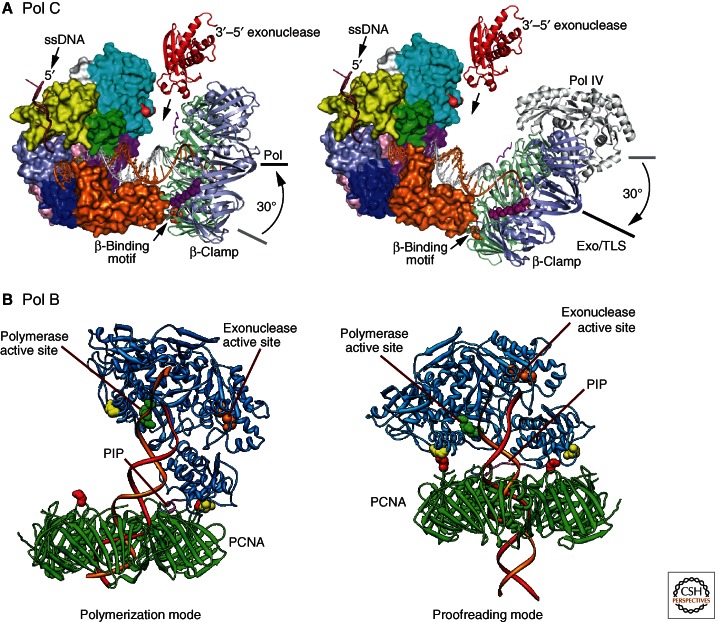
In 1959, Arthur Kornberg was awarded the Nobel Prize for his work on the principles by which DNA is duplicated by DNA polymerases. Since then, it has been confirmed in all branches of life that replicative DNA polymerases require a single-stranded template to build a complementary strand, but they cannot start a new DNA strand de novo. Thus, they also depend on a primase, which generally assembles a short RNA primer to provide a 3'-OH that can be extended by the replicative DNA polymerase. The general principles that (1) a helicase unwinds the double-stranded DNA, (2) single-stranded DNA-binding proteins stabilize the single-stranded DNA, (3) a primase builds a short RNA primer, and (4) a clamp loader loads a clamp to (5) facilitate the loading and processivity of the replicative polymerase, are well conserved among all species. Replication of the genome is remarkably robust and is performed with high fidelity even in extreme environments. Work over the last decade or so has confirmed (6) that a common two-metal ion-promoted mechanism exists for the nucleotidyltransferase reaction that builds DNA strands, and (7) that the replicative DNA polymerases always act as a key component of larger multiprotein assemblies, termed replisomes. Furthermore (8), the integrity of replisomes is maintained by multiple protein-protein and protein-DNA interactions, many of which are inherently weak. This enables large conformational changes to occur without dissociation of replisome components, and also means that in general replisomes cannot be isolated intact.
Figures
References
-
- Araki H 2010. Cyclin-dependent kinase-dependent initiation of chromosomal DNA replication. Curr Opin Cell Biol 22: 766–771 - PubMed
-
- Asturias FJ, Cheung IK, Sabouri N, Chilkova O, Wepplo D, Johansson E 2006. Structure of Saccharomyces cerevisiae DNA polymerase epsilon by cryo-electron microscopy. Nat Struct Mol Biol 13: 35–43 - PubMed
Publication types
MeSH terms
Substances
LinkOut - more resources
Full Text Sources
Other Literature Sources