Review
. 2013 Jul;23(7):876-85.
doi: 10.1038/cr.2013.74. Epub 2013 Jun 4.

Restrictions to HIV-1 replication in resting CD4+ T lymphocytes

Affiliations
Review

Restrictions to HIV-1 replication in resting CD4+ T lymphocytes

Xiaoyu Pan et al. Cell Res. 2013 Jul.

Abstract

CD4(+) T lymphocytes represent the main target cell population of human immunodeficiency virus (HIV). In an activated state, CD4(+) T cells residing in lymphoid organs are a major reservoir of ongoing HIV-1 replication in infected individuals. In contrast, resting CD4(+) T cells are highly resistant to productive HIV-1 infection, yet are massively depleted during disease progression and represent a substantial latent reservoir for the virus in vivo. Barriers preventing replication of HIV-1 in resting CD4(+) T cells include a rigid layer of cortical actin and, early after HIV-1 entry, a block that limits reverse transcription of incoming viral RNA genomes. Defining the molecular bases of these restrictions has remained one of the central open questions in HIV research. Recent advances unraveled mechanisms by which HIV-1 bypasses the entry block and established the host cell restriction factor SAMHD1, a deoxynucleoside triphosphate triphosphohydrolase, as a central determinant of the cellular restriction to HIV-1 reverse transcription in resting CD4(+) T cells. This review summarizes our current molecular and pathophysiological understanding of the multi-faceted interactions of HIV-1 with resting CD4(+) T lymphocytes.


Figures
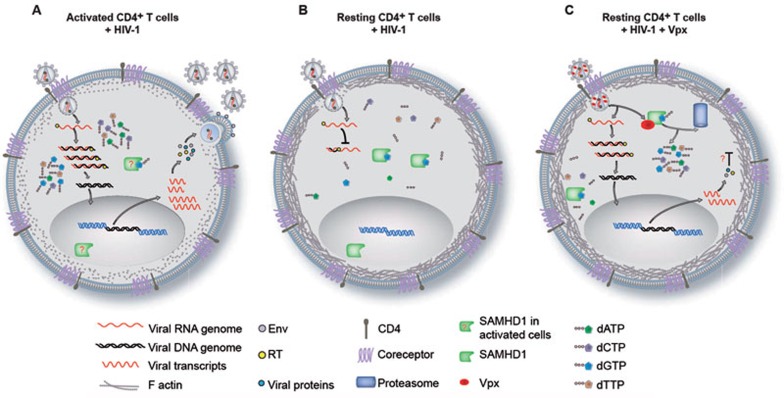
Figure 1
Figure 1
Schematic model of HIV-1 replication and restrictions thereof in activated and resting CD4+ T lymphocytes. (A) Activated CD4+ T lymphocytes are fully permissive to HIV-1 replication and all steps of the viral life cycle from entry (facilitated by loosening of the actin cortex), RT, nuclear import, integration, viral gene expression to synthesis of new viral proteins, particle assembly and release are efficient. Cellular dNTP levels are high despite the presence of high SAMHD1 expression, suggesting that the activity of the enzyme may be downregulated in these cells (indicated by the question mark). (B) HIV-1 infection of resting CD4+ T lymphocytes is abortive. HIV-1 overcomes the rigid actin cortex barrier by inducing Env-chemokine receptor signaling. RT is initiated but stalls before viral DNA synthesis is completed. Presumably due to the high activity of SAMHD1, dNTP levels in the cytoplasm are low and limit RT reactions. (C) Delivery of Vpx surmounts the SAMHD1 barrier and allows HIV-1 to infect resting CD4+ T lymphocytes. SAMHD1 is targeted by Vpx for proteasomal degradation, which is paralleled by an elevation of cellular dNTP levels. HIV-1 infection proceeds through RT, nuclear import and integration. Some viral gene expression is observed but no infectious progeny is released, suggesting the existence of yet uncharacterized additional blocks in the late phase of the viral life cycle.

References

    1. Bieniasz PD. Intrinsic immunity: a front-line defense against viral attack. Nat Immunol. 2004;5:1109–1115. - PubMed
    1. Yan N, Chen ZJ. Intrinsic antiviral immunity. Nat Immunol. 2012;13:214–222. - PMC - PubMed
    1. Harris RS, Hultquist JF, Evans DT. The restriction factors of human immunodeficiency virus. J Biol Chem. 2012;287:40875–40883. - PMC - PubMed
    1. Malim MH, Bieniasz PD. HIV Restriction factors and mechanisms of evasion. Cold Spring Harb Perspect Med. 2012;2:a006940. - PMC - PubMed
    1. Wilen CB, Tilton JC, Doms RW. Molecular mechanisms of HIV entry. Adv Exp Med Biol. 2012;726:223–242. - PubMed

MeSH terms

Substances
