Influence of study features and methods on overdiagnosis estimates in breast and prostate cancer screening
- PMID: 23732716
- PMCID: PMC3733533
- DOI: 10.7326/0003-4819-158-11-201306040-00008
Influence of study features and methods on overdiagnosis estimates in breast and prostate cancer screening
Abstract
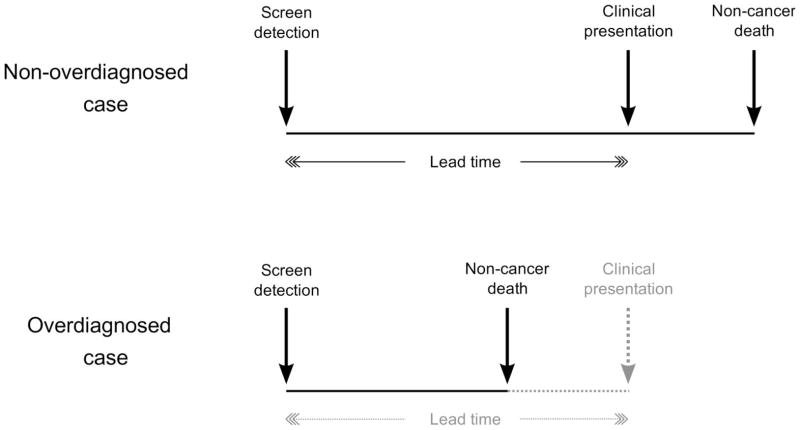
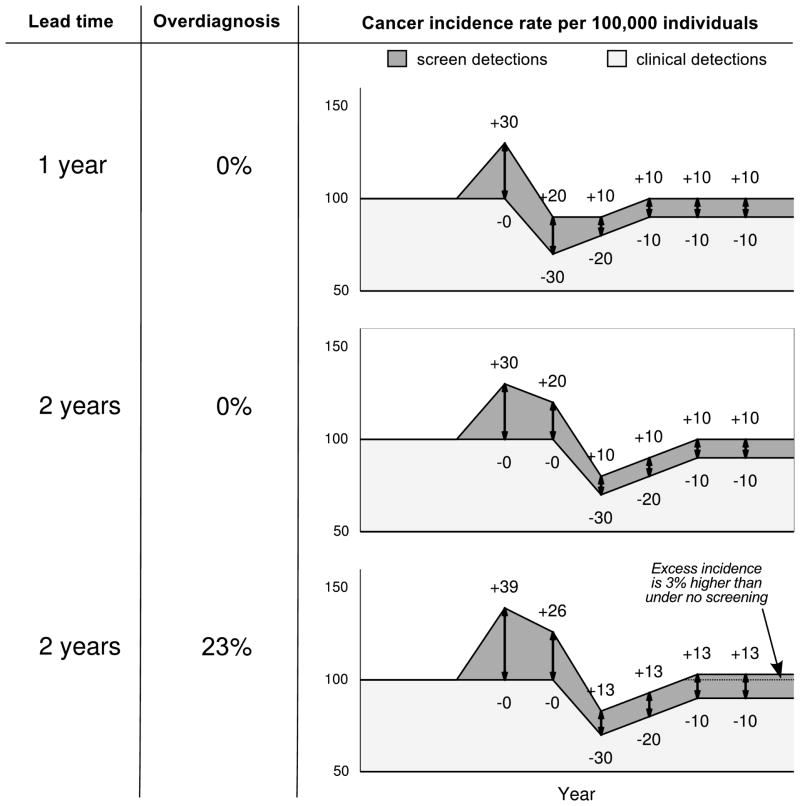
Knowledge of the likelihood that a screening-detected case of cancer has been overdiagnosed is vitally important to make treatment decisions and develop screening policy. An overdiagnosed case is an excess case detected by screening. Estimates of the frequency of overdiagnosis in breast and prostate cancer screening vary greatly across studies. This article identifies features of overdiagnosis studies that influence results and shows their effect by using published research. First, different ways to define and measure overdiagnosis are considered. Second, contextual features and how they affect overdiagnosis estimates are examined. Third, the effect of estimation approach is discussed. Many studies use excess incidence under screening as a proxy for overdiagnosis. Others use statistical models to make inferences about lead time or natural history and then derive the corresponding fraction of cases that are overdiagnosed. This article concludes with questions that readers of overdiagnosis studies can use to evaluate the validity and relevance of published estimates and recommends that authors of studies quantifying overdiagnosis provide information about these features.
Figures
References
-
- Carter HB, Piantadosi S, Isaacs JT. Clinical evidence for and implications of the multistep development of prostate cancer. J Urol. 1990;143(4):742–6. - PubMed
-
- Etzioni R, Cha R, Feuer EJ, Davidov O. Asymptomatic incidence and duration of prostate cancer. Am J Epidemiol. 1998;148(8):775–85. - PubMed
-
- Gotzsche PC, Nielsen M. Screening for breast cancer with mammography. Cochrane database of systematic reviews (Online) 2011;(1):CD001877. - PubMed
-
- Bleyer A, Welch HG. Effect of Three Decades of Screening Mammography on Breast-Cancer Incidence. New England Journal of Medicine. 2012;367(21):1998–2005. - PubMed
-
- Kalager M, Adami HO, Bretthauer M, Tamimi RM. Overdiagnosis of invasive breast cancer due to mammography screening: results from the Norwegian screening program. Annals of Internal Medicine. 2012;156(7):491–9. - PubMed
Publication types
MeSH terms
Grants and funding
LinkOut - more resources
Full Text Sources
Other Literature Sources
Medical