Reducing racial/ethnic disparities in childhood obesity: the role of early life risk factors
- PMID: 23733179
- PMCID: PMC3835398
- DOI: 10.1001/jamapediatrics.2013.85
Reducing racial/ethnic disparities in childhood obesity: the role of early life risk factors
Abstract
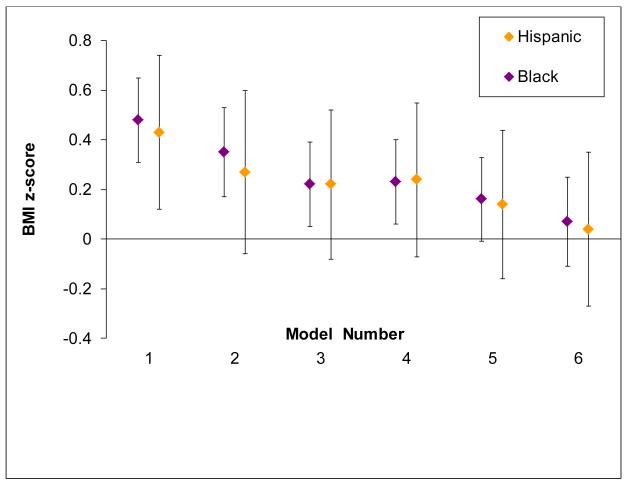
IMPORTANCE Many early life risk factors for childhood obesity are more prevalent among blacks and Hispanics than among whites and may explain the higher prevalence of obesity among racial/ethnic minority children. OBJECTIVE To examine the extent to which racial/ethnic disparities in adiposity and overweight are explained by differences in risk factors during pregnancy (gestational diabetes and depression), infancy (rapid infant weight gain, feeding other than exclusive breastfeeding, and early introduction of solid foods), and early childhood (sleeping <12 h/d, presence of a television set in the room where the child sleeps, and any intake of sugar-sweetened beverages or fast food). DESIGN Prospective prebirth cohort study. SETTING Multisite group practice in Massachusetts. PARTICIPANTS Participants included 1116 mother-child pairs (63% white, 17% black, and 4% Hispanic) EXPOSURE Mother's report of child's race/ethnicity. MAIN OUTCOMES AND MEASURES Age- and sex-specific body mass index (BMI) z score, total fat mass index from dual-energy x-ray absorptiometry, and overweight or obesity, defined as a BMI in the 85th percentile or higher at age 7 years. RESULTS Black (0.48 U [95% CI, 0.31 to 0.64]) and Hispanic (0.43 [0.12 to 0.74]) children had higher BMI z scores, as well as higher total fat mass index and overweight/obesity prevalence, than white children. After adjustment for socioeconomic confounders and parental BMI, differences in BMI z score were attenuated for black and Hispanic children (0.22 U [0.05 to 0.40] and 0.22 U [-0.08 to 0.52], respectively). Adjustment for pregnancy risk factors did not substantially change these estimates. However, after further adjustment for infancy and childhood risk factors, we observed only minimal differences in BMI z scores between whites, blacks (0.07 U [-0.11 to 0.26]), and Hispanics (0.04 U [-0.27 to 0.35]). We observed similar attenuation of racial/ethnic differences in adiposity and prevalence of overweight or obesity. CONCLUSIONS AND RELEVANCE Racial/ethnic disparities in childhood adiposity and obesity are determined by factors operating in infancy and early childhood. Efforts to reduce obesity disparities should focus on preventing early life risk factors.
Figures
References
-
- World Health Organization Global Strategy on Diet, Physical Activity and Health. 2010 http://www.who.int/dietphysicalactivity/en/December.
-
- Ogden CL, Carroll MD, Curtin LR, Lamb MM, Flegal KM. Prevalence of high body mass index in US children and adolescents, 2007-2008. JAMA. 2010 Jan 20;303(3):242–249. - PubMed
-
- Ogden CL, Carroll MD, Flegal KM. High body mass index for age among US children and adolescents, 2003-2006. JAMA. 2008 May 28;299(20):2401–2405. - PubMed
-
- Ogden CL, Carroll MD, Curtin LR, McDowell MA, Tabak CJ, Flegal KM. Prevalence of overweight and obesity in the United States, 1999-2004. JAMA. 2006 Apr 5;295(13):1549–1555. - PubMed
-
- Olds T, Maher C, Zumin S, et al. Evidence that the prevalence of childhood overweight is plateauing: data from nine countries. International journal of pediatric obesity : IJPO : an official journal of the International Association for the Study of Obesity. 2011 Oct;6(5-6):342–360. - PubMed
Publication types
MeSH terms
Grants and funding
LinkOut - more resources
Full Text Sources
Other Literature Sources
Medical