. 2013 Aug;57(8):3941-9.
doi: 10.1128/AAC.02459-12. Epub 2013 Jun 3.

Antibiotic trapping by plasmid-encoded CMY-2 β-lactamase combined with reduced outer membrane permeability as a mechanism of carbapenem resistance in Escherichia coli

Affiliations

Antibiotic trapping by plasmid-encoded CMY-2 β-lactamase combined with reduced outer membrane permeability as a mechanism of carbapenem resistance in Escherichia coli

Wil H F Goessens et al. Antimicrob Agents Chemother. 2013 Aug.

Abstract

A liver transplant patient was admitted with cholangitis, for which meropenem therapy was started. Initial cultures showed a carbapenem-susceptible (CS) Escherichia coli strain, but during admission, a carbapenem-resistant (CR) E. coli strain was isolated. Analysis of the outer membrane protein profiles showed that both CS and CR E. coli lacked the porins OmpF and OmpC. Furthermore, PCR and sequence analysis revealed that both CS and CR E. coli possessed bla(CTX-M-15) and bla(OXA-1). The CR E. coli strain additionally harbored bla(CMY-2) and demonstrated a >15-fold increase in β-lactamase activity against nitrocefin, but no hydrolysis of meropenem was detected. However, nitrocefin hydrolysis appeared strongly inhibited by meropenem. Furthermore, the CMY-2 enzyme demonstrated lower electrophoretic mobility after its incubation either in vitro or in vivo with meropenem, indicative of its covalent modification with meropenem. The presence of the acyl-enzyme complex was confirmed by mass spectrometry. By transformation of the CMY-2-encoding plasmid into various E. coli strains, it was established that both porin deficiency and high-level expression of the enzyme were needed to confer meropenem resistance. In conclusion, carbapenem resistance emerged by a combination of elevated β-lactamase production and lack of porin expression. Due to the reduced outer membrane permeability, only small amounts of meropenem can enter the periplasm, where they are trapped but not degraded by the large amount of the β-lactamase. This study, therefore, provides evidence that the mechanism of "trapping" by CMY-2 β-lactamase plays a role in carbapenem resistance.


Figures
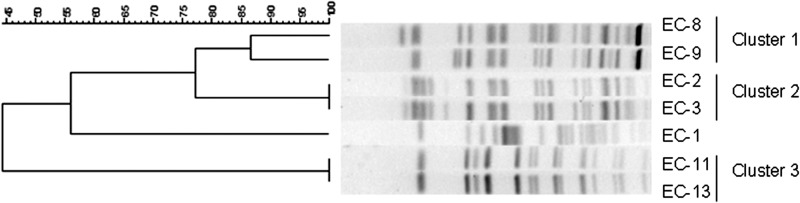
Fig 1
Fig 1
PFGE profiles of E. coli isolates. Genetic similarity was determined by using the Dice similarity index. The carbapenem-resistant isolates EC-8 and EC-9 cluster together.
Fig 2
Fig 2
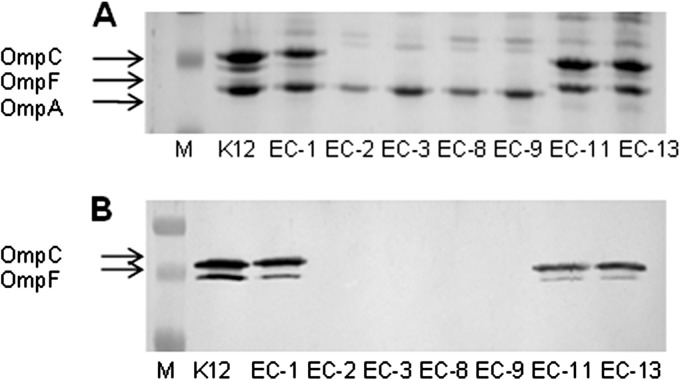
SDS-PAGE gel (A) and Western blot (B) of outer membrane proteins of E. coli isolates. (A) SDS-PAGE of OMP profiles of carbapenem-susceptible (EC-1 to EC-3, EC-11, and EC-13) and -resistant (EC-8 and EC-9) isolates. The lane marked K12 shows the OMP profile of an E. coli K-12 control strain expressing both OmpC and OmpF. The lane marked M contains molecular mass marker proteins. Arrows indicate the positions of OmpC, OmpF, and OmpA. (B) Western blot of OMP profiles incubated with anti-porin antibodies.
Fig 3
Fig 3
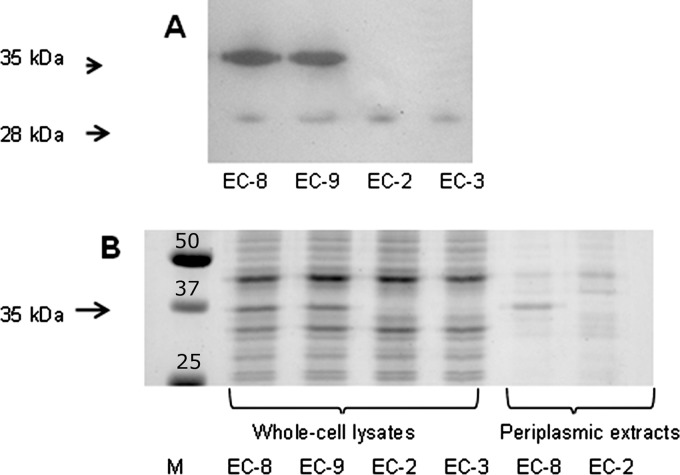
Zymogram and SDS-PAGE gel revealing expression of β-lactamase in the carbapenem-resistant E. coli isolates. (A) The zymogram was obtained by incubating the gel, on which periplasmic proteins from isolates EC-8, EC-9, EC-2, and EC-3 were separated, with nitrocefin as a β-lactamase substrate. A predominant band of 35 kDa with β-lactamase activity is detected only in the carbapenem-resistant isolates EC-8 and EC-9. A weaker band of 28 kDa is found in all four isolates. (B) SDS-PAGE profiles of whole-cell lysates of the same isolates as in panel A and of periplasmic extracts. The lane marked M contains molecular mass marker proteins; their molecular mass (in kDa) is indicated.
Fig 4
Fig 4
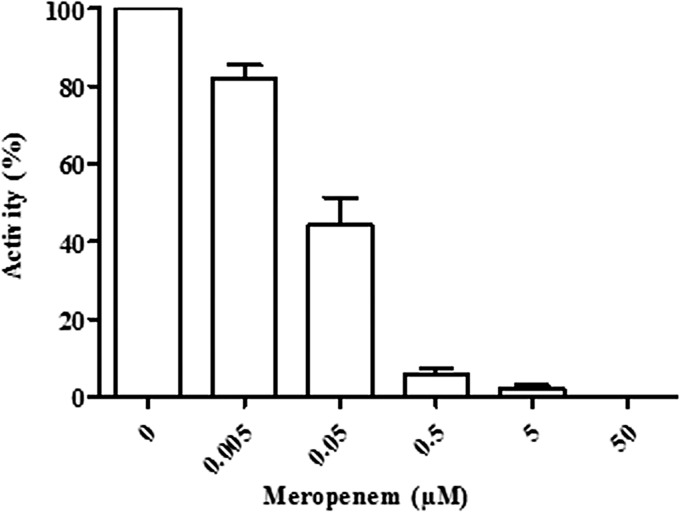
Inhibition of β-lactamase activity by meropenem. Periplasmic extracts of isolate EC-8 were incubated for 1 min with various concentrations of meropenem as indicated. Subsequently, the remaining β-lactamase activity was determined using nitrocefin as a β-lactamase substrate. β-Lactamase activity after preincubation without meropenem is set at 100%.
Fig 5
Fig 5
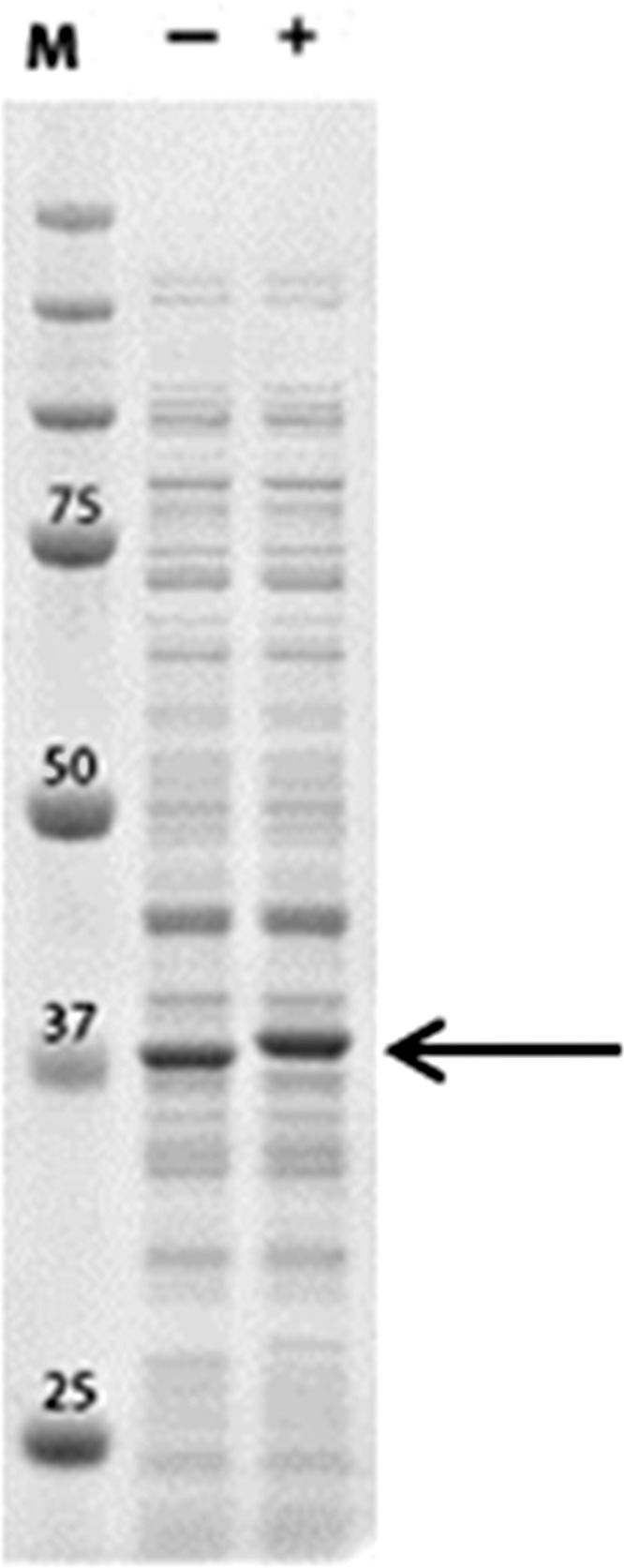
Covalent modification of CMY-2 with meropenem revealed by SDS-PAGE. Periplasmic extract of EC-8 was either incubated (+) or not (−) with 1 mM meropenem and analyzed by SDS-PAGE after boiling of the samples. The plasmid-encoded CMY-2 is visible as a predominant band indicated by the arrow. The lane marked M contains molecular mass marker proteins; the molecular mass of the most relevant bands is indicated (in kDa).
Fig 6
Fig 6
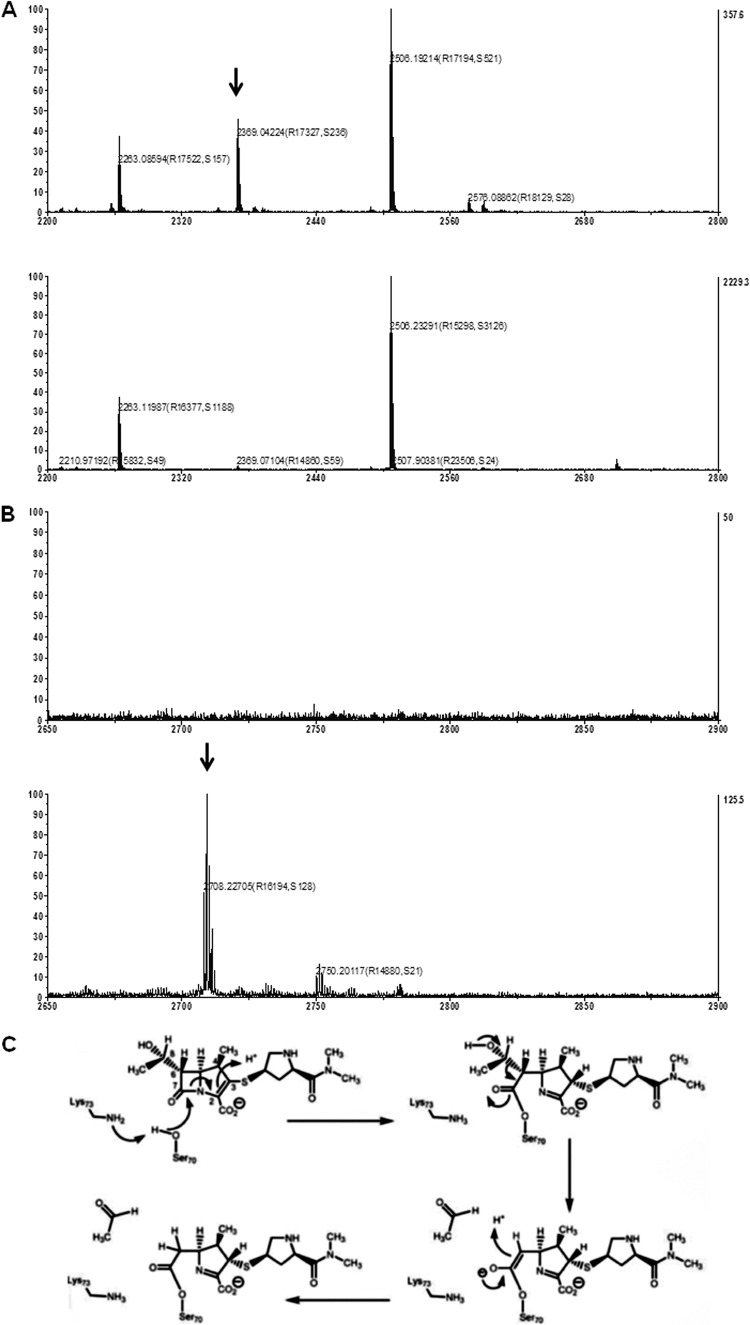
Mass spectra of tryptic peptides of the CMY-2 enzyme after incubation in the absence or presence of meropenem. (A) Mass spectra (range, 2,200 to 2,800) of tryptic peptides of CMY-2 either preincubated (lower spectrum) or not (top spectrum) with meropenem. The peak at a mass of 2,369.04 (arrow) corresponds to the calculated mass of 2,369.21 Da of the peptide ADIANNHPVTQQTLFELGSVSK, containing the active-site serine (in bold) of the CMY-2 enzyme. (B) Mass spectra (range, 2,650 to 2,900) of tryptic peptides of CMY-2 either preincubated (lower panel) or not (top panel) with meropenem. The calculated mass of the CMY-2 tryptic peptide containing the active-site serine (2,369.21 Da) substituted with meropenem (383.46 Da) after removal of an acetaldehyde group (44.05 Da) (see panel C) is 2,708.62 Da, consistent with the peak at a mass of 2,708.23 Da that was found in our experiments in the sample incubated with meropenem (arrow). (C) Proposed chemical mechanisms for the BlaC-catalyzed reaction with meropenem resulting in a covalent acyl-enzyme adduct (53). Reprinted from reference with permission from AAAS.
Fig 7
Fig 7
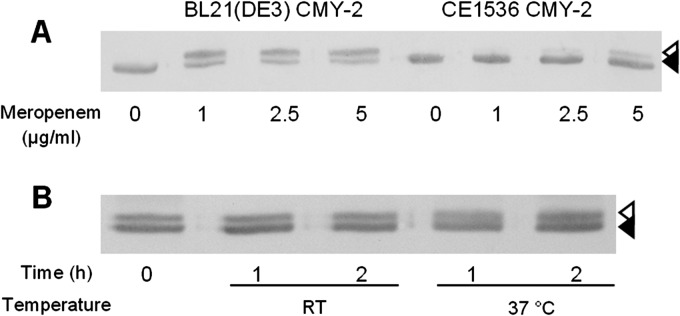
Covalent modification of CMY-2 β-lactamase in vivo and stability of the complex. (A) Cells of strain BL21(DE3) and its porin-deficient mutant, CE1536, both carrying the CMY-2-encoding plasmid, were incubated for 20 min with meropenem at the concentrations indicated. Then the cells were extensively washed and the soluble fraction was isolated and analyzed by SDS-PAGE and Western blotting with AmpC-specific antiserum. (B) BL21(DE3) cells carrying the CMY-2-encoding plasmid were incubated for 20 min with 1 μg/ml meropenem, after which the cells were washed extensively. Then the soluble fraction was isolated and incubated for the indicated time periods at room temperature (RT) or 37°C before analysis by SDS-PAGE and Western blotting with AmpC-specific antiserum. The CMY-2 β-lactamase and its covalently modified product are indicated by filled and open arrowheads, respectively.

References

    1. Nordmann P, Cuzon G, Naas T. 2009. The real threat of Klebsiella pneumoniae carbapenemase-producing bacteria. Lancet Infect. Dis. 9:228–236 - PubMed
    1. Walsh TR, Toleman MA, Poirel L, Nordmann P. 2005. Metallo-β-lactamases: the quiet before the storm? Clin. Microbiol. Rev. 18:306–325 - PMC - PubMed
    1. Doumith M, Ellington MJ, Livermore DM, Woodford N. 2009. Molecular mechanisms disrupting porin expression in ertapenem-resistant Klebsiella and Enterobacter spp. clinical isolates from the UK. J. Antimicrob. Chemother. 63:659–667 - PubMed
    1. Liu Y-F, Yan JJ, Ko WC, Tsai SH, Wu JJ. 2008. Characterization of carbapenem-non-susceptible Escherichia coli isolates from a university hospital in Taiwan. J. Antimicrob. Chemother. 61:1020–1023 - PubMed
    1. Yang Q, Wang H, Sun H, Chen H, Xu Y, Chen M. 2010. Phenotypic and genotypic characterization of Enterobacteriaceae with decreased susceptibility to carbapenems: results from large hospital-based surveillance studies in China. Antimicrob. Agents Chemother. 54:573–577 - PMC - PubMed

Publication types

MeSH terms

LinkOut - more resources