. 2013 Sep;57(9):4105-13.
doi: 10.1128/AAC.00204-13. Epub 2013 Jun 3.

Multiple genetic pathways involving amino acid position 143 of HIV-1 integrase are preferentially associated with specific secondary amino acid substitutions and confer resistance to raltegravir and cross-resistance to elvitegravir

Affiliations

Multiple genetic pathways involving amino acid position 143 of HIV-1 integrase are preferentially associated with specific secondary amino acid substitutions and confer resistance to raltegravir and cross-resistance to elvitegravir

Wei Huang et al. Antimicrob Agents Chemother. 2013 Sep.

Abstract

Y143C,R substitutions in HIV-1 integrase define one of three primary raltegravir (RAL) resistance pathways. Here we describe clinical isolates with alternative substitutions at position 143 (Y143A, Y143G, Y143H, and Y143S [Y143A,G,H,S]) that emerge less frequently, and we compare the genotypic and phenotypic profiles of these viruses to Y143C,R viruses to reconcile the preferential selection of Y143C,R variants during RAL treatment. Integrase amino acid sequences and RAL susceptibility were characterized in 117 patient isolates submitted for drug resistance testing and contained Y143 amino acid changes. The influence of specific Y143 substitutions on RAL susceptibility and their preferential association with particular secondary substitutions were further defined by evaluating the composition of patient virus populations along with a large panel of site-directed mutants. Our observations demonstrate that the RAL resistance profiles of Y143A,G,H,S viruses and their association with specific secondary substitutions are similar to the well-established Y143C profile but distinct from the Y143R profile. Y143R viruses differ from Y143A,C,G,H,S viruses in that Y143R confers a greater reduction in RAL susceptibility as a single substitution, consistent with a lower resistance barrier. Among Y143A,C,G,H,S viruses, the higher prevalence of Y143C viruses is the result of a lower genetic barrier than that of the Y143A,G,S viruses and a lower resistance barrier than that of the Y143H viruses. In addition, Y143A,C,G,H,S viruses require multiple secondary substitutions to develop large reductions in RAL susceptibility. Patient-derived viruses containing Y143 substitutions exhibit cross-resistance to elvitegravir.


Figures
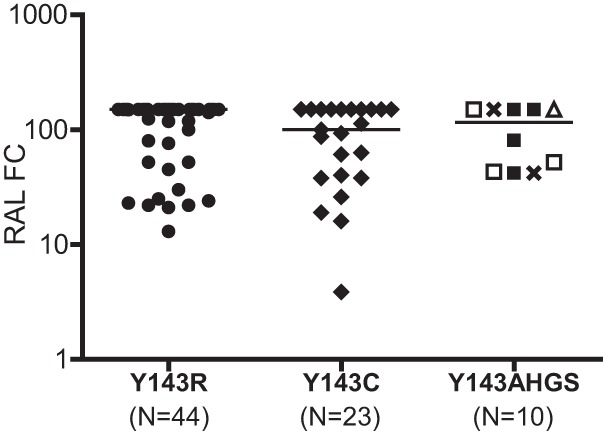
Fig 1
Fig 1
RAL susceptibility of 77 pseudoviruses containing patient-derived HIV-1 integrase sequences with Y143X substitutions. Susceptibility was measured using the Phenosense Integrase assay and is expressed as the fold change (FC) in the EC50 of patient-derived viruses relative to the wild-type reference virus. Solid circles and diamonds depict the RAL susceptibility of viruses containing Y143R and Y143C substitutions, respectively. Open triangle, open squares, crosses, and filled squares depict viruses containing Y143A (n = 1), Y143G (n = 3), Y143H (n = 2), and Y143S (n = 4), respectively. The median FC for each virus group is indicated by a solid line. The highest RAL concentration evaluated in these assays prevented exact quantitation of EC50 FC measurements that exceeded the reference virus EC50 150-fold. Viruses with mixtures at position 143 were excluded.
Fig 2
Fig 2
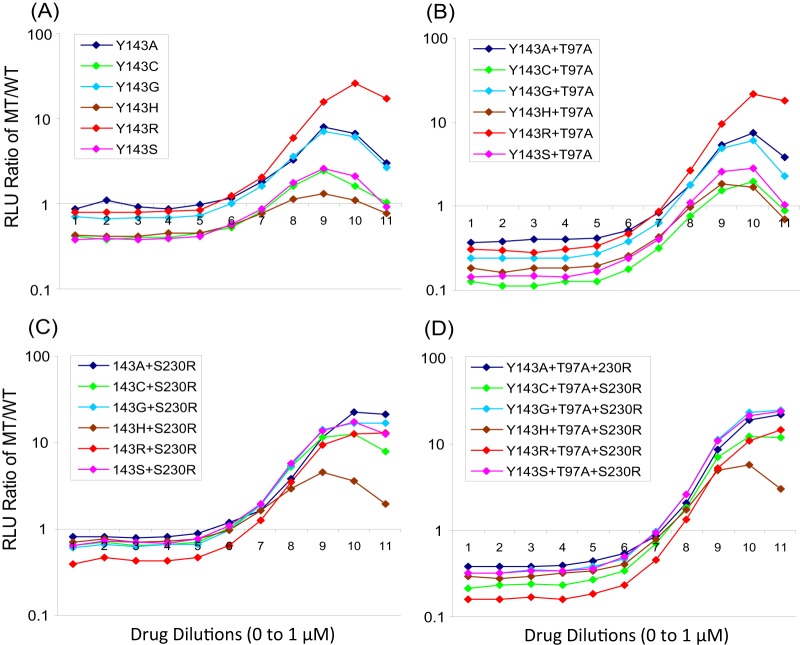
Replication profiles of site-directed mutants carrying a specific Y143 substitution alone and in combination with secondary substitutions. The ratios of mutant (MT) to wild-type (WT) replication (relative light units [RLU]) were assessed as single determinations in the absence of RAL (designated 1 on the x axis) and in the presence of 10 serial 3-fold dilutions of RAL (0.000051 μM to 1 μM, designated 2 to 11 on the x axis). (A) Y143X single-site mutants (A, C, G, H, R, and S); (B) Y143X plus T97A double-site mutants; (C) Y143X plus S230R double-site mutants; (D) Y143X plus T97A and S230R triple-site mutants.
Fig 3
Fig 3
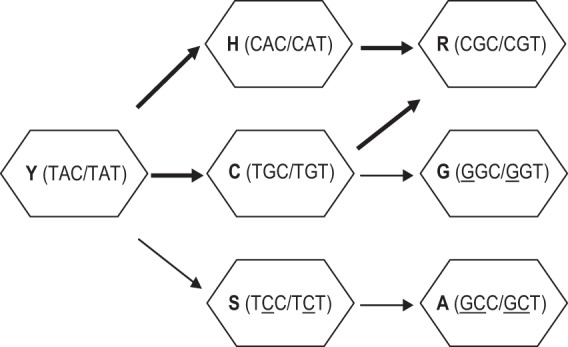
Nucleotide changes in Y143 codons that result in observed amino acid substitutions. Single nucleotide changes within either of two possible Y143 codons (TAC or TAT) are sufficient to produce Y143H, Y143C, or Y143S substitutions. Two nucleotide changes are required to produce Y143R, Y143G, or Y143A substitutions. Transitions (purine to purine or pyrimidine to pyrimidine changes) and transversions (purine to pyrimidine or pyrimidine to purine) are indicated with thick or thin arrows, respectively. Nucleotides involved in transversions are underlined.
Fig 4
Fig 4
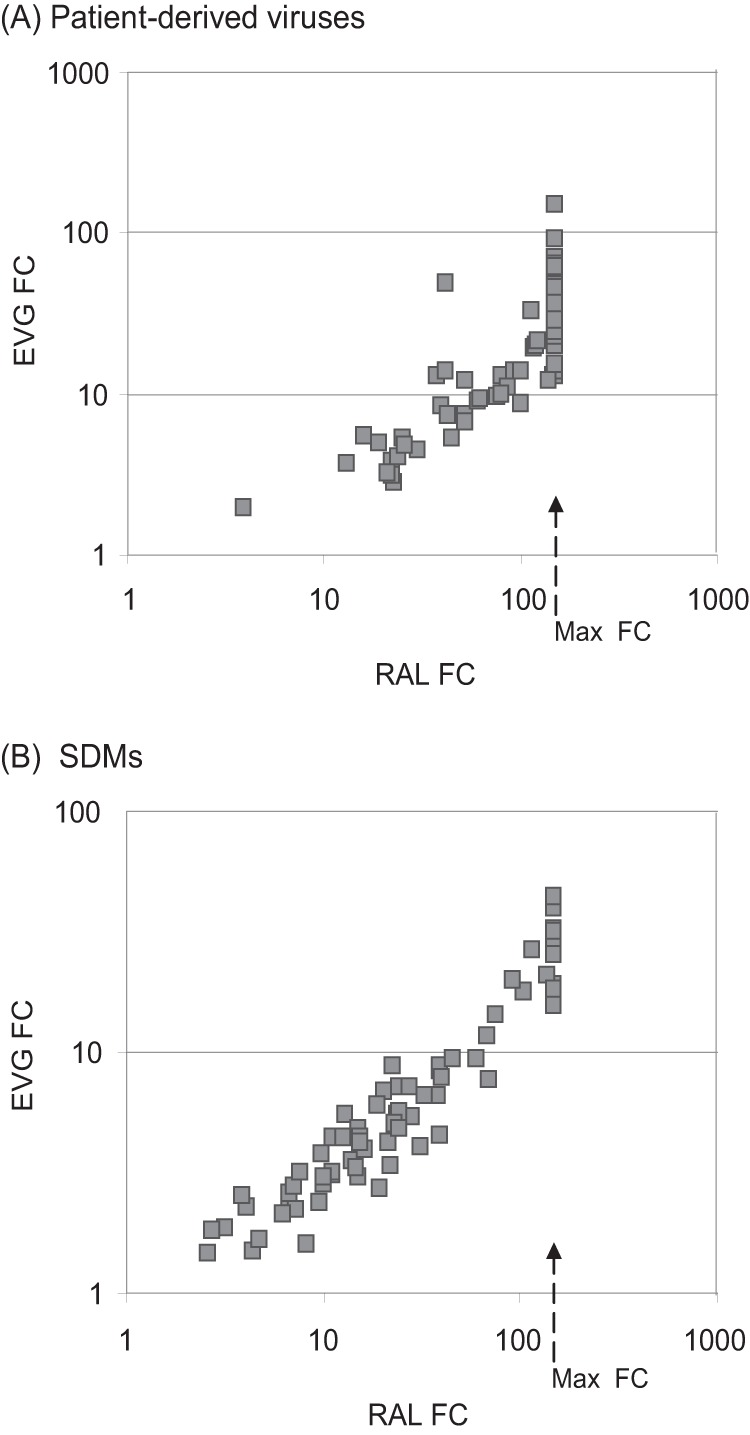
Comparison of RAL and EVG susceptibility of patient-derived viruses and site-directed-mutants (SDMs) containing Y143X substitutions using the PhenoSense Integrase assay and expressed as FC in EC50 relative to the wild-type reference virus. (A) Correlation of RAL and EVG susceptibility among 77 patient viruses (see Fig. 1). (B) Correlation of RAL and EVG susceptibility of SDMs containing Y143X substitutions alone or in combination with additional RAL resistance-associated secondary substitutions (see Table 3 and Fig. 5). Arrows indicate the highest RAL FC in EC50 that was measured in the assay.
Fig 5
Fig 5
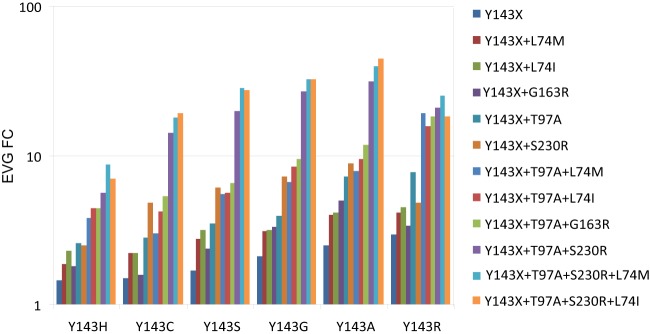
EVG susceptibility of pseudoviruses engineered by site-directed mutagenesis (SDMs) containing Y143X substitutions alone or in combination with additional RAL resistance-associated secondary substitutions. Susceptibility was measured using the PhenoSense Integrase assay and expressed as FC in EC50 relative to the wild-type reference virus. EVG FC results are expressed as the means of duplicates of each mutant. The FC variation between duplicates of each mutant was <1.5.

References

    1. Bonnenfant S, Thomas CM, Vita C, Subra F, Deprez E, Zouhiri F, Desmaele D, D'Angelo J, Mouscadet JF, Leh H. 2004. Styrylquinolines, integrase inhibitors acting prior to integration: a new mechanism of action for anti-integrase agents. J. Virol. 78:5728–5736 - PMC - PubMed
    1. Pannecouque C, Pluymers W, Van Maele B, Tetz V, Cherepanov P, De Clercq E, Witvrouw M, Debyser Z. 2002. New class of HIV integrase inhibitors that block viral replication in cell culture. Curr. Biol. 12:1169–1177 - PubMed
    1. Bushman FD, Craigie R. 1991. Activities of human immunodeficiency virus (HIV) integration protein in vitro: specific cleavage and integration of HIV DNA. Proc. Natl. Acad. Sci. U. S. A. 88:1339–1343 - PMC - PubMed
    1. Bushman FD, Fujiwara T, Craigie R. 1990. Retroviral DNA integration directed by HIV integration protein in vitro. Science 249:1555–1558 - PubMed
    1. Hazuda DJ, Felock P, Witmer M, Wolfe A, Stillmock K, Grobler JA, Espeseth A, Gabryelski L, Schleif W, Blau C, Miller MD. 2000. Inhibitors of strand transfer that prevent integration and inhibit HIV-1 replication in cells. Science 287:646–650 - PubMed

Publication types

MeSH terms