


Plastic bags for prevention of hypothermia in preterm and low birth weight infants
- PMID: 23733796
- PMCID: PMC3691528
- DOI: 10.1542/peds.2012-2030
Plastic bags for prevention of hypothermia in preterm and low birth weight infants
Abstract
Background and objectives: Hypothermia contributes to neonatal mortality and morbidity, especially in preterm and low birth weight infants in developing countries. Plastic bags covering the trunk and extremities of very low birth weight infants reduces hypothermia. This technique has not been studied in larger infants or in many resource-limited settings. The objective was to determine if placing preterm and low birth weight infants inside a plastic bag at birth maintains normothermia.
Methods: Infants at 26 to 36 weeks' gestational age and/or with a birth weight of 1000 to 2500 g born at the University Teaching Hospital in Lusaka, Zambia, were randomized by using a 1:1 allocation and parallel design to standard thermoregulation (blanket or radiant warmer) care or to standard thermoregulation care plus placement inside a plastic bag at birth. The primary outcome measure was axillary temperature in the World Health Organization-defined normal range (36.5-37.5°C) at 1 hour after birth.
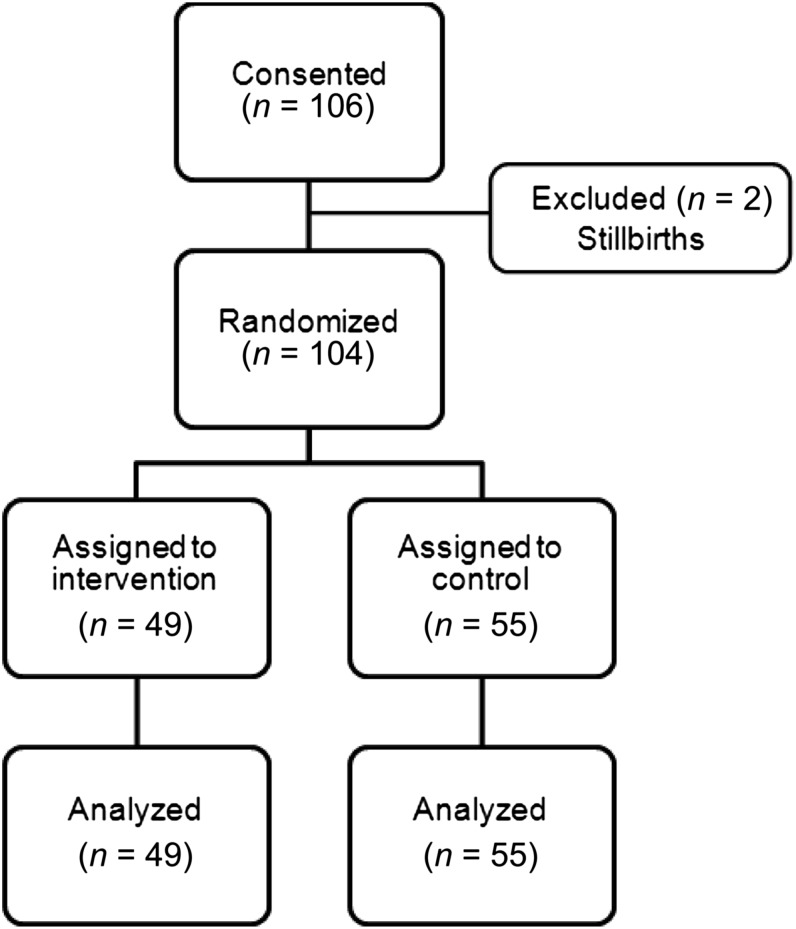
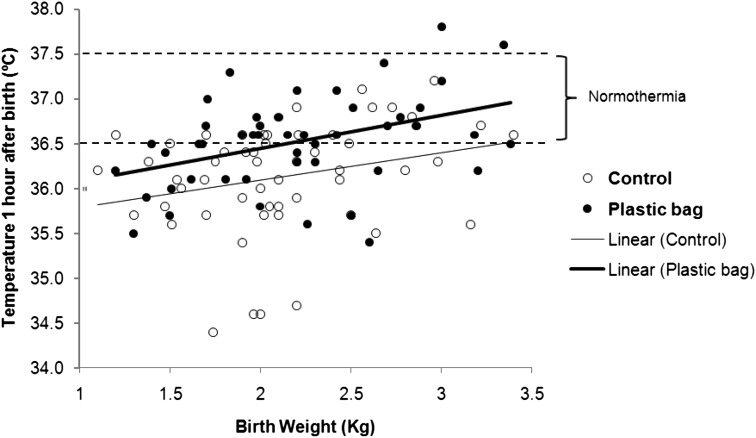
Results: A total of 104 infants were randomized. At 1 hour after birth, infants randomized to plastic bag (n = 49) were more likely to have a temperature in the normal range as compared with infants in the standard thermoregulation care group (n = 55; 59.2% vs 32.7%; relative risk 1.81; 95% confidence interval 1.16-2.81; P = .007). The temperature at 1 hour after birth in the infants randomized to plastic bag was 36.5 ± 0.5°C compared with 36.1 ± 0.6°C in standard care infants (P < .001). Hyperthermia (>38.0°C) did not occur in any infant.
Conclusions: Placement of preterm/low birth weight infants inside a plastic bag at birth compared with standard thermoregulation care reduced hypothermia without resulting in hyperthermia, and is a low-cost, low-technology tool for resource-limited settings.
Trial registration: ClinicalTrials.gov NCT01403623.
Keywords: diseases/prevention and control; hypothermia/prevention and control; infant newborn; infant premature; perinatal care/methods.
Figures
Comment in
-
Plastics bags reduce hypothermia in newly born infants in the developing world.Evid Based Med. 2014 Apr;19(2):59. doi: 10.1136/eb-2013-101513. Epub 2013 Oct 10. Evid Based Med. 2014. PMID: 24113230 No abstract available.
References
-
- Liu L, Johnson HL, Cousens S, et al. Child Health Epidemiology Reference Group of WHO and UNICEF . Global, regional, and national causes of child mortality: an updated systematic analysis for 2010 with time trends since 2000. Lancet. 2012;379(9832):2151–2161 - PubMed
-
- Lawn JE, Kerber K, Enweronu-Laryea C, Cousens S. 3.6 million neonatal deaths—what is progressing and what is not? Semin Perinatol. 2010;34(6):371–386 - PubMed
-
- Silverman WA, Fertig JW, Berger AP. The influence of the thermal environment upon the survival of newly born premature infants. Pediatrics. 1958;22(5):876–886 - PubMed
-
- Day RL, Caliguiri L, Kamenski C, Ehrlich F. Body temperature and survival of premature infants. Pediatrics. 1964;34:171–181 - PubMed
-
- Klaus MH, Fanaroff AA. Care of the High-Risk Neonate. 6th ed. St. Louis, MO: W. B. Saunders Company; 2001
Publication types
MeSH terms
Substances
Associated data
Grants and funding
LinkOut - more resources
Full Text Sources
Other Literature Sources
Medical
