


Evaluation of radiation doses and associated risk from the Fukushima nuclear accident to marine biota and human consumers of seafood
- PMID: 23733934
- PMCID: PMC3696798
- DOI: 10.1073/pnas.1221834110
Evaluation of radiation doses and associated risk from the Fukushima nuclear accident to marine biota and human consumers of seafood
Abstract
Radioactive isotopes originating from the damaged Fukushima nuclear reactor in Japan following the earthquake and tsunami in March 2011 were found in resident marine animals and in migratory Pacific bluefin tuna (PBFT). Publication of this information resulted in a worldwide response that caused public anxiety and concern, although PBFT captured off California in August 2011 contained activity concentrations below those from naturally occurring radionuclides. To link the radioactivity to possible health impairments, we calculated doses, attributable to the Fukushima-derived and the naturally occurring radionuclides, to both the marine biota and human fish consumers. We showed that doses in all cases were dominated by the naturally occurring alpha-emitter (210)Po and that Fukushima-derived doses were three to four orders of magnitude below (210)Po-derived doses. Doses to marine biota were about two orders of magnitude below the lowest benchmark protection level proposed for ecosystems (10 µGy⋅h(-1)). The additional dose from Fukushima radionuclides to humans consuming tainted PBFT in the United States was calculated to be 0.9 and 4.7 µSv for average consumers and subsistence fishermen, respectively. Such doses are comparable to, or less than, the dose all humans routinely obtain from naturally occurring radionuclides in many food items, medical treatments, air travel, or other background sources. Although uncertainties remain regarding the assessment of cancer risk at low doses of ionizing radiation to humans, the dose received from PBFT consumption by subsistence fishermen can be estimated to result in two additional fatal cancer cases per 10,000,000 similarly exposed people.
Keywords: cesium; migration.
Conflict of interest statement
The authors declare no conflict of interest.
Figures
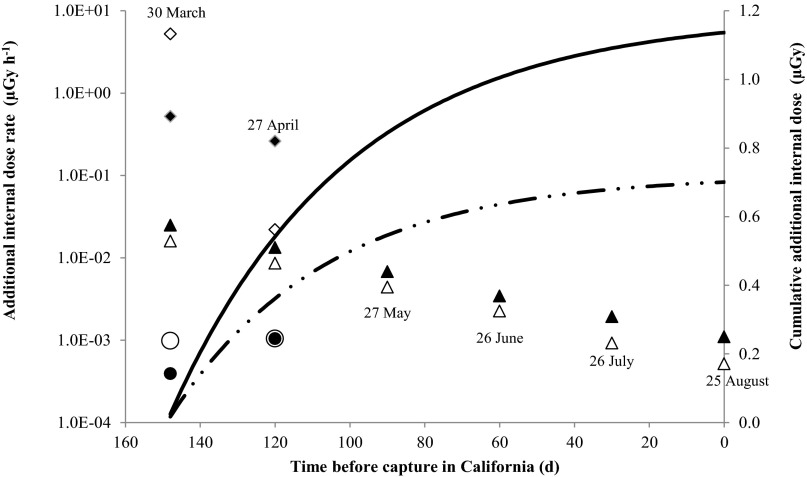
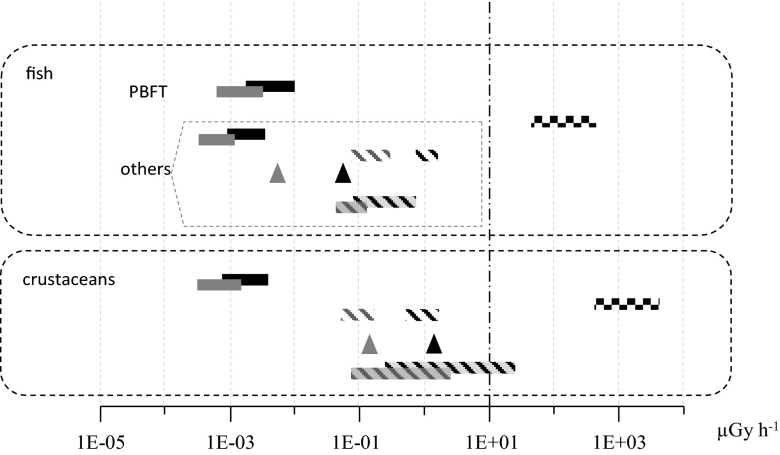
 , nonweighted). Also shown are total dose rates from naturally occurring radionuclides from Brown et al. (37) (black and grey hatch, radiation-weighted dose rates; grey and grey hatch, nonweighted dose rates). International effects benchmarks are presented for comparison [broken vertical line, ERICA screening benchmark value protective of ecosystems (11, 17); checkered bars, ICRP-derived consideration reference levels (10)].
References
-
- Beresford NA, Copplestone D. Effects of ionizing radiation on wildlife: What knowledge have we gained between the Chernobyl and Fukushima accidents? Integr Environ Assess Manag. 2011;7(3):371–373. - PubMed
-
- Garnier-Laplace J, Beaugelin-Seiller K, Hinton TG. Fukushima wildlife dose reconstruction signals ecological consequences. Environ Sci Technol. 2011;45(12):5077–5078. - PubMed
Publication types
MeSH terms
Substances
LinkOut - more resources
Full Text Sources
Other Literature Sources
Molecular Biology Databases
