


The defective RNAs of Closteroviridae
- PMID: 23734149
- PMCID: PMC3661990
- DOI: 10.3389/fmicb.2013.00132
The defective RNAs of Closteroviridae
Abstract
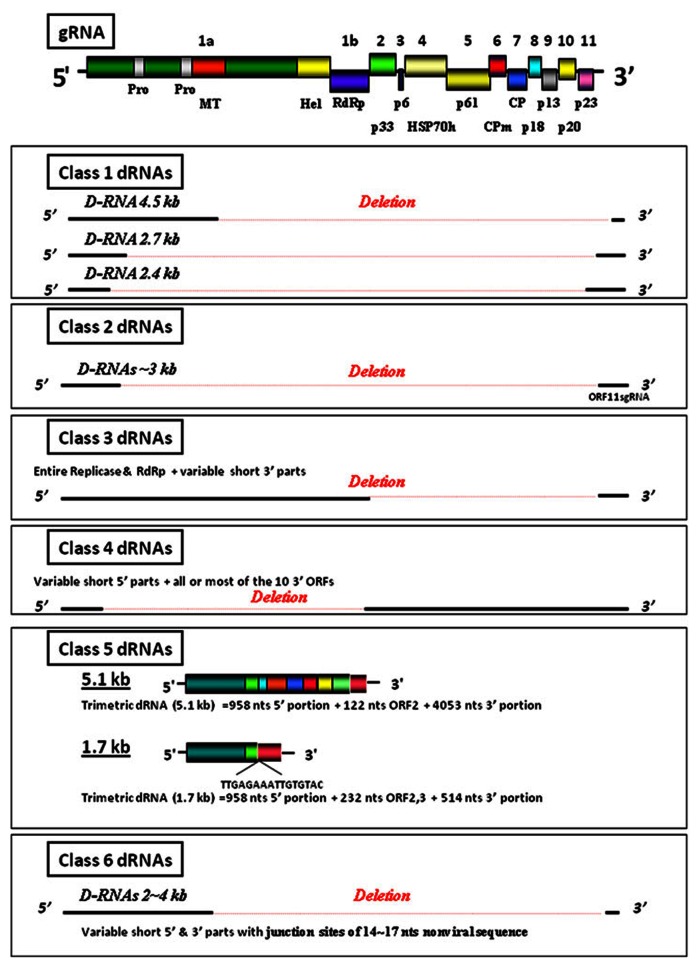
The family Closteroviridae consists of two genera, Closterovirus and Ampelovirus with monopartite genomes transmitted respectively by aphids and mealybugs and the Crinivirus with bipartite genomes transmitted by whiteflies. The Closteroviridae consists of more than 30 virus species, which differ considerably in their phytopathological significance. Some, like beet yellows virus and citrus tristeza virus (CTV) were associated for many decades with their respective hosts, sugar beets and citrus. Others, like the grapevine leafroll-associated ampeloviruses 1, and 3 were also associated with their grapevine hosts for long periods; however, difficulties in virus isolation hampered their molecular characterization. The majority of the recently identified Closteroviridae were probably associated with their vegetative propagated host plants for long periods and only detected through the considerable advances in dsRNA isolation and sequencing of PCR amplified replicons. Molecular characterization of CTV and several other Closteroviridae revealed that, in addition to genomic and subgenomic RNAs, infected plants contain several different subviral defective RNAs (dRNAs). The roles and biological functions of dRNAs associated with Closteroviridae remain terra incognita.
Keywords: RNA recombination; RNA viruses; citrus viruses; defective RNA; non-replicative RNAs; template-switching; viral replicase; virus replication.
Figures
References
-
- Ayllon M. A., Lopez C., Navas-Castillo J., Mawassi M., Dawson W. O., Guerri J., et al. (1999). New defective RNAs from citrus tristeza virus: evidence for a replicase-driven template switching mechanism in their generation. J. Gen. Virol. 80 817–821 - PubMed
-
- Bar-Joseph M., Marcus R., Lee R. F. (1989). The continuous challenge of citrus tristeza virus control. Annu. Rev. Phytopathol. 27 291–316
-
- Bar-Joseph M., Yang G., Gafny R., Mawassi M. (1997). Subgenomic RNAs: the possible building blocks for modular recombination of Closteroviridae genomes. Semin. Virol. 8 113–119
LinkOut - more resources
Full Text Sources
Other Literature Sources
