. 2013 May 29;8(5):e65226.
doi: 10.1371/journal.pone.0065226. Print 2013.

Rapid 16S rRNA next-generation sequencing of polymicrobial clinical samples for diagnosis of complex bacterial infections

Affiliations

Rapid 16S rRNA next-generation sequencing of polymicrobial clinical samples for diagnosis of complex bacterial infections

Stephen J Salipante et al. PLoS One. .

Abstract

Classifying individual bacterial species comprising complex, polymicrobial patient specimens remains a challenge for culture-based and molecular microbiology techniques in common clinical use. We therefore adapted practices from metagenomics research to rapidly catalog the bacterial composition of clinical specimens directly from patients, without need for prior culture. We have combined a semiconductor deep sequencing protocol that produces reads spanning 16S ribosomal RNA gene variable regions 1 and 2 (∼360 bp) with a de-noising pipeline that significantly improves the fraction of error-free sequences. The resulting sequences can be used to perform accurate genus- or species-level taxonomic assignment. We explore the microbial composition of challenging, heterogeneous clinical specimens by deep sequencing, culture-based strain typing, and Sanger sequencing of bulk PCR product. We report that deep sequencing can catalog bacterial species in mixed specimens from which usable data cannot be obtained by conventional clinical methods. Deep sequencing a collection of sputum samples from cystic fibrosis (CF) patients reveals well-described CF pathogens in specimens where they were not detected by standard clinical culture methods, especially for low-prevalence or fastidious bacteria. We also found that sputa submitted for CF diagnostic workup can be divided into a limited number of groups based on the phylogenetic composition of the airway microbiota, suggesting that metagenomic profiling may prove useful as a clinical diagnostic strategy in the future. The described method is sufficiently rapid (theoretically compatible with same-day turnaround times) and inexpensive for routine clinical use.


Conflict of interest statement

Competing Interests: The authors have the following interests: co-authors Gina Costa, Jessica Spangler, Clarence Lee, and Timothy Harkins are employees of Life Technologies (parent company of Ion Torrent), and that this work was financially supported in part by Life Technologies Corporation. There are no patents, products in development or marketed products to declare. This does not alter the authors' adherence to all the PLOS ONE policies on sharing data and materials.

Figures

Figure 1
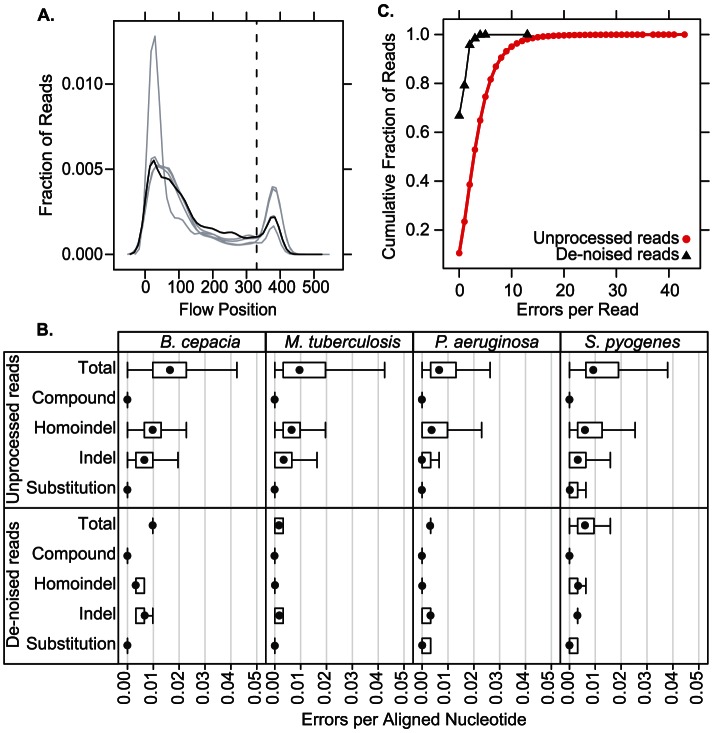
Figure 1. Distribution of read lengths and sequence errors.
(A) Kernel density plot of read lengths obtained by extended-length ion semiconductor sequencing. Each line represent results from an independent library, black line indicates library containing controls for error rate calculations and sensitivity studies. Vertical line marks the cutoff for full-length sequences. (B) Error rates for unprocessed and de-noised sequence reads, stratified by error type and reference organism. (C) Cumulative proportion of unprocessed and de-noised sequence reads at defined error counts. For unprocessed reads the fraction of sequences represented at a particular error count reflects the number of reads, and for de-noised sequences it reflects the total number of reads contributing to clusters.
Figure 2
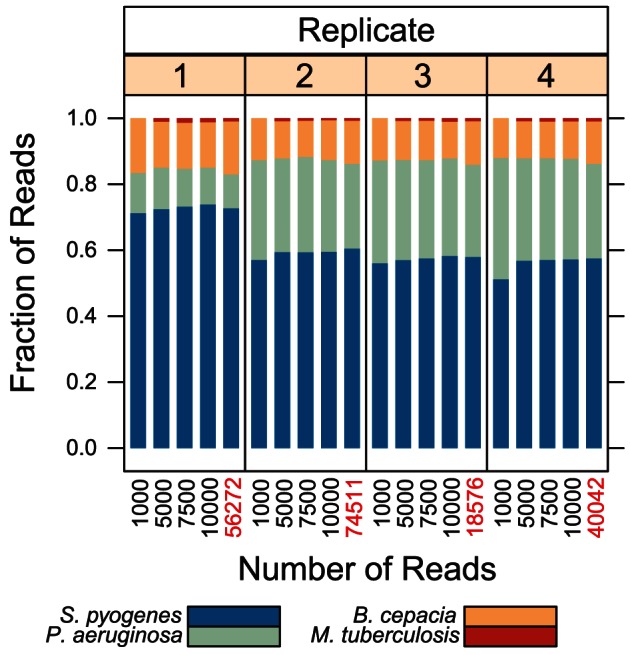
Figure 2. Recovery of low-prevalence species in polymicrobial specimens and reproducibility.
The fraction of de-noised sequence reads with highest pairwise alignment scores to the indicated reference sequence among four replicates of sequencing a mixture of reference organisms. Replicates 3 and 4 were generated from 1/10 and 1/100 the template DNA of the other replicates, respectively. The number of de-noised reads (black) or unprocessed reads (red) contributing to each analysis is indicated on the x-axis.
Figure 3
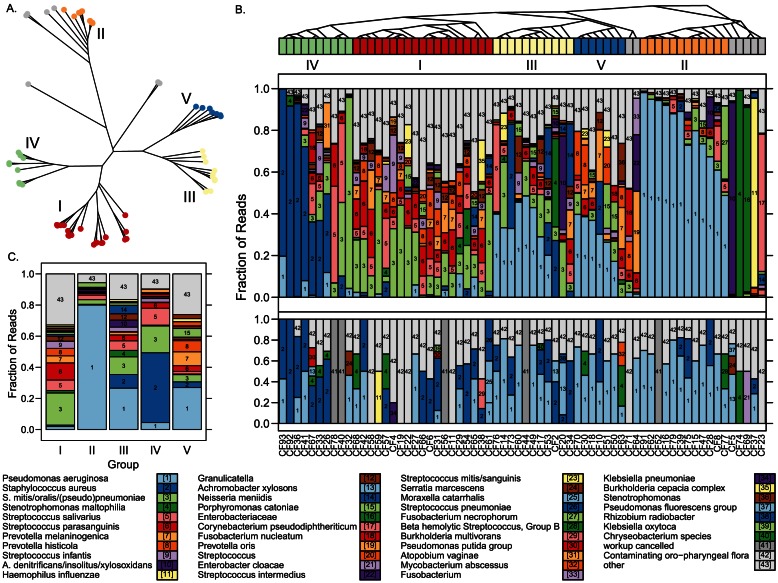
Figure 3. Metagenomic content and phylogenetic clustering of 66 CF sputa samples.
Taxonomic names (family, genus, species, or a combination of species where appropriate) appearing with a relative abundance of at least 15% of denoised reads in one or more specimens are indicated in the legend. Any taxonomic name that failed to meet this threshold was assigned the label “Other”. Organisms considered to be components of normal oropharyngeal microbiota by culture were not further speciated according to standard procedures in the clinical laboratory, and were assigned the general label “Contaminating orophoryngeal flora”. Taxonomic labels apply to parts B and C. (A) Phylogenetic “squash” clustering of CF bacterial composition. Samples are color-coded according to group (indicated in Roman numerals). Samples colored grey are ungrouped. (B) Classification performed by analysis of de-noised deep sequencing reads using pplacer (top panel) and culture (bottom panel). The relative number of each species (by read count or colony abundance, respectively) is represented by the height of corresponding bars. Phylogenetic “squash” clustering of specimens from deep sequence data is represented as a cladogram, with specimens colored as in part A. (C) Consensus microbiota profile of phylogenetic groups, averaged from all members of the group. Relative abundance of species, as estimated by the fraction of contributory reads, is indicated.

References

    1. Gill SR, Pop M, Deboy RT, Eckburg PB, Turnbaugh PJ, et al. (2006) Metagenomic analysis of the human distal gut microbiome. Science 312: 1355–1359. - PMC - PubMed
    1. Gajer P, Brotman RM, Bai G, Sakamoto J, Schutte UM, et al. (2012) Temporal dynamics of the human vaginal microbiota. Sci Transl Med 4: 132ra152. - PMC - PubMed
    1. Rhoads DD, Wolcott RD, Sun Y, Dowd SE (2012) Comparison of culture and molecular identification of bacteria in chronic wounds. Int J Mol Sci 13: 2535–2550. - PMC - PubMed
    1. Blumberg R, Powrie F (2012) Microbiota, disease, and back to health: a metastable journey. Sci Transl Med 4: 137rv137. - PMC - PubMed
    1. Schlaberg R, Simmon KE, Fisher MA (2012) A systematic approach for discovering novel, clinically relevant bacteria. Emerg Infect Dis 18: 422–430. - PMC - PubMed

Publication types

MeSH terms