


Impact of low blood lead concentrations on IQ and school performance in Chinese children
- PMID: 23734241
- PMCID: PMC3667072
- DOI: 10.1371/journal.pone.0065230
Impact of low blood lead concentrations on IQ and school performance in Chinese children
Abstract
Objectives: Examine the relationships between blood lead concentrations and children's intelligence quotient (IQ) and school performance.
Participants and methods: Participants were 1341 children (738 boys and 603 girls) from Jintan, China. Blood lead concentrations were measured when children were 3-5 years old. IQ was assessed using the Chinese version and norms of the Wechsler Preschool and Primary Scale of Intelligence - Revised when children were 6 years old. School performance was assessed by standardized city tests on 3 major subjects (Chinese, Math, and English [as a foreign language]) when children were age 8-10 years.
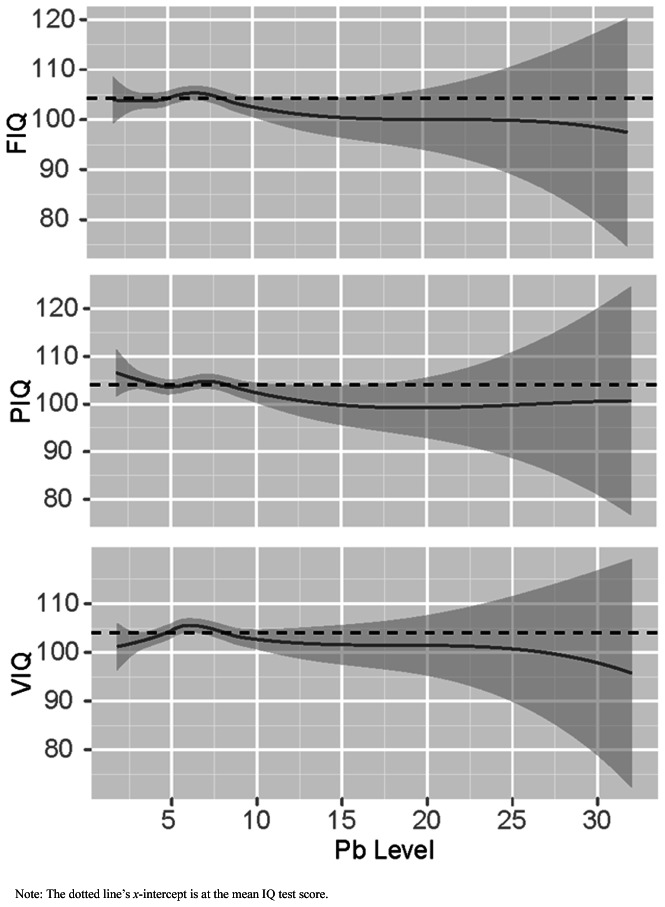
Results: Mean blood lead concentration was 6.43 µg/dL (SD = 2.64). For blood lead concentrations, 7.8% of children (n = 105) had ≥10.0 µg/dL, 13.8% (n = 185) had 8.0 to <10.0 µg/dL, and 78.4% (n = 1051) had <8.0 µg/dL. Compared to children with blood lead concentrations <8 µg/dL, those with blood lead concentrations ≥8 µg/dL scored 2-3 points lower in IQ and 5-6 points lower in school tests. There were no significant differences in IQ or school tests between children with blood lead concentrations groups 8-10 and ≥10 µg/dL. After adjustment for child and family characteristics and IQ, blood lead concentrations ≥10 µg/dL vs <8 µg/dL at ages 3-5 years was associated with reduced scores on school tests at age 8-10 years (Chinese, β = -3.54, 95%CI = -6.46, -0.63; Math, β = -4.63, 95%CI = -7.86, -1.40; English, β = -4.66, 95%CI = -8.09, -1.23). IQ partially mediated the relationship between elevated blood lead concentrations and later school performance.
Conclusions: Findings support that blood lead concentrations in early childhood, even <10 µg/dL, have a long-term negative impact on cognitive development. The association between blood lead concentrations 8-10 µg/dL and cognitive development needs further study in Chinese children and children from other developing countries.
Conflict of interest statement
Figures
References
-
- Needleman HL, Schell A, Bellinger D, Leviton A, Allred EN (1990) The long-term effects of exposure to low doses of lead in childhood. An 11-year follow-up report. N Engl J Med 322: 83–88. - PubMed
-
- Dietrich KN, Ris MD, Succop PA, Berger OG, Bornschein RL (2001) Early exposure to lead and juvenile delinquency. Neurotoxicol Teratol 23: 511–8. - PubMed
Publication types
MeSH terms
Substances
Grants and funding
LinkOut - more resources
Full Text Sources
Other Literature Sources
