


Bivalent ligands that target μ opioid (MOP) and cannabinoid1 (CB1) receptors are potent analgesics devoid of tolerance
- PMID: 23734559
- PMCID: PMC3849126
- DOI: 10.1021/jm4005219
Bivalent ligands that target μ opioid (MOP) and cannabinoid1 (CB1) receptors are potent analgesics devoid of tolerance
Abstract
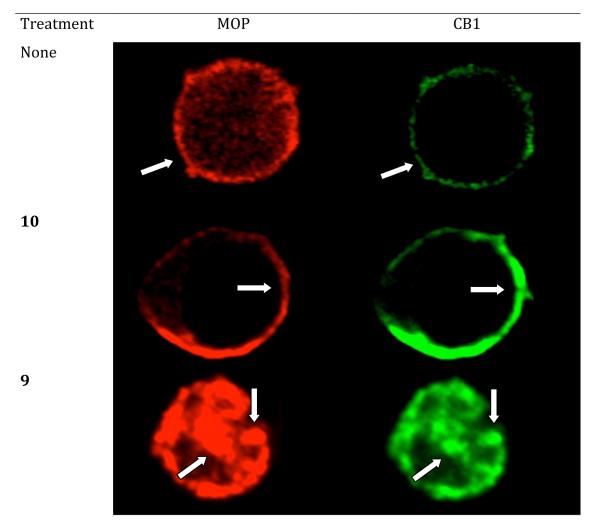
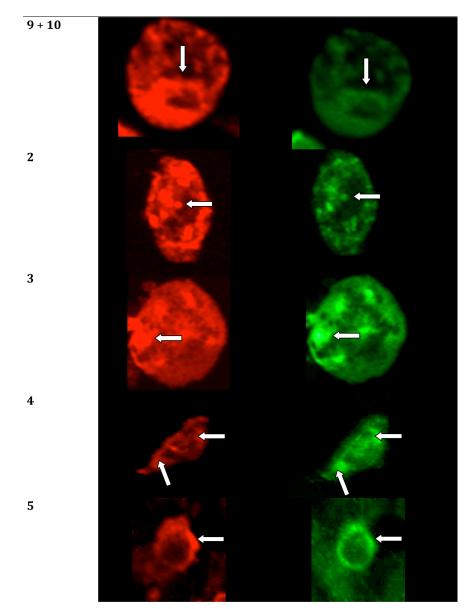
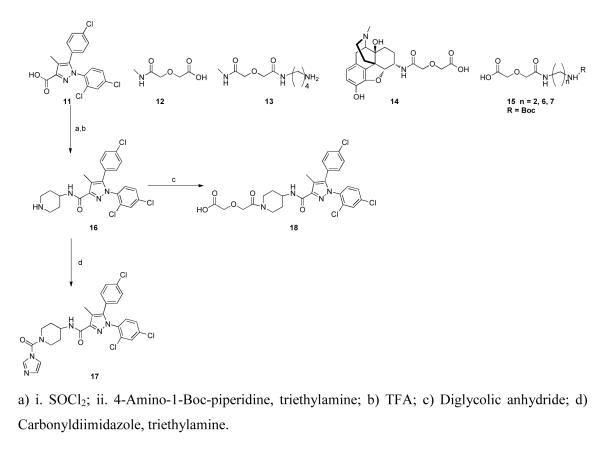
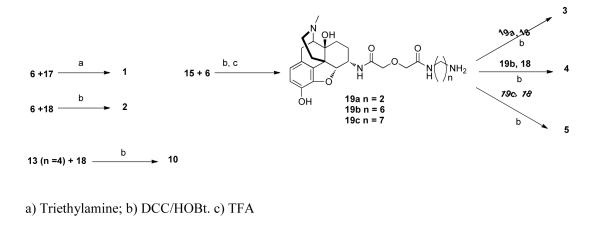
Given that μ opioid (MOP) and canabinoid (CB1) receptors are colocalized in various regions of the central nervous system and have been reported to associate as heteromer (MOP-CB1) in cultured cells, the possibility of functional, endogenous MOP-CB1 in nociception and other pharmacologic effects has been raised. As a first step in investigating this possibility, we have synthesized a series of bivalent ligands 1-5 that contain both μ agonist and CB1 antagonist pharmacophores for use as tools to study the functional interaction between MOP and CB1 receptors in vivo. Immunofluorescent studies on HEK293 cells coexpressing both receptors suggested 5 (20-atom spacer) to be the only member of the series that bridges the protomers of the heteromer. Antinociceptive testing in mice revealed 5 to be the most potent member of the series. As neither a mixture of monovalent ligands 9 + 10 nor bivalents 2-5 produced tolerance in mice, MOR-CB1 apparently is not an important target for reducing tolerance.
Figures
References
-
- Vigano D, Rubino T, Parolaro D. Molecular and cellular basis of cannabinoid and opioid interactions. Pharmacol., Biochem. Behav. 2005;81:360–368. - PubMed
-
- Mansour A, Khachaturian H, Lewis M, Akil H, Watson SJ. Anatomy of CNS opioid receptors. Trends NeuroSci. (Pers. Ed.) 1988;11:308–314. 2 plates. - PubMed
-
- Parolaro D, Rubino T, Vigano D, Massi P, Guidali C, Realini N. Cellular mechanisms underlying the interaction between cannabinoid and opioid system. Curr. Drug Targets. 2010;11:393–405. - PubMed
Publication types
MeSH terms
Substances
Grants and funding
LinkOut - more resources
Full Text Sources
Other Literature Sources
Research Materials
