


Representing physiological processes and their participants with PhysioMaps
- PMID: 23735231
- PMCID: PMC3632997
- DOI: 10.1186/2041-1480-4-S1-S2
Representing physiological processes and their participants with PhysioMaps
Abstract
Background: As the number and size of biological knowledge resources for physiology grows, researchers need improved tools for searching and integrating knowledge and physiological models. Unfortunately, current resources-databases, simulation models, and knowledge bases, for example-are only occasionally and idiosyncratically explicit about the semantics of the biological entities and processes that they describe.
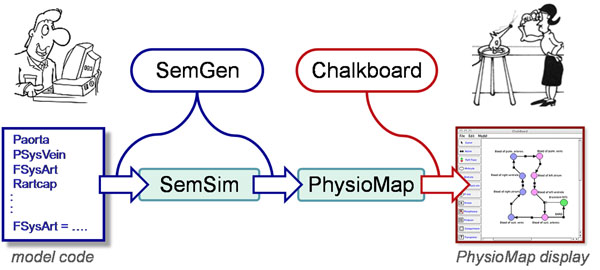
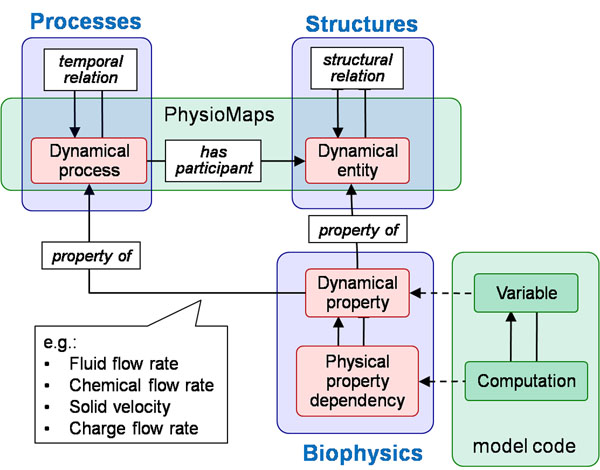
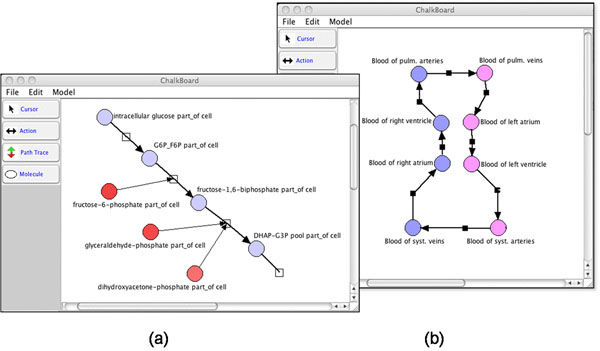
Results: We present a formal approach, based on the semantics of biophysics as represented in the Ontology of Physics for Biology, that divides physiological knowledge into three partitions: structural knowledge, process knowledge and biophysical knowledge. We then computationally integrate these partitions across multiple structural and biophysical domains as computable ontologies by which such knowledge can be archived, reused, and displayed. Our key result is the semi-automatic parsing of biosimulation model code into PhysioMaps that can be displayed and interrogated for qualitative responses to hypothetical perturbations.
Conclusions: Strong, explicit semantics of biophysics can provide a formal, computational basis for integrating physiological knowledge in a manner that supports visualization of the physiological content of biosimulation models across spatial scales and biophysical domains.
Figures
References
-
- KEGG (Kyoto Encyclopedia of Genes and Genomes) accessed: 2012 from http://www.genome.jp/kegg/
-
- Reactome (Reactome) accessed: 2012 from http://www.reactome.org.
-
- BioModels (Biomodels Database - A Database of Annotated Published Models) accessed: 2012 from http://www.ebi.ac.uk/biomodels-main/
LinkOut - more resources
Full Text Sources
Other Literature Sources
Research Materials
