


Review
doi: 10.1016/j.coviro.2013.05.011.
Epub 2013 Jun 2.
Evasion of adaptive and innate immune response mechanisms by γ-herpesviruses
Affiliations
- PMID: 23735334
- PMCID: PMC4397892
- DOI: 10.1016/j.coviro.2013.05.011
Item in Clipboard
Review
Evasion of adaptive and innate immune response mechanisms by γ-herpesviruses
Curr Opin Virol.
2013 Jun.
Abstract
γ-Herpesviral immune evasion mechanisms are optimized to support the acute, lytic and the longterm, latent phase of infection. During acute infection, specific immune modulatory proteins limit, but also exploit, the antiviral activities of cell intrinsic innate immune responses as well as those of innate and adaptive immune cells. During latent infection, a restricted gene expression program limits immune targeting and cis-acting mechanisms to reduce the antigen presentation as well as antigenicity of latency-associated proteins. Here, we will review recent progress in our understanding of γ-herpesviral immune evasion strategies.
Copyright © 2013 Elsevier B.V. All rights reserved.
Figures
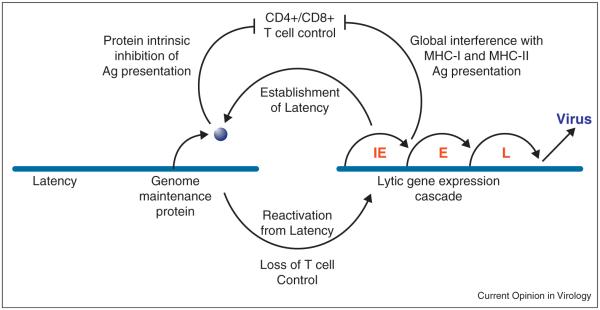
Evasion of T cell responses by g herpesviruses.
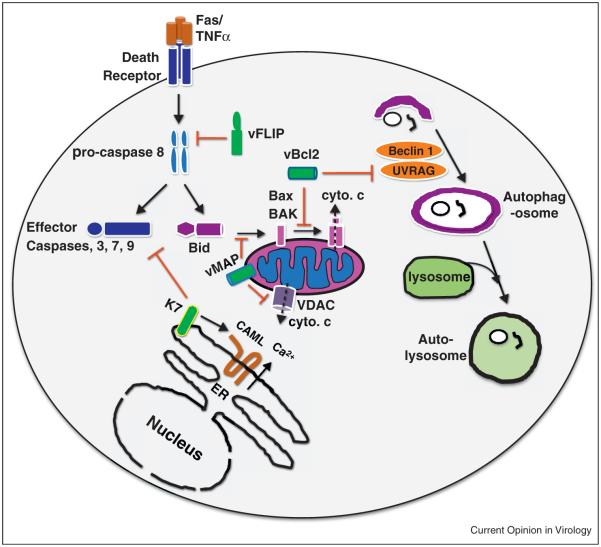
Inhibition of the classical apoptosis and autophagy pathway by γ-herpesvirus proteins. KSHV vFLIP and K7 target pro-caspase 8 and activated caspase 3 for inhibition, whereas vBcl2 and MHV-68 vMAP antagonize the oligomerization of Bax/Bak and VDAC that release cytochrome c (cyto. c). Additionally, KSHV K7 activates CAML in releasing calcium from the ER to attenuate stress induced apoptosis. Of the classic autophagy pathway, vBcl2 suppresses UVRAG in autophagosome formation. Viral proteins are colored in green.
References
-
- Freeman ML, Lanzer KG, Cookenham T, Peters B, Sidney J, et al. Two kinetic patterns of epitope-specific CD8 T-cell responses following murine gammaherpesvirus 68 infection. J Virol. 2010;84:2881–2892. The authors identified a range of novel H-2(b) restricted epitopes and showed that the T cell response to these epitopes falls into two kinetic classes based on the speed of decline. The slowly declining response corresponded to the latent phase since decline was accelerated when mice were infected with a virus unable to establish latency. This suggests that T cell responses mirror the viral life cycle. - PMC - PubMed
-
- Blake N. Immune evasion by gammaherpesvirus genome maintenance proteins. J Gen Virol. 2010;91:829–846. - PubMed
Publication types
MeSH terms
Grants and funding
LinkOut - more resources
Full Text Sources
Other Literature Sources
