


Characteristics of group A Streptococcus strains circulating during scarlet fever epidemic, Beijing, China, 2011
- PMID: 23735582
- PMCID: PMC4816378
- DOI: 10.3201/eid1906.121020
Characteristics of group A Streptococcus strains circulating during scarlet fever epidemic, Beijing, China, 2011
Abstract
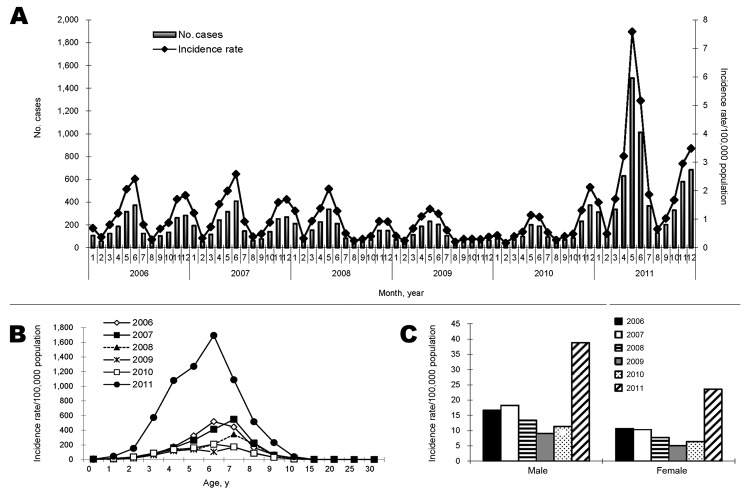
Scarlet fever is one of a variety of diseases caused by group A Streptococcus (GAS). During 2011, a scarlet fever epidemic characterized by peak monthly incidence rates 2.9-6.7 times higher than those in 2006-2010 occurred in Beijing, China. During the epidemic, hospital-based enhanced surveillance for scarlet fever and pharyngitis was conducted to determine characteristics of circulating GAS strains. The surveillance identified 3,359 clinical cases of scarlet fever or pharyngitis. GAS was isolated from 647 of the patients; 76.4% of the strains were type emm12, and 17.1% were emm1. Almost all isolates harbored superantigens speC and ssa. All isolates were susceptible to penicillin, and resistance rates were 96.1% to erythromycin, 93.7% to tetracycline, and 79.4% to clindamycin. Because emm12 type GAS is not the predominant type in other countries, wider surveillance for the possible spread of emm12 type GAS from China to other countries is warranted.
Keywords: Beijing; China; GAS; People’s Republic of China; antimicrobial drug susceptibility; bacteria; emm type; epidemic; group A Streptococcus; pharyngitis; scarlet fever; superantigen; surveillance.
Figures
References
-
- Hoge CW, Schwartz B, Talkington DF, Breiman RF, MacNeill EM, Englender SJ. The changing epidemiology of invasive group A streptococcal infections and the emergence of streptococcal toxic shock–like syndrome. A retrospective population-based study. JAMA. 1993;269:384–9. 10.1001/jama.1993.03500030082037 - DOI - PubMed
Publication types
MeSH terms
LinkOut - more resources
Full Text Sources
Other Literature Sources
Research Materials