. 2013 Jun 4;3(6):e266.
doi: 10.1038/tp.2013.39.

Stress-induced anhedonia is associated with hypertrophy of medium spiny neurons of the nucleus accumbens

Affiliations

Stress-induced anhedonia is associated with hypertrophy of medium spiny neurons of the nucleus accumbens

J M Bessa et al. Transl Psychiatry. .

Abstract

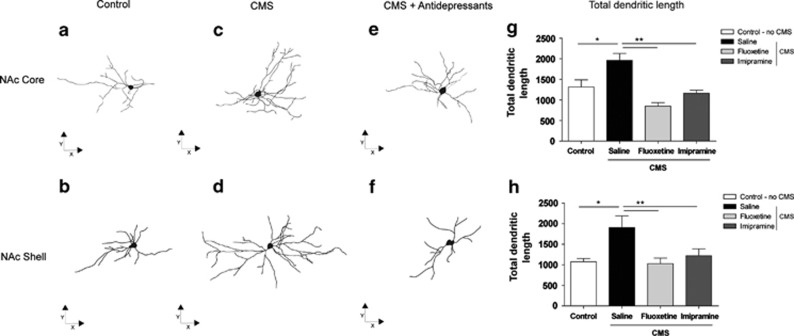
There is accumulating evidence that the nucleus accumbens (NAc) has an important role in the pathophysiology of depression. As the NAc is a key component in the neural circuitry of reward, it has been hypothesized that anhedonia, a core symptom of depression, might be related to dysfunction of this brain region. Neuronal morphology and expression of plasticity-related molecules were examined in the NAc of rats displaying anhedonic behavior (measured in the sucrose-consumption test) in response to chronic mild stress. To demonstrate the relevance of our measurements to depression, we tested whether the observed changes were sensitive to reversal with antidepressants (imipramine and fluoxetine). Data show that animals displaying anhedonic behavior display an hypertrophy of medium spiny neurons in the NAc and, in parallel, have increased expression of the genes encoding for brain-derived neurotrophic factor, neural cell adhesion molecule and synaptic protein synapsin 1. Importantly, the reversal of stress-induced anhedonia by antidepressants is linked to a restoration of gene-expression patterns and dendritic morphology in the NAc. Using an animal model of depression, we show that stress induces anhedonic behavior that is associated with specific changes in the neuronal morphology and in the gene-expression profile of the NAc that are effectively reversed after treatment with antidepressants.


Figures
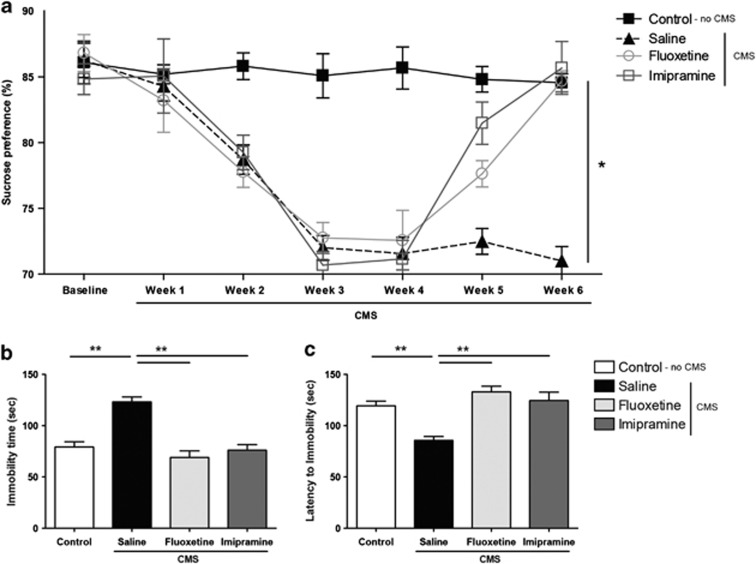
Figure 1
Figure 1
Behavioral effects of chronic mild stress (CMS) on hedonic and learned helplessness behavior. (a) Sucrose preference in the sucrose-consumption tests performed during CMS. (b) Immobility time and (c) latency to immobility time in the forced swimming test performed after CMS and drug administration. *P<0.005; **P<0.001. Data presented as mean±s.e.m.
Figure 2
Figure 2
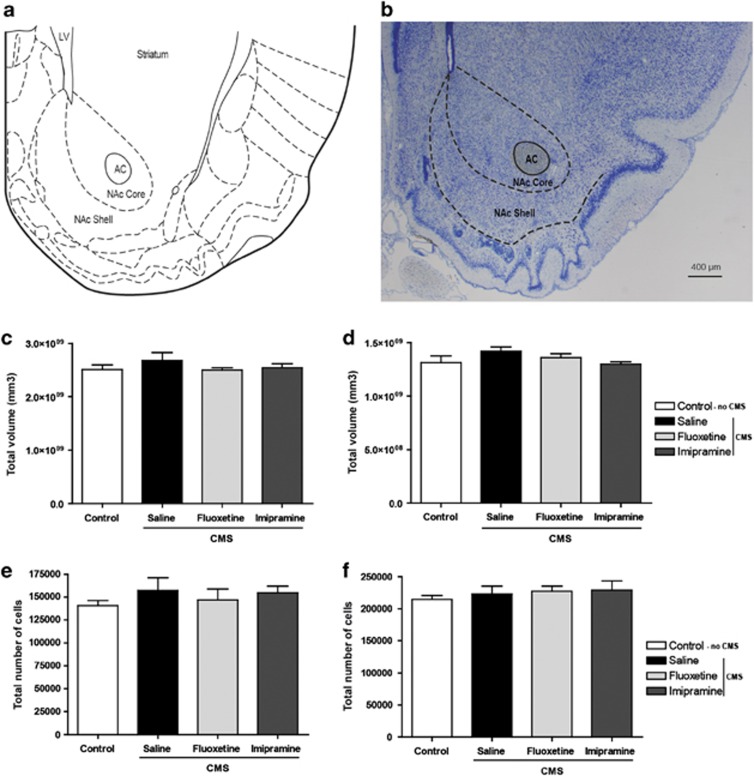
Stereological volumetric measurements and estimation of total number of neurons. (a) Paxinos atlas scheme, figure 56 (Bregma 1.8). (b) Low-power micrograph of a glycolmethacrylate-embedded brain section stained with Giemsa. Volumetric measurements of the core (c) and shell (d) divisions of the nucleus accumbens (NAc). Stereological estimation of the total number of cells in the core (e) and shell (f) divisions of the NAc. AC, anterior comissure; CMS, chronic mild stress; LV, lateral ventricle.
Figure 3
Figure 3
3D morphometric analysis of Golgi-impregnated neurons using computer- assisted reconstructions of nucleus accumbens (NAc) medium spiny neurons. Representative neurons of different experimental groups in the core (a, c, e), and shell (b, d, f) divisions of the NAc. Cells are depicted in the XY orthogonal plan. Total dendritic length of neurons in the core (g) and shell (h) divisions of the NAc. Asterisk represents the comparison between the control and chronic mild stress (CMS) groups. Double asterisk represents the effects of antidepressant treatment. *P<0.03, **P<0.03. Data represented as mean±s.e.m.
Figure 4
Figure 4
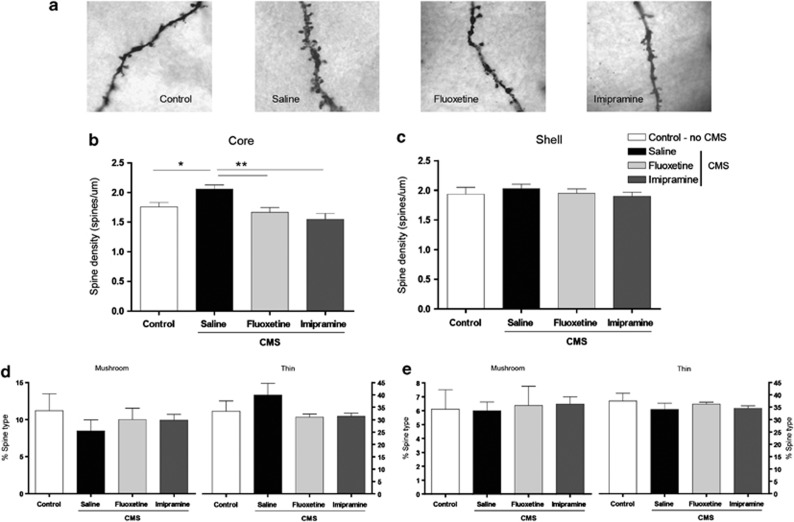
Spine density and morphological classification. Representative dendritic segments for spine analysis from each experimental group (a). Spine densities of nucleus accumbens (NAc) medium spiny neurons in the core (b) and shell (c) divisions of the NAc. Morphological classification of dendritic spines in the core (d) and shell (e) subregions of NAc. Asterisk represents the comparison between the control and chronic mild stress groups. Double asterisk represents the effects of antidepressant treatment. *P<0.02, **P<0.02. Data represented as mean±s.e.m.
Figure 5
Figure 5
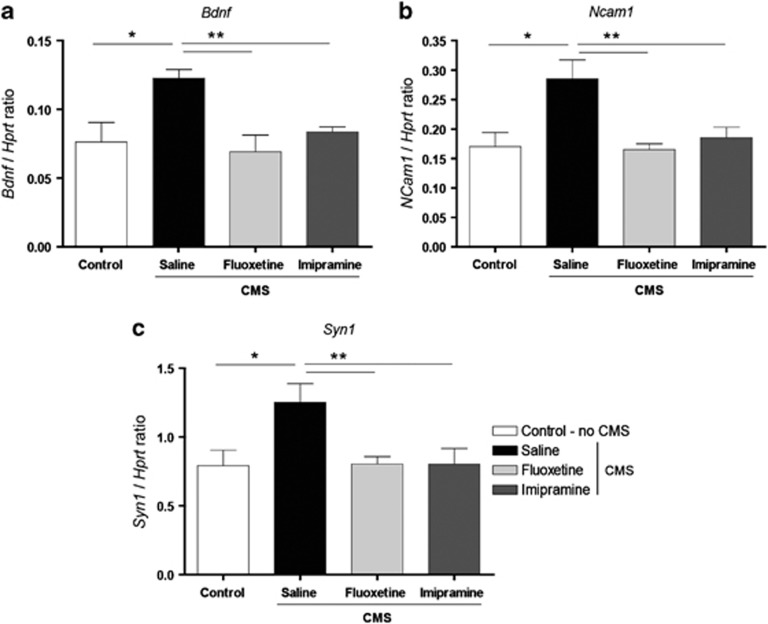
mRNA expression levels of (a) Bdnf (brain-derived growth factor), (b) Ncam1 (neural cell adhesion molecule 1) and (c) Syn1 (synapsin 1) in the nucleus accumbens measured by quantitative real-time PCR. All the genes analyzed showed an increased expression level in response to chronic mild stress (CMS), this effect being abrogated by the antidepressant treatment. Asterisk represents the comparison between control and CMS groups. Double asterisk represents the effects of antidepressant treatment. *P<0.05, **P<0.05. Data represented as mean±s.e.m. Hprt, hypoxanthine guanine phosphoribosyl transferase.

References

    1. Gorwood P. Neurobiological mechanisms of anhedonia. Dialogues Clin Neurosci. 2008;10:291–299. - PMC - PubMed
    1. Wise RA. Neuroleptics and operant behavior: the anhedonia hypothesis. Behav Brain Sci. 1982;5:39–87.
    1. Di Chiara G, Loddo P, Tanda G. Reciprocal changes in prefrontal and limbic dopamine responsiveness to aversive and rewarding stimuli after chronic mild stress: implications for the psychobiology of depression. Biol Psychiatry. 1999;46:1624–1633. - PubMed
    1. Newton SS, Thome J, Wallace TL, Shirayama Y, Schlesinger L, Sakai N, et al. Inhibition of cAMP response element-binding protein or dynorphin in the nucleus accumbens produces an antidepressant-like effect. J Neurosci. 2002;22:10883–10890. - PMC - PubMed
    1. Rada P, Moreno SA, Tucci S, Gonzalez LE, Harrison T, Chau DT, et al. Glutamate release in the nucleus accumbens is involved in behavioral depression during the Porsolt swim test. Neuroscience. 2003;119:557–565. - PubMed

Publication types