Review
. 2013 Jun 3;18(6):6469-90.
doi: 10.3390/molecules18066469.

(89)Zr, a radiometal nuclide with high potential for molecular imaging with PET: chemistry, applications and remaining challenges

Affiliations
Review

(89)Zr, a radiometal nuclide with high potential for molecular imaging with PET: chemistry, applications and remaining challenges

Gabriel Fischer et al. Molecules. .

Abstract

Molecular imaging-and especially Positron Emission Tomography (PET)-is of increasing importance for the diagnosis of various diseases and thus is experiencing increasing dissemination. Consequently, there is a growing demand for appropriate PET tracers which allow for a specific accumulation in the target structure as well as its visualization and exhibit decay characteristics matching their in vivo pharmacokinetics. To meet this demand, the development of new targeting vectors as well as the use of uncommon radionuclides becomes increasingly important. Uncommon nuclides in this regard enable the utilization of various selectively accumulating bioactive molecules such as peptides, antibodies, their fragments, other proteins and artificial structures for PET imaging in personalized medicine. Among these radionuclides, 89Zr (t1/2 = 3.27 days and mean Eβ+ = 0.389 MeV) has attracted increasing attention within the last years due to its favorably long half-life, which enables imaging at late time-points, being especially favorable in case of slowly-accumulating targeting vectors. This review outlines the recent developments in the field of 89Zr-labeled bioactive molecules, their potential and application in PET imaging and beyond, as well as remaining challenges.


Figures
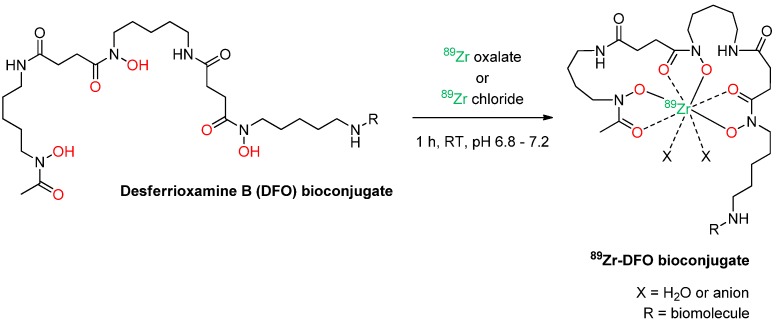
Scheme 1
Scheme 1
Schematic depiction of the radiolabeling reaction of a DFO-derivatized biomolecule with 89Zr (in red: hydroxamate coordination sphere of DFO).
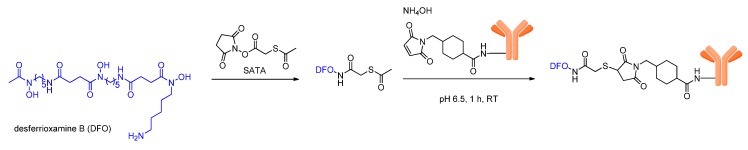
Scheme 2
Scheme 2
Schematic depiction of the conjugation reaction of thiol-derivatized DFO to maleimide-modified biomolecules.
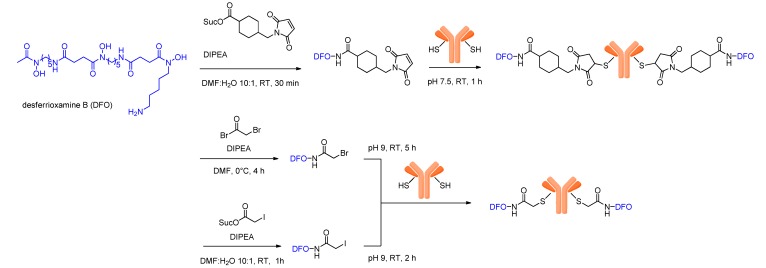
Scheme 3
Scheme 3
Schematic depiction of a site-specific DFO-conjugation by reaction of maleimide-, bromoacetyl- and iodoacetyl-derivatized DFO with biomolecules exhibiting unpaired cysteines.
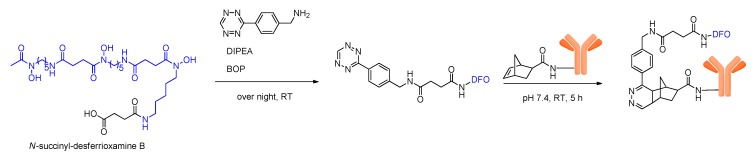
Scheme 4
Scheme 4
Schematic depiction of biomolecule-DFO-conjugation via Diels-Alder cycloaddition.
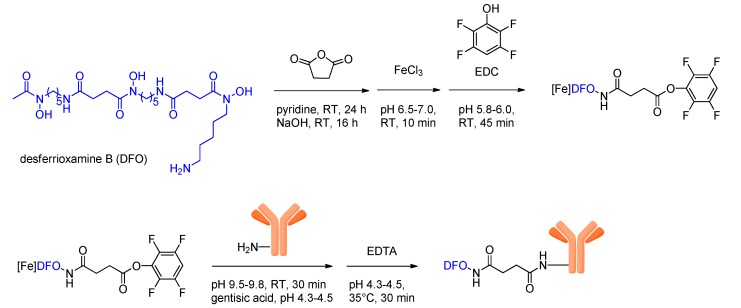
Scheme 5
Scheme 5
Schematic depiction of biomolecule-DFO-conjugation via reaction of amino functionalities of the biomolecule with a DFO-active ester.
Scheme 6
Scheme 6
Schematic depiction of biomolecule-DFO-conjugation via reaction of lysine amino functionalities of the biomolecule with a DFO-isothiocyanate.

References

    1. Zhang Y., Hong H., Cai W. PET tracers based on Zirconium-89. Curr. Radiopharm. 2011;4:131–139. doi: 10.2174/1874471011104020131. - DOI - PMC - PubMed
    1. Severin G.W., Engle J.W., Barnhart T.E., Nickles R.J. Zr-89 Radiochemistry for positron emission tomography. Med. Chem. 2011;7:389–394. - PMC - PubMed
    1. Nayak T.K., Brechbiel M.W. Radioimmunoimaging with longer-lived positron-emitting radionuclides: Potentials and challenges. Bioconjug. Chem. 2009;20:825–841. doi: 10.1021/bc800299f. - DOI - PMC - PubMed
    1. Deri M.A., Zeglis B.M., Francesconi L.C., Lewis J.S. PET imaging with Zr-89: From radiochemistry to the clinic. Nucl. Med. Biol. 2013;40:3–14. doi: 10.1016/j.nucmedbio.2012.08.004. - DOI - PMC - PubMed
    1. Holland J.P., Sheh Y.C., Lewis J.S. Standardized methods for the production of high specific-activity zirconium-89. Nucl. Med. Biol. 2009;36:729–739. - PMC - PubMed

Publication types