Review
. 2013 Oct;122(5):415-29.
doi: 10.1007/s00412-013-0417-x. Epub 2013 Jun 5.

The diverse functional LINCs of the nuclear envelope to the cytoskeleton and chromatin

Affiliations
Review

The diverse functional LINCs of the nuclear envelope to the cytoskeleton and chromatin

Andrea Rothballer et al. Chromosoma. 2013 Oct.

Abstract

The nuclear envelope (NE) is connected to the different types of cytoskeletal elements by linker of nucleoskeleton and cytoskeleton (LINC) complexes. LINC complexes exist from yeast to humans, and have preserved their general architecture throughout evolution. They are composed of SUN and KASH domain proteins of the inner and the outer nuclear membrane, respectively. These SUN-KASH bridges are used for the transmission of forces across the NE and support diverse biological processes. Here, we review the function of SUN and KASH domain proteins in various unicellular and multicellular species. Specifically, we discuss their influence on nuclear morphology and cytoskeletal organization. Further, emphasis is given on the role of LINC complexes in nuclear anchorage and migration as well as in genome organization.


Figures
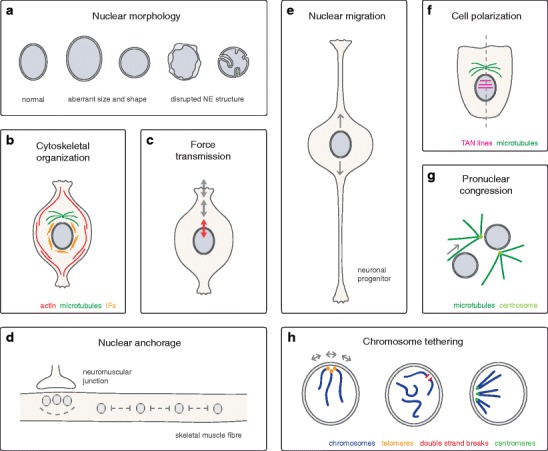
Fig. 1
Fig. 1
Cellular functions of LINC complexes. a Nuclear morphology. LINC complexes are required to maintain nuclear size and shape in mammals (Lu et al. ; Luke et al. 2008) and in A. thaliana (Zhou et al. 2012), as well as structure and integrity of the mammalian NE (Crisp et al. ; Zhang et al. 2007a). b Cytoskeletal organization. LINC complexes influence structure and distribution of perinuclear actin and intermediate filaments (IFs) in vertebrate cells (Khatau et al. ; Lombardi et al. ; Schneider et al. ; Morgan et al. ; Postel et al. ; Chambliss et al. 2013), and tether centrosomes to the NE in various metazoans (Schneider et al. ; Zhang et al. ; Malone et al. ; Morgan et al. ; Roux et al. ; Patterson et al. 2004). c Force transmission. LINC complexes transmit forces across the NE and affect mechanical properties of cultured mammalian cells (Lombardi et al. ; Anno et al. ; Stewart-Hutchinson et al. 2008). d Nuclear anchorage. LINC complexes mediate anchorage and positioning of nuclei in syncytial systems of various metazoans (Zhang et al. ; Zhang et al. ; Grady et al. ; Lei et al. ; Starr and Han ; Malone et al. ; Elhanany-Tamir et al. 2012). In mammalian skeletal muscle (shown here), LINC complexes are required for the even spacing of extrasynaptic nuclei throughout myotubes, as well as for the clustering of synaptic nuclei beneath the neuromuscular junction (Zhang et al. ; Zhang et al. ; Grady et al. ; Lei et al. 2009). e Nuclear migration. LINC complexes function in nuclear migration during various metazoan developmental events (Yu et al. ; Zhang et al. ; Malone et al. ; McGee et al. ; Starr et al. ; Meyerzon et al. ; Fridolfsson et al. ; Mosley-Bishop et al. ; Fischer-Vize and Mosley ; Patterson et al. ; Kracklauer et al. 2007). In neural progenitors of the mammalian neocortex and retina (shown here), LINC complex-mediated nuclear migration processes are essential for proliferation and differentiation (Yu et al. ; Zhang et al. 2009). f Cell polarization. LINC complexes are required for nuclear positioning and orientation of the nuclear–centrosomal axis during fibroblast polarization (Lombardi et al. ; Luxton et al. 2010). LINC complexes form transmembrane actin-associated nuclear (TAN) lines to couple the nucleus to retrograde actin flow (Luxton et al. 2010). g Pronuclear congression. LINC complexes function in congression of male and female pronuclei in the fertilized zygote of C. elegans and vertebrates. Dedicated KASH domain proteins connect pronuclei to microtubule asters and the centrosome to allow their migration towards each other (Malone et al. ; Lindeman and Pelegri 2012). h Chromosome tethering. LINC complex-mediated tethering of chromosomes to the NE plays a role in various biological processes. In S. cerevisiae, tethering of telomeres and DNA double strand breaks has been implicated in silencing, stabilization, and repair (Bupp et al. ; Schober et al. ; Oza et al. 2009). In S. pombe, tethering of centromeres is important for mitotic chromosome segregation (Hou et al. 2012). Meiotic chromosomes are anchored to the NE via LINC complexes in both yeast and metazoans with impact on homolog pairing and recombination (Conrad et al. ; Conrad et al. ; Kosaka et al. ; Wanat et al. ; Chikashige et al. ; Shimanuki et al. ; Penkner et al. ; Penkner et al. ; Sato et al. ; Ding et al. ; Morimoto et al. 2012)
Fig. 2
Fig. 2
Nucleo-cytoskeletal interactions through LINC complexes. SUN-KASH pairs (dark and light blue) and their connections to the cytoskeleton in mammals (a), C. elegans (b), and D. melanogaster (c). Trimeric organization of SUN domain proteins (Sosa et al. 2012) has been omitted for clarity. Giant KASH domain proteins directly bind to actin (red) (Zhang et al. ; Zhang et al. ; Zhen et al. ; Padmakumar et al. ; Volk ; Starr and Han 2002). Intermediate filaments (orange) and microtubules (green) are linked via plectin (Ketema et al. ; Wilhelmsen et al. 2005) and motor proteins (Schneider et al. ; Yu et al. ; Zhang et al. ; Meyerzon et al. ; Fridolfsson et al. 2010), respectively. C. elegans ZYG-12A directly associates with the centrosome (Malone et al. 2003). D. melanogaster Klarsicht colocalizes with microtubules, but their molecular connection has not been characterized (Fischer et al. 2004). Spag4 cooperates with the coiled-coil protein Yuri Gagarin and dynein, potentially via a KASH domain protein (Kracklauer et al. 2010). Question marks indicate that the specific protein or structure involved in the depicted complexes has not yet been defined

References

    1. Anno T, Sakamoto N, Sato M. Role of nesprin-1 in nuclear deformation in endothelial cells under static and uniaxial stretching conditions. Biochem Biophys Res Commun. 2012;424(1):94–99. doi: 10.1016/j.bbrc.2012.06.073. - DOI - PubMed
    1. Antoniacci LM, Kenna MA, Skibbens RV. The nuclear envelope and spindle pole body-associated Mps3 protein bind telomere regulators and function in telomere clustering. Cell Cycle. 2007;6(1):75–79. doi: 10.4161/cc.6.1.3647. - DOI - PubMed
    1. Antoniacci LM, Kenna MA, Uetz P, Fields S, Skibbens RV. The spindle pole body assembly component mps3p/nep98p functions in sister chromatid cohesion. J Biol Chem. 2004;279(47):49542–49550. doi: 10.1074/jbc.M404324200. - DOI - PubMed
    1. Baye LM, Link BA. Nuclear migration during retinal development. Brain Res. 2008;1192:29–36. doi: 10.1016/j.brainres.2007.05.021. - DOI - PMC - PubMed
    1. Behrens TW, Jagadeesh J, Scherle P, Kearns G, Yewdell J, Staudt LM. Jaw1, A lymphoid-restricted membrane protein localized to the endoplasmic reticulum. J Immunol. 1994;153(2):682–690. - PubMed

Publication types

LinkOut - more resources
