. 2013:68:3-51.
doi: 10.1007/978-94-007-6552-8_1.

Introduction: the structural basis of virus function

Affiliations

Introduction: the structural basis of virus function

Mauricio G Mateu. Subcell Biochem. 2013.

Abstract

Viruses may be regarded as dynamic nucleoprotein assemblies capable of assisted multiplication within cells, and of propagation between cells and organisms. Infectious virus particles (virions) assembled in a host cell are dynamic, generally metastable particles: They are robust enough to protect the viral genome outside the cell, but are also poised to undergo structural changes and execute mechanochemical actions required for infection of other cells. This chapter provides an introduction to the structural and physical biology of viruses by including: (i) an elementary overview on virions and the structural basis of virus function; (ii) a concise summary on basic techniques used in structural or physical virology; (iii) brief structure-based general descriptions of the different stages in the virus cycle, especially those in which virions and/or their components are involved. These contents may facilitate a better understanding of the specialized subjects treated in the rest of the book. This chapter is also intended as a "road map" to help interconnect and integrate in a single picture the different topics described in depth in the 21 monographic chapters in this book.


Figures
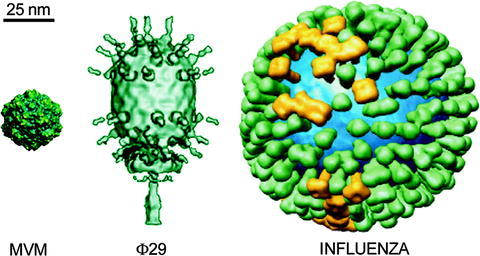
Fig. 1.1
Fig. 1.1
Major types of viruses by molecular composition. Left and center, non-enveloped viruses; left, a very simple virus (the parvovirus MVM); center, a complex virus (the tailed bacteriophage φ29). Right, an enveloped virus (the orthomyxovirus influenza virus). They are reproduced at (approximately) the same scale, indicated by the horizontal bar (top left). The MVM structural model [Agbandje-McKenna M, Llamas-Saiz AL, Wang F, Tattersall P, Rossmann MG (1998) Structure 6:1369–1381] was obtained from VIPERdb [Carrillo-Tripp M, Sheperd CM, Borelli IA, Sangita V, Lander G, Natarajan P, Johnson JE, Brooks III CL, Reddy VS (2009) Nucleic Acids Res 37:D436–D442]. The models of φ29 and influenza virus are respectively reproduced from [Wikoff WR, Johnson JE (1999) Curr Biol 9:R296–R300] and [Harris A, Cardone C, Winkler DC, Heymann JB, Brecher M, White JM, Steven AC (2006) Proc Natl Acad Sci USA 103:19123–19127], with permission. (Figure kindly provided by M.A. Fuertes)
Fig. 1.2
Fig. 1.2
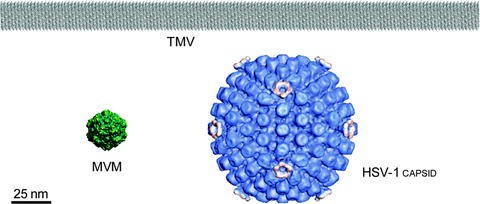
Major types of viral capsid symmetry. Top image: helical; the capsid of TMV is shown. Bottom images: icosahedral; left image, the simple icosahedral capsid of the parvovirus MVM; right image, the complex icosahedral capsid of the herpesvirus HSV-1. Images of TMV, MVM and HSV-1 are respectively adapted or reproduced from [Clare DK, Orlova EV (2010) J Struct Biol 171:303–308], [Agbandje-McKenna M, Llamas-Saiz AL, Wang F, Tattersall P, Rossmann MG (1998) Structure 6:1369–1381], and [Grünewald K, Desai P, Winkler DC, Heymann JB, Belnap D, Baumeister W, Steven AC (2003) Science 302:1396–1398], with permission. (Figure kindly provided by M.A. Fuertes)
Fig. 1.3
Fig. 1.3
General morphologies of virions belonging to some important animal virus families. The families are grouped according to viral DNA type (Figure reproduced from [Carrasco L, Almendral JM (ed) (2006) Virus Patógenos. Ed. Hélice and Fundación BBVA, Madrid], with permission from Ed. Hélice and Fundación BBVA)
Fig. 1.4
Fig. 1.4
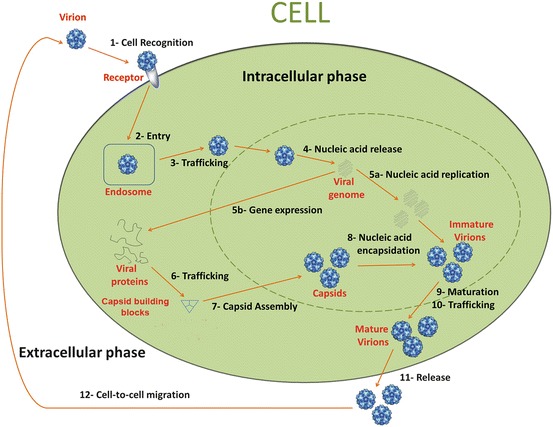
A generic viral cycle. The following stages of the cycle are schematized: 1 Recognition of host cell receptor(s) on the host cell surface. 2 Entry of the virus particle (or of some components) into the host cell. 3 Trafficking of the viral particle (or some components) in the host cell. 4 Release of the nucleic acid. 5a Replication of the viral genome. 5b Expression of the viral genome. 6 Trafficking of the synthesized virus components to sites where the morphogenesis of virus particles will take place. 7 Assembly of the virus capsid from the previously synthesized CP subunits. 8 Packaging of the nucleic acid genome inside an assembled capsid (capsid assembly and nucleic acid packaging may occur concomitantly). 9 Maturation of the virus particle. Depending on the animal virus species, stages 4, 5a, 5b (in part), 6, 7, 8 and 9 may occur in either the cytoplasm or the nucleus of the host cell; this is indicated in the figure by encircling those steps by a discontinuous line, which represents the nuclear membrane only in those cases where the processes indicated occur in the cell nucleus. 10 Intracellular trafficking of the virus particles and/or mature virions, which may occur between, during and/or after steps 7, 8, and/or 9. 11 Release of virions from the cell. 12 Navigation of virus particles in the extracellular environment. See text for a more complete description and some important variations (Figure kindly provided by M.A. Fuertes)
Fig. 1.5
Fig. 1.5
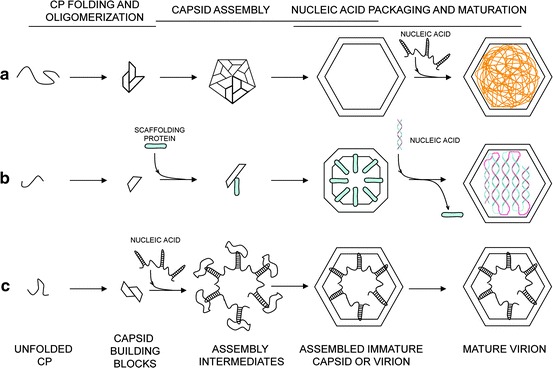
Simplified schemes of three general strategies for assembly of virus capsids. (a) Unassisted self-assembly. (b) Scaffolding protein-assisted assembly. (c) Viral nucleic acid-assisted assembly (see text for details) (Figure kindly provided by M.A. Fuertes and reproduced from [Mateu MG (2013) Arch Biochem Biophys 531, 65–79]. With permission)
Fig. 1.6
Fig. 1.6
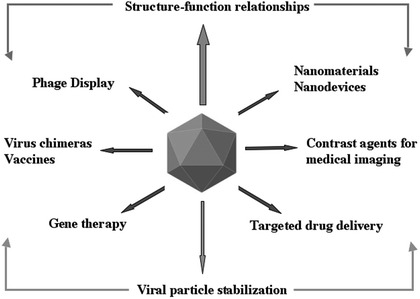
Some applications of virus particles in biomedicine, biotechnology and nanotechnology (see text for an explanation)

References

References and Further Reading

Molecular Virology Textbooks
    1. Flint SJ, Enquist LW, Racaniello VR, Skalka AM. Principles of virology. 3. Washington, DC: ASM Press; 2009.
    1. Dimmock N, Easton A, Leppard K. Introduction to modern virology. 6. Malden: Blackwell; 2007.
    1. Carter JB, Saunders VA. Virology. Principles and applications. Chichester: Wiley; 2007.
    1. Wagner EK, Hewlett MJ, Bloom DC, Camerini D. Basic virology. Malden: Blackwell; 2008.
    1. Cann AJ. Principles of molecular virology. 5. Waltham: Academic; 2012.
Advanced Reference Books on Virology
    1. Knipe DM, Howley PM, editors. Fields virology. 5. Philadelphia: Lippincott Williams & Wilkins; 2007.
    1. Mahy BWJ, van Regenmortel MHV, editors. Encyclopedia of virology. 3. Boston: Academic; 2008.
Advanced Books on Structural or Physical Virology
    1. Casjens S, editor. Virus structure and assembly. Boston: Jones and Bartlett; 1985.
    1. Chiu W, Burnett RM, Garcea RL, editors. Structural biology of viruses. New York: Oxford University Press; 1997.
    1. Chiu W, Johnson JE (eds) (2003) Virus structure. Advances in protein chemistry, vol 64. Academic Press, New York. An excellent collection of advanced reviews on a limited but highly relevant selection of structural virology topics
    1. Stockley PG, Twarock R, editors. Emerging topics in physical virology. London: Imperial College Press; 2010.
    1. Agbandje-McKenna M, McKenna R, editors. Structural virology. Cambridge: RSC Publishing; 2011.
References on Virus Genetic and Phenotypic Variation and Evolution
    1. Sobrino F, Domingo E, editors. Foot and mouth disease: current perspectives. Wymondham/Norfolk: Horizon Bioscience; 2004.
    1. Domingo E, Biebricher C, Eigen M, Holland J. Quasispecies and RNA virus evolution: principles and consequences. Austin: Landes Bioscience; 2001.

Publication types

LinkOut - more resources